

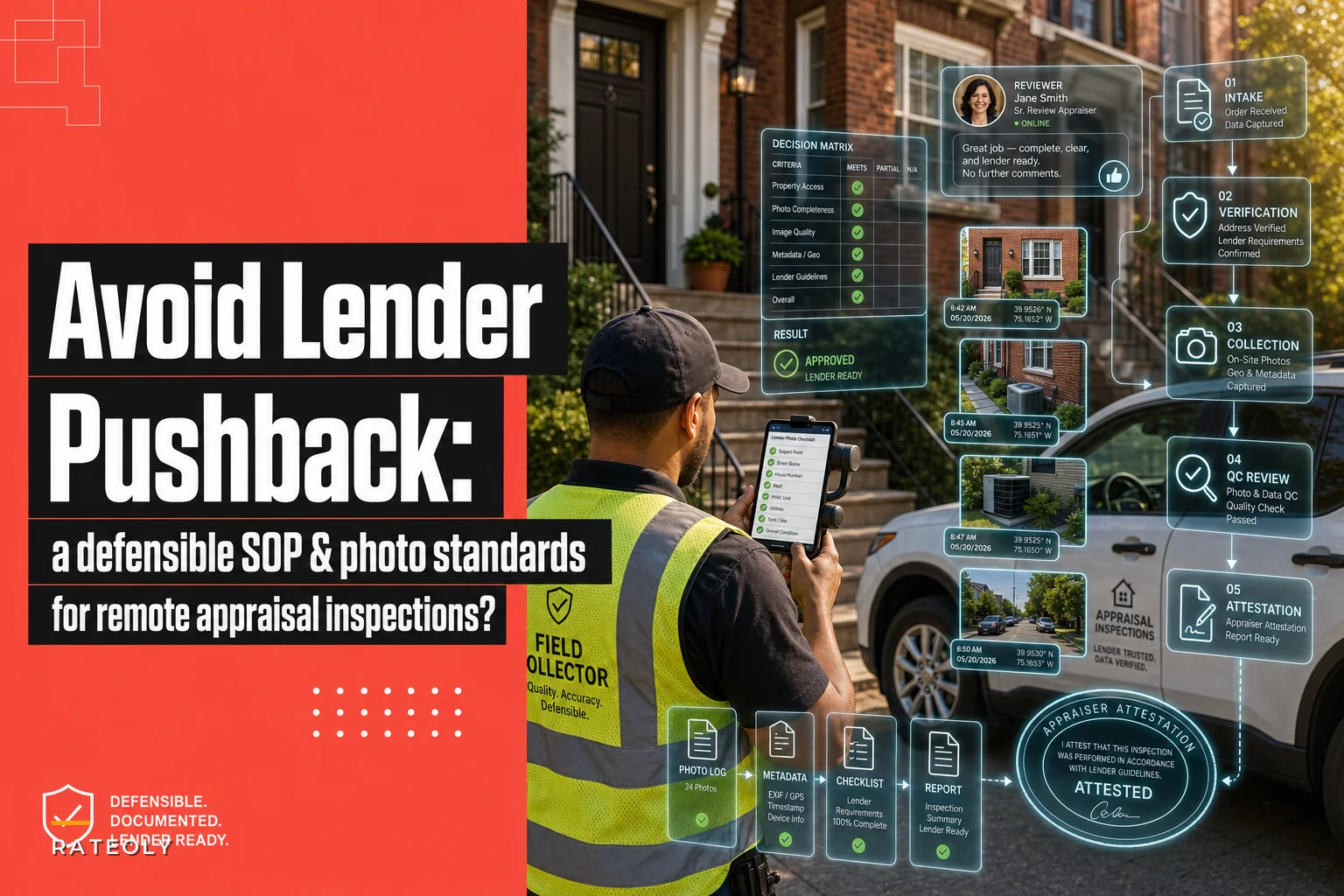

Remote and hybrid inspections have quietly become normal for a big chunk of GSE-eligible work, but the operational habits around them haven't caught up. Most firms still treat a remote inspection like a physical one with a phone attached — same photo count, same casual notes, same assumption that nobody will question how the data was captured. Then a desk reviewer flags a file, asks who was at the property, and the whole thing unravels because there's no record of who did what and when.
That gap is where lender pushback lives. Not in the value opinion — in the chain of custody around the inspection itself. This piece is about closing that gap with a remote appraisal inspections SOP that survives review, a decision matrix for when remote is actually appropriate, and photo standards written for the person auditing you, not for you.
The specific failure that triggers rework
A typical breakdown looks like this. An appraiser accepts a hybrid assignment where a third-party property data collector does the on-site walkthrough. The collector uploads 40-something photos and a floor sketch. The appraiser builds the report, delivers, and moves on.
Three weeks later the lender's QC pulls the file for a review sample. The reviewer notices the kitchen photos don't show the same countertop material referenced in the sketch notes, and there's no timestamp confirming the collection date matches the effective date. Now there are questions: Was this the right property? Who verified the collector's identity? Did the appraiser confirm the scope was met, or just accept whatever landed in the folder?
None of those questions are about the value. They're about defensibility. And when you can't answer them quickly, the file gets kicked back, the assignment loses two or three days, and the lender starts wondering whether your remote files are trustworthy at all.
The uncomfortable part: the appraiser usually did the valuation work correctly. The file failed on documentation hygiene around a process nobody had standardized.
Why remote inspections fail review more often than physical ones
Physical inspections carry an implicit chain of custody. The appraiser was there. Their signature attests to it. The photos came from their phone. There's one person to ask.
Manage every appraisal with confidence and clarity.
Rateoly helps you coordinate inspections, generate reports, and communicate seamlessly with clients.
- Comprehensive appraisal tracking
- Automated client notifications
- Integrated scheduling & report management
No credit card required
-
The person collecting data isn't the person forming the opinion of value
-
Photo metadata may be stripped by the collection app or a compression step
-
The effective date, inspection date, and collection date can drift apart
-
Scope expectations live in someone's head instead of a written checklist
-
There's no consistent record of why remote was chosen for this specific property
This usually happens when a firm scales remote volume faster than it standardizes it. One appraiser handles hybrids one way, another does it differently, and the front desk assigns based on turn-time pressure rather than property suitability. The files look fine until a reviewer looks closely.
A decision matrix for when remote actually makes sense
The first defensible move is documenting why a property got a remote or hybrid treatment. Reviewers respect a written rule far more than a judgment call. Below is a matrix you can adapt — the point is that every remote decision maps to a stated reason, not to whoever was closest to being free that afternoon.
| Property / Assignment factor | Full physical | Hybrid (third-party collection) | Desktop / remote |
|---|---|---|---|
| Standard suburban SFR, average condition, good comps | Optional | Preferred | Acceptable with strong data |
| Complex or unique property (custom, waterfront, acreage) | Required | Case-by-case | Avoid |
| Recent renovation or condition uncertainty | Preferred | Only with detailed collector notes | Avoid |
| High-value / high-risk loan tier | Lender-dependent | Case-by-case | Rarely appropriate |
| Rural, thin comp market | Preferred | Case-by-case | Avoid |
| Prior file, data <12 months old, minor update | Not needed | Acceptable | Preferred |
| Access issues / tenant-occupied disputes | Case-by-case | Preferred | Case-by-case |
The value isn't the specific cells — your shop may draw the lines differently based on your lender panel. The value is that the decision gets recorded against a rule. When a reviewer asks why this was done remotely, the answer is a matrix reference and a one-line note, not a shrug.
When remote is a bad idea regardless of turn-time pressure
-
Condition is the whole question. If the assignment hinges on distinguishing C3 from C4, a remote collector's photos rarely settle it cleanly.
-
The property is genuinely atypical. Unique features need eyes that know what to look for, and third-party collectors are trained for standard stock.
-
The comp set is thin. When you're already stretching on comparables, you don't want to also be defending a weaker inspection method.
Forcing these into remote to save a day is how you trade one saved day for a three-day rework loop later.
Photo standards written for the reviewer
Photo count isn't the metric that matters. Coverage and provability are. A reviewer isn't counting to 40 — they're checking whether the photos establish the property, its condition, and the collection event itself.
-
Full front elevation showing the address number where visible, plus a street-view shot establishing location context
-
All sides of the dwelling — not just front and back; side shots close the "did they actually walk it" question
-
Every kitchen and bath with at least one wide shot showing overall condition and one detail shot of surfaces and fixtures referenced in notes
-
Mechanical shots — HVAC unit, water heater, electrical panel — because these are the first things a skeptical reviewer looks for
-
Any deferred maintenance or condition issue photographed clearly, even if minor, so the condition rating is defensible
-
A shot that ties to the sketch — if the sketch says "open concept," a photo should show it
-
Timestamp-bearing capture where the collection app supports it, or a documented alternative
-
Consistent naming so a reviewer can navigate without guessing (room-based naming beats sequential numbers)
Use room-based filenames so a reviewer can jump to the relevant shots without guessing.
The mistake most firms make is treating the photo set as evidence for the appraiser rather than evidence for the reviewer. The appraiser knows the property. The reviewer wasn't there and is looking for reasons to trust — or doubt — the file. Shoot for the doubter.
Metadata and chain of custody: the part that fails silently
Metadata problems are the quietest killers because everything looks fine on screen. The photos display, the report reads well, and nobody notices the EXIF data was stripped until a reviewer needs to confirm capture date and location.
-
Compression strips the metadata. Many collection and upload tools re-encode images, which wipes timestamp and geolocation. The photo survives; the proof doesn't.
-
The three dates drift. Effective date, inspection/collection date, and report date should have a clean, documented relationship. When they don't line up and there's no note explaining why, the reviewer assumes the worst.
A defensible file preserves original captures with metadata intact, or — when the tool strips it — records the capture details in a way that's contemporaneous and hard to backfill. The order of operations matters here, and it's worth writing into your SOP explicitly.
A workflow that holds up under review
The sequence that keeps a remote file defensible, described as an actual handoff chain:
-
Assignment intake logs the remote-vs-physical decision against the matrix, with a one-line rationale saved to the file.
-
Collector verification confirms who is doing the on-site work and captures their identity and credential reference before they go out.
-
Scope brief goes to the collector as a written checklist — the exact shots, the sketch requirements, the condition items to document — so "I didn't know you needed that" never happens.
-
Collection happens with metadata-preserving capture where possible; the collector notes date and any access conditions.
-
Intake QC — before the appraiser builds anything — checks that photo coverage matches the checklist and the dates reconcile. Gaps get sent back now, not after delivery.
-
Appraiser review and attestation documents that the scope was met and the data is sufficient to form the opinion.
-
Pre-delivery check confirms the file contains the decision rationale, the collector reference, the reconciled dates, and the complete photo set with naming intact.
The single most valuable step is number five. Catching a coverage gap before the report is built costs a few minutes. Catching it after a lender kicks the file costs days and credibility.
This is also where operational software earns its place — not as a magic fix, but as the thing that enforces the sequence. A workflow platform that requires the matrix decision at intake, pushes the scope checklist to the collector, and blocks delivery until photo coverage and date reconciliation are logged turns a good SOP into one that actually gets followed under deadline pressure. AI-assisted checks can flag missing shot categories or stripped metadata before a human reviewer would — the kind of quiet, repetitive verification people skip when they're rushing. The tool isn't doing the appraisal. It's making sure the paper trail exists every single time, not just when someone remembers.
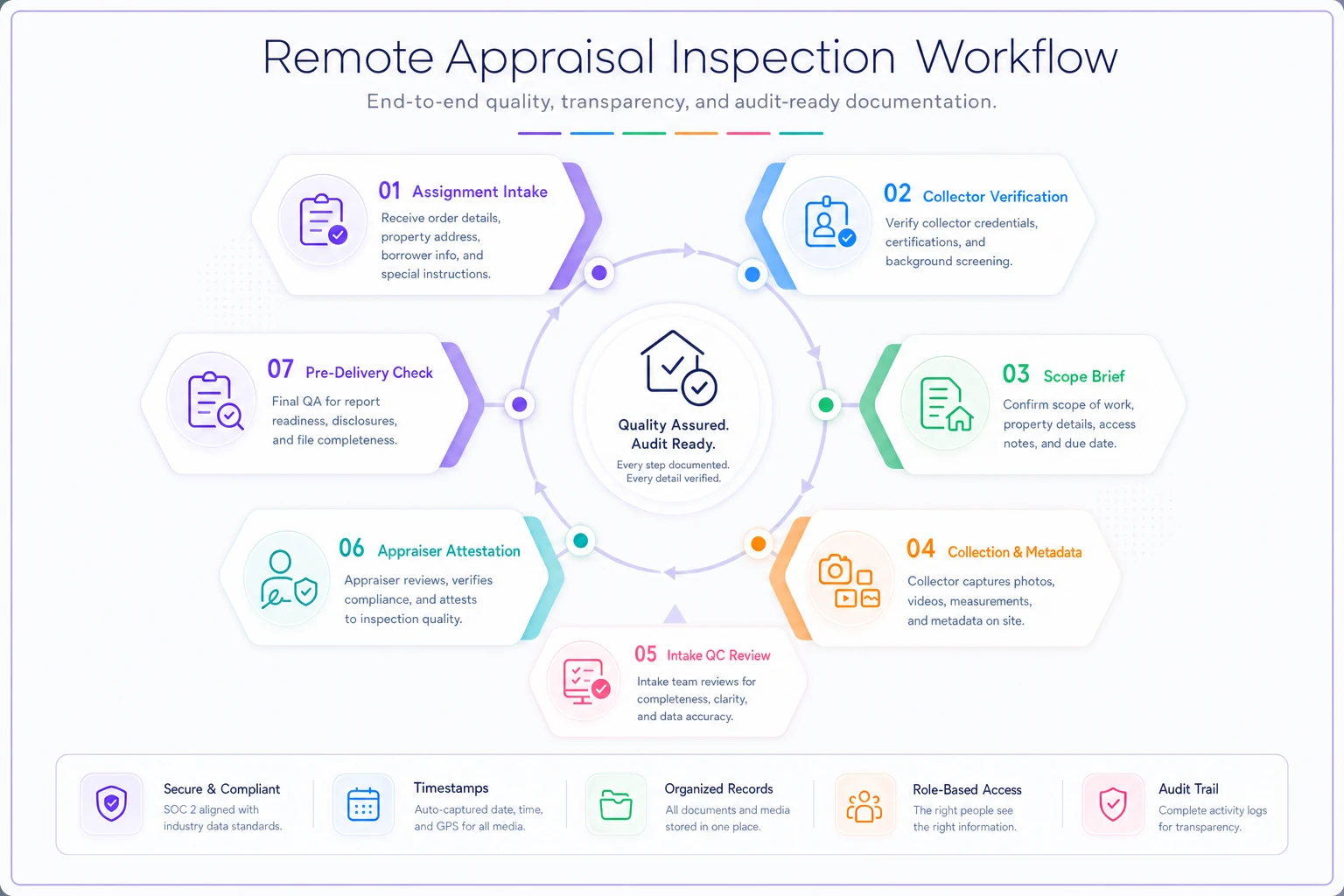
A simple flow image helps ops and reviewers see where controls sit and where gaps appear.
The tool isn't doing the appraisal. It's making sure the paper trail exists every single time, not just when someone remembers.
A real scenario
A mid-size firm — three staff appraisers, a couple of reviewers, leaning on third-party collection for roughly half their volume — was seeing remote files kicked back at a rate that was starting to strain two lender relationships. Not a flood, but enough. Around one in eight hybrid files came back with a documentation question, and each one ate two to four days of turn time plus the back-and-forth.
The fix wasn't more photos or a policy memo. They put three things in writing: a decision matrix at intake, a written scope checklist sent to every collector, and a hard intake-QC step before the appraiser touched the file. They also started preserving original captures separately so metadata survived compression.
Within a couple months the kickback rate on hybrid files dropped to something closer to one in twenty-five. The questions that did come in were answerable in minutes because the rationale and dates were already in the file. Turn times on remote work steadied out, and the two lenders that had been grumbling stopped flagging their remote volume for extra scrutiny. Nothing about the valuations changed — what changed was that the files could defend themselves.
The point
Defensibility on remote work isn't about doing more. It's about making the invisible parts of the process visible before someone asks. The decision to go remote, the identity of who collected the data, the coverage of the photos, the reconciliation of the dates — none of it is hard, but all of it is easy to skip when you're moving fast and nobody's watching.
The firms that get pushback are rarely the ones doing bad appraisals. They're the ones whose good work is trapped in files that can't prove themselves. Write the SOP for the reviewer who wasn't there. Build the checklist for the doubter. Put the enforcement somewhere that doesn't rely on anyone remembering. Do that, and remote inspections stop being a liability and go back to being what they were supposed to be — a faster way to do work you can stand behind.
Ready to elevate your appraisal operations?
Join 500+ appraisal firms using Rateoly to enhance accuracy, save time, and improve client satisfaction.