



Appraisal firms burning through 14–18 days per order when the market demands 7-day turns aren't just losing time—they're losing clients and leaving real money on the table. The culprit usually isn't appraiser skill or report quality. It's the scheduling chaos that happens between order acceptance and property inspection.
Top-line recommendation: Prioritize C first (low‑capex, quick wins), then implement A to convert recovered drive/time into sustained capacity; defer B until A+C prove utilization and demand justify hires. ROI formula: Payback months = Implementation cost / monthly net savings. Use the Field Service ROI Calculator (https://blog.service.works/service-business/field-service-roi-calculator/) to model variations. Prioritization guidance: see Risk-Based Construction Inspection (https://nap.nationalacademies.org/read/27099/chapter/6) and AEX scheduling evidence (https://aexinc.comMan Vs Field Squared Advanced Scheduling). See Intake SOP.
Approaches comparison
| Approach | Cost | Deploy | Impact | ROI speed |
|---|---|---|---|---|
| A — Block scheduling + routing | Low–Moderate | Weeks | Medium–High | Fast after tuning |
| B — Add field capacity | High | Months | High capacity but costly | Slow |
| C — Rule-based prioritization & batching | Very low | Days–Weeks | Immediate SLA improvement | Fastest |
Block scheduling transforms scattered chaos into predictable workflow
Block scheduling shifts scheduling from reactive to proactive by assigning inspection zones and dedicating specific days to specific areas (for example: northeast quadrant Monday mornings, downtown commercial Tuesday afternoons).
Manage every appraisal with confidence and clarity.
Rateoly helps you coordinate inspections, generate reports, and communicate seamlessly with clients.
- Comprehensive appraisal tracking
- Automated client notifications
- Integrated scheduling & report management
No credit card required
A mid-sized Phoenix firm with four appraisers averaged 3 inspections daily and roughly 90 minutes of combined drive time. After switching to block scheduling they cut drive time to about 40 minutes and recovered roughly one inspection-hour per appraiser per day, equating to ~20 extra inspections weekly across the team.
Resistance usually comes from perceived inflexibility. In practice, clients adapt when you consistently inspect their area on set days; response time improves because you stop reshuffling to cover scattered requests.
Block scheduling creates natural batching: comparable photos and neighborhood data are gathered once instead of across multiple trips, and efficiency compounds as appraisers work contiguous neighborhoods.
Route optimization isn't just about shortest distance
True routing optimization requires modeling inspection duration, access restrictions, traffic patterns, and inspection complexity—not just straight-line distance.
-
1,200 sq ft ranch — about 25 minutes
-
4,000 sq ft colonial with finished basement — about 45 minutes
-
Simple retail space — about 30 minutes
-
Multi-tenant office building — around 2 hours
Access restrictions must be routing rules: government buildings that allow inspections only before noon, gated communities requiring property management scheduling, and schools that prohibit arrival/dismissal windows.
Sequence complex inspections early when appraisers have more mental energy and leave routine drive-bys for late afternoon. Smart routing software handles constraints automatically, but even manual planning beats booking in arrival order.
A five-inspection scenario across a 15-mile radius can become complex once school windows, business close times, and executor presence requirements are considered; plan sequencing with those constraints rather than assuming fixed travel time.
Client availability templates eliminate repetitive back-and-forth
Most firms rediscover client availability with every order. Building availability templates begins with pattern recognition—track scheduling interactions for 30 days and capture recurring restrictions.
-
Property management companies with fixed inspection windows
-
Businesses limiting access to non-operational hours
-
Residential landlords requiring tenant coordination
-
Government facilities with security protocols
-
Healthcare facilities with area restrictions
Templates should include availability windows plus access instructions (lockbox codes, parking), property quirks (aggressive dog, construction), and client preferences (confirmation timing, communication channel).
Example: An order from ABC Property Management can auto-populate Tuesday/Thursday availability, 48-hour notice, lockbox access, and visitor parking instructions so the scheduler and appraiser aren't repeating the same questions.
SLA-driven prioritization prevents deadline disasters
| Priority Level | SLA Window | Scheduling Rule | Inspection Window |
|---|---|---|---|
| Critical | 24-48 hours | Next available slot | Same/next day |
| Rush | 3-4 days | Within 48 hours | Days 1-2 |
| Standard | 5-7 days | Within 72 hours | Days 2-4 |
| Routine | 8-10 days | Within 5 days | Days 3-6 |
| Flexible | 10+ days | Best efficiency fit | Days 4-8 |
Rule-based prioritization assigns inspection slots by deadline urgency rather than arrival sequence. Enforcement mechanisms are essential: escalate approaching-breach orders and prevent louder clients from bumping rush orders.
A Texas firm that implemented SLA-based routing saw on-time delivery rise from 78% to 94% in two months. The improvement came from sequencing work correctly, not necessarily working faster.
Rules need teeth: a 48-hour rush received at 2pm should be placed on tomorrow's schedule even if it requires reshuffling; standard orders with fewer days remaining take priority over routine ones with more slack.
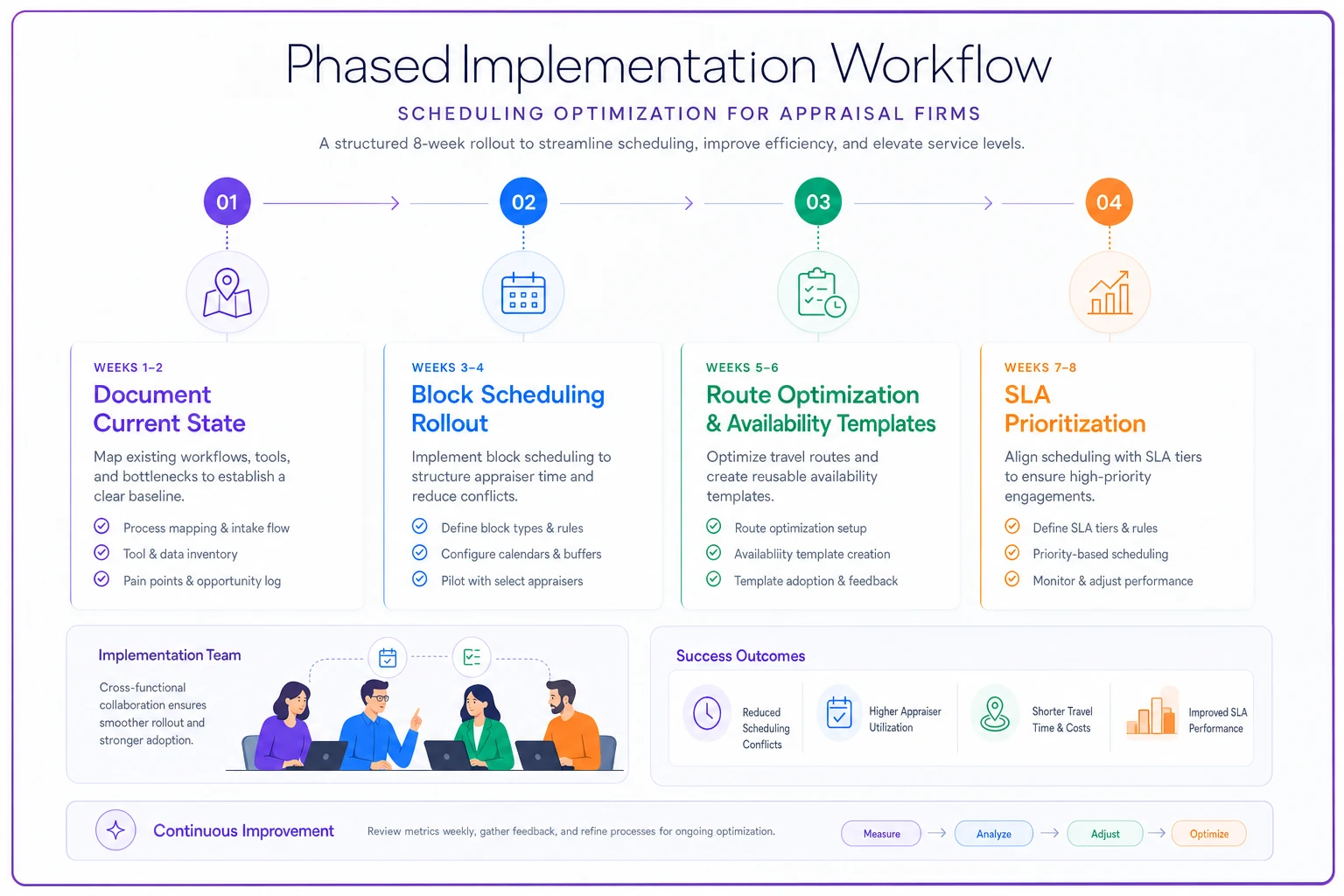
Implementation requires gradual transition, not overnight revolution
Implement changes in phases—start with one appraiser or zone and scale as you validate results. This controlled approach lets you identify problems before they affect the whole operation.
-
Weeks 1-2
Document current state—track drive times, scheduling touchpoints, and missed deadlines
-
Weeks 3-4
Implement block scheduling for highest-volume zones (2-3 areas covering ~40-50%)
-
Weeks 5-6
Add route optimization and availability templates to eliminate back-tracking
-
Weeks 7-8
Introduce SLA prioritization rules, starting with a two-tier rush vs standard system
Expect resistance from appraisers, schedulers, and customer service. Use baseline data—drive time reductions, on-time improvements, and cost savings—to address concerns and build buy-in.
Common pitfalls that derail scheduling optimization
Several predictable mistakes derail projects: optimizing the wrong metric, over-automation that creates brittleness, overly rigid geographic blocks, template proliferation, and making too many exceptions for clients.
-
Minimizing drive distance while ignoring inspection complexity
-
Packing schedules too tight without buffers
-
Making geographic blocks inflexible instead of allowing fuzzy edges
-
Creating too many templates instead of standardizing common patterns
-
Allowing frequent client exceptions that erode the system
Build slack into schedules (reserve capacity and an urgent afternoon block) and limit template growth by starting simple and adding patterns only when they repeat frequently.
Measuring success beyond simple turn times
Turn time is important but incomplete. Track scheduling touches, appraiser windshield time, breach rates, and rush-order percentages to get a fuller picture.
-
Scheduling touches per order (calls, emails, texts)
-
Daily drive time per appraiser
-
Deadline breach rate and rush order percentage
-
Appraiser overtime hours
-
Employee satisfaction and churn indicators
A California firm tracked comprehensive metrics and saw average turn time drop from 11 to 7 days, drive time fall from 95 to 55 minutes, scheduling touches halve, on-time completion rise from 81% to 93%, and rush orders cut from 18% to 9%.
The result: short-term expedited revenue fell slightly, but profitability rose due to less overtime and reduced operational stress.
When structured scheduling makes sense (and when it doesn't)
Structured scheduling delivers the most value to firms handling 200+ inspections monthly across multiple appraisers and broad geographic areas. Smaller or highly localized operations may not justify the overhead unless they face acute scheduling pain.
-
Firm size
200+ inspections/month generally benefits most
-
Geographic spread
metro- or multi-county coverage gains the most from routing
-
Property mix
mostly residential benefits from standardization; diverse commercial needs flexibility
-
Market dynamics
high-volume periods increase the ROI of optimization
The sweet spot is roughly 60–70% predictable inspections with 30–40% requiring custom handling.
The technology question: build, buy, or hybrid
Many firms rely on calendars, spreadsheets, and institutional memory until volume or turnover breaks the process. Purpose-built appraisal management software adds mapping, SLA tracking, and automated routing that generic tools lack.
Build versus buy depends on scale and technical capability: high-volume firms may justify custom development, but most benefit from configured commercial solutions that meet appraisal-specific needs out of the box.
AI scheduling assistance can analyze historical patterns and suggest routing and durations, but it should supplement human judgment rather than replace it. A hybrid approach—commercial software plus custom workflows and AI—usually delivers the best results for mid-sized firms.
The compound effect of scheduling excellence
Small, consistent improvements compound: block scheduling saves ~30 minutes daily, route optimization adds ~20, templates cut scheduling touches, and SLA prioritization prevents last-minute fire drills.
Together these changes free appraisers to appraise more and drive less, reduce stress for schedulers, and deliver consistent service that clients prefer over unpredictable flexibility.
Firms stuck at 14-day turn times are not failing on effort—they're constrained by broken processes. The path to reliable 7-day delivery is process-driven, not headcount-driven.
Start small: pick one zone, one day, or one process to improve, measure the impact, and scale. The market rewards firms that deliver consistently—fix scheduling now while you have the breathing room to tune the system.
Ready to elevate your appraisal operations?
Join 500+ appraisal firms using Rateoly to enhance accuracy, save time, and improve client satisfaction.