

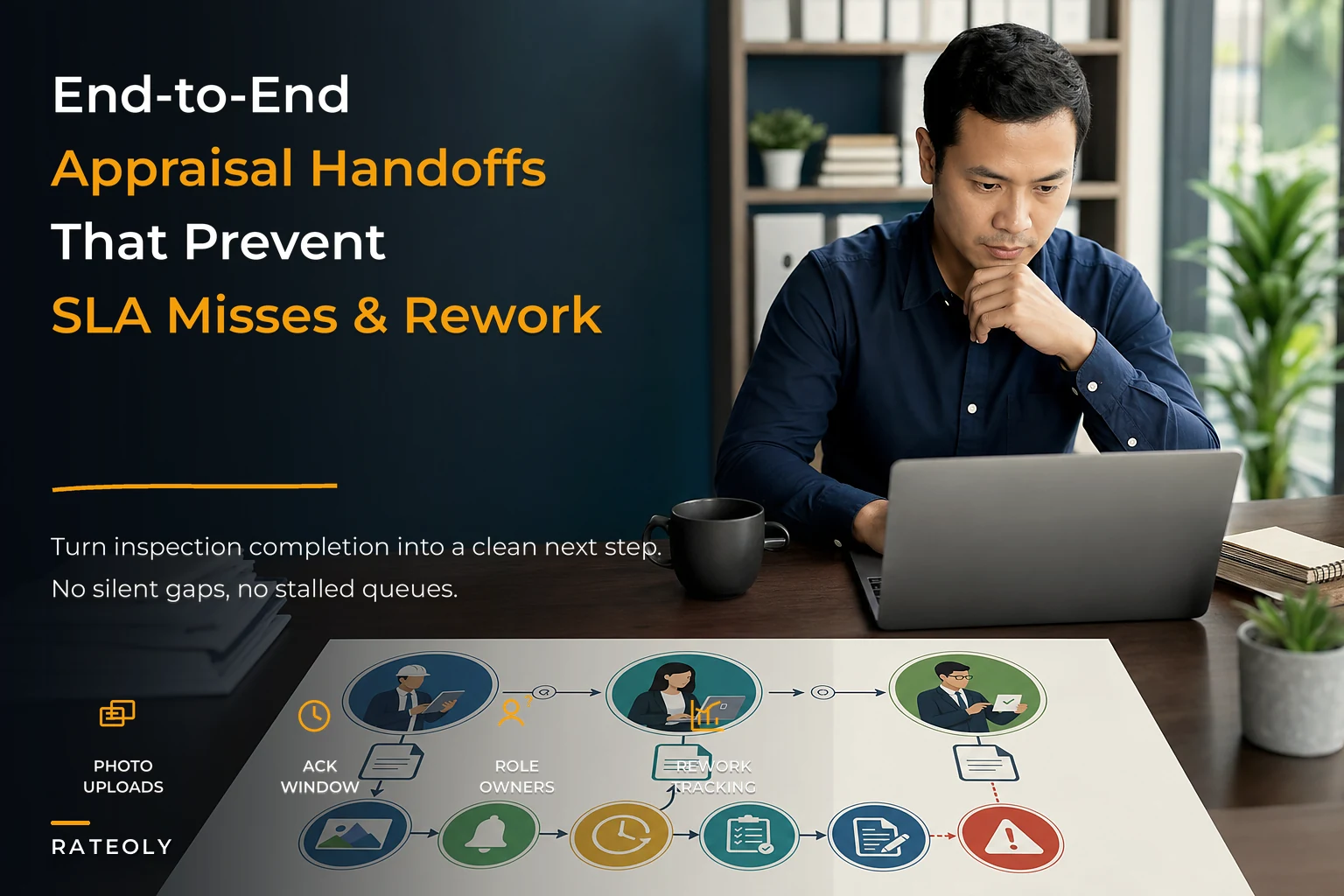

Running an appraisal firm with 8-12 appraisers feels manageable until you actually track where orders get stuck. The order comes in Monday morning, sits in someone's inbox for two days, gets assigned Wednesday afternoon, the inspection happens Friday, then nothing moves until the following Tuesday when someone remembers to check on it. Meanwhile your client's calling about the status and you're scrambling through email threads trying to figure out who has the ball.
This pattern destroys firms. Not dramatically — just slowly, order by order, until you're averaging 9-day turnarounds on what should be 5-day jobs and your best clients start quietly testing other firms.
The real damage happens in the gaps between handoffs. The field appraiser finishes the inspection but doesn't notify the report writer. The QC reviewer flags an issue but the original appraiser doesn't see it for 48 hours because they're out on jobs. These transition points — where responsibility shifts from one person to the next — are responsible for most of your delays and nearly all of your rework.
Why traditional task assignment breaks down
Small appraisal shops usually start with a simple system: orders come in, get assigned to whoever's available, everyone figures out their part. Works fine at 30 orders a month across three appraisers who sit in the same office.
Then watch what happens at 150 monthly orders across eight appraisers in different locations. Intake assigns an order to John for Thursday. John's already booked but doesn't update the schedule until Wednesday night. The order gets reassigned to Sarah Thursday morning. She rushes out without reviewing the property details and misses that it's a duplex needing additional comps. She runs a standard SFR inspection. The mistake surfaces during report writing three days later. Now you need a reinspection and the whole order slides back a week.
That's not incompetence. It's a coordination problem that emerges naturally when informal handoffs meet higher volume. The loose system that felt flexible at 30 orders becomes a liability at 150.
Most firms respond by adding communication tools — Slack, shared calendars, morning standups. These help a bit, but they don't fix the actual problem. You're still relying on individual memory and initiative to move orders through the pipeline. Someone has to remember to check Slack. Someone has to update the calendar. Someone has to mention their bottleneck in the huddle.
Mapping your actual workflow
Before you standardize anything, document what actually happens to orders at your firm. Not the clean process you described to your newest hire — the messy reality.
Manage every appraisal with confidence and clarity.
Rateoly helps you coordinate inspections, generate reports, and communicate seamlessly with clients.
- Comprehensive appraisal tracking
- Automated client notifications
- Integrated scheduling & report management
No credit card required
Follow five recent orders through your entire pipeline. Track every step, every pause, every back-and-forth:
-
Who touched the order
-
What they did
-
How long it sat before the next action
-
Where they got their information
-
Who they notified when they were done
You'll find things that surprise you. Orders sitting in "inspection complete" for days because the appraiser uploaded photos but never triggered the report writing queue. Report writers spending 45 minutes hunting for comp data that research already pulled but stored in a different folder. QC reviewers re-checking work that had already been reviewed because there's no marker showing first-pass completion.
Use actual timestamps from your systems when mapping steps so you measure real waits instead of relying on memory.
One mid-size firm I worked with found their average order touched nine different people across 23 separate handoffs. Their "standard" residential appraisal process had quietly turned into seven slightly different variations depending on who handled intake that day.
Here's what a realistic workflow map looks like for a typical residential appraisal:
Order Intake → Assignment (0.5–2 days)
-
Client portal submission or email request
-
Intake review for completeness
-
Fee quote preparation
-
Client approval
-
Assignment to field appraiser
Inspection Scheduling → Completion (1–3 days)
-
Appraiser accepts assignment
-
Contact property owner/agent
-
Schedule inspection
-
Conduct field inspection
-
Upload photos and measurements
Data Research → Report Prep (0.5–1 day)
-
Research comparable sales
-
Verify public records
-
Pull market data
-
Compile supporting documentation
Report Writing (1–2 days)
-
Complete appraisal report
-
Apply adjustments
-
Write market analysis
-
Generate exhibits
Quality Review → Delivery (0.5–1 day)
-
Technical review
-
Compliance check
-
Revisions if needed
-
Final packaging
-
Client delivery
That's the clean version. Reality includes revision loops, clarification requests, missing data hunts, and coordination gaps between every major phase.
Building role-based handoff protocols
Once you can see your actual workflow, you can design handoff protocols that remove the ambiguity about who owns what and when ownership transfers.
The core idea: handoffs should be active, not passive. Instead of work sitting in a shared queue waiting for someone to notice it, the person finishing a phase actively transfers ownership to the next role.
For each handoff point, define:
-
Completion criteria — exactly what must be done before handoff
-
Notification method — how the next person gets alerted
-
Information transfer — what data and files must be included
-
Acceptance window — how long the next person has to acknowledge
-
Escalation trigger — what happens if there's no acknowledgment
Here's an example from field inspection to report writing:
The field appraiser completes inspection and must:
-
Upload all photos to the designated project folder (minimum 25 photos)
-
Complete the measurement worksheet with sketch
-
Note any property conditions affecting value
-
Flag any comp concerns for the researcher
-
Mark inspection "complete" in the tracking system by 5 PM same day
This triggers automatic notification to the assigned report writer, who must:
-
Acknowledge receipt within 4 business hours
-
Review the inspection package for completeness
-
Flag any missing elements within 8 business hours
-
Begin report writing within 24 hours of acknowledgment
No acknowledgment within 4 hours? Escalates to the operations manager. Missing elements flagged? Automatically returns to the field appraiser queue with specific requirements listed.
The field appraiser knows exactly what "done" means. The report writer knows exactly when they own the order. The system handles the coordination — nobody has to remember.
This visual summarizes the inspection-to-report handoff and the key responsibilities at each step.
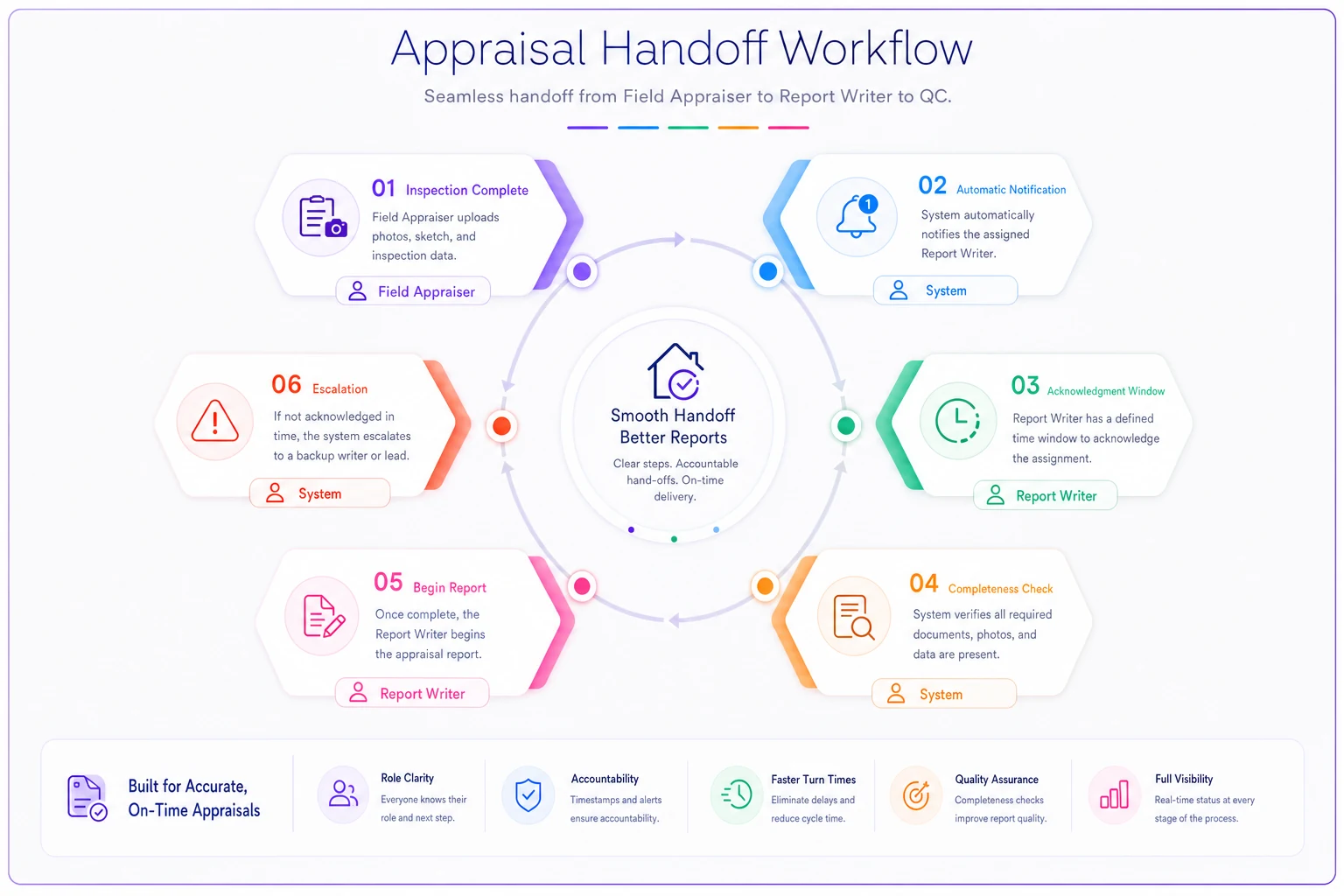
Use it to train teams and to align on exactly what gets transferred at each handoff.
Designing SLAs that actually drive performance
SLAs work when they reflect operational reality and incentivize the right behaviors. Most firms set targets like "5-day turnaround" without breaking down where those five days should go.
Effective SLAs target specific phases:
| Phase | Target Duration | Measurement Point |
|---|---|---|
| Intake to Assignment | 4 hours | Order received → Appraiser notified |
| Assignment to Scheduled | 24 hours | Appraiser notified → Inspection confirmed |
| Scheduled to Inspected | Per schedule | Scheduled time → Photos uploaded |
| Inspected to Report Start | 8 hours | Photos uploaded → Report writing begun |
| Report Start to Draft | 24 hours | Writing begun → Draft complete |
| Draft to QC Complete | 12 hours | Draft submitted → QC decision |
| QC to Delivery | 4 hours | QC approved → Client received |
Granular SLAs show you exactly where delays happen. If your overall turnaround is 7 days but inspection-to-report consistently runs 48 hours against an 8-hour SLA, you've found your bottleneck.
SLAs alone don't fix problems though — they just surface them. You need enforcement mechanisms. What happens when the 8-hour inspection-to-report window gets missed? Does the order auto-escalate? Does someone get notified? Is there a backup report writer?
A firm in Texas implemented phase-based SLAs with automatic reassignment triggers. If a report writer didn't start within 8 hours of inspection completion, the order moved to an overflow queue where senior appraisers could claim it for overtime pay. Orders never sat idle. Appraisers who wanted extra income grabbed the overflow work. Natural load balancing, no manager intervention required.
KPIs that predict problems before clients call
Traditional appraisal KPIs focus on outcomes: turnaround time, revision rate, satisfaction scores. These tell you what happened — not what's about to happen.
Predictive KPIs monitor the workflow itself:
-
Queue depth by phase — how many orders sit at each stage? A growing inspection queue signals scheduling problems. A growing QC queue means reviewers are overloaded.
-
Handoff velocity — how fast do orders move between phases? Track the median time from phase completion to next phase start. When this slows, delays follow.
-
Rework loops by type — not just how many orders need revision, but why and where. Field appraisers consistently missing photos? Report writers misunderstanding comp criteria? Each pattern points to a specific fix.
-
Resource utilization variance — not average utilization, but the spread. If half your appraisers run at 110% while others sit at 60%, you have an assignment problem that will eventually blow up.
-
First-touch resolution rate — what percentage of orders flow through without any backward movement? Every loop adds days.
Here's how it plays out in practice: your queue depth shows 18 orders waiting for QC, up from the usual 8–10. Handoff velocity from report completion to QC start has stretched from 4 hours to 14. First-touch resolution dropped from 78% to 61% in a week.
That pattern means your QC reviewer is overwhelmed, rushing, causing more errors, generating more rework loops. You can intervene before those 18 orders turn into 18 delayed deliveries and 18 angry client calls.
The compounding damage of broken handoffs
Poor handoff protocols don't just delay individual orders — they create cascading failures.
A report writer doesn't get clear inspection data. They spend an extra hour guessing at property details, then make their best call. QC catches discrepancies and sends it back. The report writer needs clarification from the field appraiser, who's now on three other jobs. Two days pass before everyone connects. The report gets revised, goes back to QC, delivers 5 days late.
But during those two days of phone tag, that same report writer couldn't touch three other orders waiting in queue. Those three are now behind schedule before anyone opens them. The field appraiser, interrupted repeatedly for clarifications, rushes through current inspections and makes similar documentation mistakes. Next week, five more orders are in the same loop.
This is how a 15% rework rate becomes 30% and average turnaround creeps from 5 days to 8. Not through dramatic failures — through dozens of small handoff breakdowns that stack up.
Building handoff accountability into your operation
Clear protocols mean nothing without accountability. Someone needs to own each transition point and be answerable when handoffs fail.
Most firms try to solve this with software — workflow tools that automatically route orders. That helps, but it misses the human side. Software can move an order from inspection-complete to report-writing queue. It can't ensure the inspection package actually contains what the report writer needs.
Real accountability comes from role ownership combined with peer visibility. Assign specific people as handoff owners for each transition:
-
Intake coordinator owns intake-to-assignment
-
Lead field appraiser owns inspection-to-reporting
-
QC manager owns review-to-delivery
These owners don't do all the work — they make sure the protocol gets followed. They review failed handoffs weekly, spot patterns, and adjust.
Peer visibility adds natural pressure. Post weekly handoff metrics where everyone can see them — not to shame anyone, but to create shared awareness. When report writers see that 40% of inspection packages arrive incomplete, they understand why their work takes longer. When field appraisers see that missing sketch details cause 25% of revision requests, they pay closer attention.
When to break your own standardized workflow
Standardization drives efficiency but can create rigidity that damages client relationships. You need escape hatches.
Define clear override triggers:
-
Rush orders from top-tier clients (contributing over 15% of revenue)
-
Complex properties requiring senior appraiser involvement
-
Revision requests that challenge your original value conclusion
-
Orders with legal implications or pending litigation
For each trigger, build an alternate workflow that maintains quality while moving faster. That might mean:
-
Senior appraiser handles the entire order end-to-end
-
Parallel processing where research runs during inspection
-
Direct client communication upfront to clarify requirements
-
Dedicated QC reviewer familiar with the client's preferences
A firm in Phoenix built a "VIP track" for their top three lender clients. Those orders skip the normal queue and go straight to senior appraisers who handle everything from inspection through delivery. Less efficient from a productivity standpoint — senior appraisers cost more per hour — but it guarantees 3-day turnaround for clients sending 60% of total volume.
One thing to watch: if you're overriding standard workflow for 30% of orders, you don't have a standard workflow. You have two poorly defined workflows creating confusion.
The technology question
Every appraisal workflow conversation eventually hits this. Buy workflow software? Build something custom? Stick with spreadsheets?
The answer depends on volume and complexity. Below 50 monthly orders, disciplined spreadsheets and communication work fine. The overhead of maintaining software often costs more than it saves.
Between 50–150 orders monthly, you need some form of workflow tracking — even a simple project board where orders move through columns representing phases. The key capability: real-time visibility into where every order sits and who owns it.
Above 150 orders monthly, manual tracking breaks. You need software that moves orders between phases automatically, triggers notifications, and enforces SLAs.
But here's the thing most firms get wrong: the software should encode your workflow, not dictate it. Too many firms buy appraisal management software and then restructure their entire operation to fit the software's assumptions. Six months later they're fighting the system, building workarounds, wondering what they paid for.
Modern AI-powered operational platforms can do more than just route orders — they can flag which orders are likely to miss SLAs before they actually do, suggest routing based on appraiser workload and property type, and surface patterns in your data you'd probably never catch manually. A good platform might notice that orders from certain ZIP codes consistently run long due to comp complexity, then adjust estimated timelines automatically.
But even the best software is just encoding human decisions. You still need clear handoff protocols, defined SLAs, and people who are accountable. Technology makes those things visible and enforceable at scale — it doesn't replace them.
Making process changes stick
Standardizing workflow sounds good in theory. Then Monday morning hits and everyone reverts to old habits. The intake coordinator emails assignments directly to their favorite appraisers. Field appraisers text photos instead of uploading to the system. Report writers skip the research queue and pull their own comps.
Process change fails when it fights human nature. People don't resist standardization out of stubbornness — the old way feels easier in the moment, even when it creates more work overall.
Make the new process the path of least resistance:
-
If appraisers won't upload photos to the right folder, build an upload portal that automatically sorts them
-
If report writers skip the research queue, make research data automatically populate in their reporting template
-
If QC reviewers forget to mark reviews complete, tie their completion metrics to system status
You're building guardrails that guide behavior without requiring conscious effort. The right thing becomes the easy thing.
Track adoption through behavior, not training completion. Don't measure how many people attended the workflow training — measure how many orders actually follow the standard handoff protocol. When adoption drops, dig into why. Usually there's a step that's unnecessarily complicated or a tool that's frustrating to use.
A firm in Colorado struggled with field appraisers documenting property conditions inconsistently. Training didn't fix it. Checklists didn't fix it. What worked: a mobile app with guided photo capture that prompted specific shots and condition notes room by room. The appraisers didn't have to remember what to document — the app walked them through it.
Real-world transformation: from chaos to predictable delivery
Here's how this actually plays out. A 12-person appraisal firm in suburban Atlanta was struggling. They averaged 180 orders monthly with 8-day turnarounds and about 25% of orders requiring revision. Client complaints were picking up. Their largest lender was testing other firms.
After mapping the actual workflow, they found orders were bouncing between an average of 11 touch points with no clear ownership model. An order might sit a full day waiting for assignment, rush through inspection and report writing, then sit another two days in the QC queue. The inconsistency made it nearly impossible to predict delivery dates.
They put in:
-
Clear role definitions with primary and backup owners for each phase
-
Handoff protocols with specific completion criteria
-
4-hour acknowledgment windows across all handoffs
-
Phase-based SLAs tied to bonuses
-
Daily review of orders at risk of missing SLAs
The first month was rough. People forgot the new protocols. Orders still got lost between phases. But they kept measuring and adjusting. By month three, average turnaround dropped to 5.5 days. Revision rate fell to 12%.
More importantly, delivery became predictable. They could tell clients exactly when orders would arrive and hit those dates 94% of the time. Their largest lender increased volume by 30% and signed a two-year exclusive agreement for certain property types.
The transformation wasn't about working faster — it was about eliminating dead time between phases and reducing rework through cleaner handoffs. Same people, same core work, just better coordinated.
The path forward
Appraisal workflow standardization isn't about building rigid processes that frustrate your team. It's about creating clear pathways so work flows efficiently without constant oversight.
Start small. Pick your highest-volume, most standard order type — probably traditional residential purchases. Map that workflow. Design handoff protocols for just that order type. Measure for a month. Then expand.
The goal isn't perfection. It's predictability. When you can reliably deliver quality appraisals on schedule, everything else gets easier. Client relationships strengthen. Team stress drops. Revenue stabilizes.
The alternative — operating in reactive mode, managing by crisis — only gets worse as volume grows. Every additional order adds more chaos to an already strained system. Eventually something breaks. Usually it's your best people, who get tired of the dysfunction and move to better-run firms.
Clean handoffs, met SLAs, clear role ownership — that's when appraisal work becomes professionally satisfying again. When you're valued for expertise rather than spending energy on coordination failures that should never have happened in the first place.
Ready to elevate your appraisal operations?
Join 500+ appraisal firms using Rateoly to enhance accuracy, save time, and improve client satisfaction.