


Most appraisal firms have some version of a narrative library. A folder full of text snippets for common situations, paragraphs describing market conditions, standard adjustment explanations. The problem isn't having templates—it's how they get used, quietly modified, and eventually turn into compliance headaches.
It starts innocently. An appraiser needs to explain a GLA adjustment, grabs something from the library, tweaks a few words, pastes it in. Next week, a different appraiser does the same thing with the same template but different tweaks. Six months later there are seventeen variations of the same narrative floating around, some potentially non-compliant, and nobody knows which version is actually correct anymore.
Then the audit comes. The reviewer finds inconsistent explanations across reports. Different appraisers describing identical adjustments with conflicting logic. Templates from 2019 still referencing outdated USPAP standards. Residential narratives copy-pasted into commercial reports where they make no sense.
Why appraisal narrative templates become a compliance mess
The core problem isn't the concept of templates—it's the execution. Traditional systems treat narratives like static documents when they actually need to function as structured building blocks with clear rules attached.
Think about how narratives actually get written. An appraiser working on a complex property needs to explain why the cost approach wasn't developed. They remember writing something similar last month, dig through old reports, find the paragraph, copy it over. But that report was for a different property type in a different market. The core logic might apply. The specific details don't.
Multiply this across a team and things deteriorate fast. Everyone copies from everyone else's reports. Good language gets reused, but so does mediocre language. Worse, non-compliant phrasing spreads through your report database without anyone noticing. One appraiser writes something that sounds reasonable but technically violates USPAP, three others copy it, and now you have a systemic problem.
The scariest part is that most firms don't catch this until an external review. By then, the problematic language might be in hundreds of reports. Firms can spend weeks cleaning up narrative inconsistencies after a state board inquiry flags repetitive non-compliant phrasing across multiple appraisers' work—and that's a brutal situation to be in.
Building a modular narrative system that actually works
A functional narrative library needs more structure than just dumping paragraphs into folders. You need clear categories, explicit reuse rules, and mandatory customization points.
Manage every appraisal with confidence and clarity.
Rateoly helps you coordinate inspections, generate reports, and communicate seamlessly with clients.
- Comprehensive appraisal tracking
- Automated client notifications
- Integrated scheduling & report management
No credit card required
Start with categorization—but don't organize by property type. Organize by narrative function. Create distinct categories for:
Market condition narratives — These can be broadly reused within the same market area and time period. A paragraph describing current inventory levels in a specific submarket applies to multiple reports done that quarter.
Adjustment explanations — These need customization points for specific comparables but can share core methodology language. Your GLA adjustment logic stays consistent; the actual comparable data changes.
Approach reconciliation — The framework stays the same, but property-specific details must be customized every time. Why you weighted the sales approach at 80% needs case-by-case justification.
Limiting conditions — Generally standardized and reusable verbatim, but need regular compliance reviews to ensure they match current standards.
Extraordinary assumptions — Never fully reusable. The structure might look similar, but the specific assumption and its impact must be customized for each report. No exceptions.
For each category, establish clear reuse rules. Market narratives might be fully reusable for 90 days within the same submarket. Adjustment explanations require updating comparable specifics but can maintain the methodology description. Some narratives should never be copied wholesale—mark those clearly and make sure everyone knows it.
Below is a quick reference for how reuse rules map to narrative category:
| Narrative Category | Reuse Level | Expiration / Restriction |
|---|---|---|
| Market condition narratives | Broadly reusable | 90 days within same submarket |
| Adjustment explanations | Partial reuse | Update comparable specifics each time |
| Approach reconciliation | Framework only | Property details must be customized |
| Limiting conditions | Verbatim reusable | Periodic compliance review required |
| Extraordinary assumptions | Never fully reusable | Full customization required, no exceptions |
The categories only work if people actually respect the boundaries. That part takes some culture change, not just a new folder structure.
Creating mandatory customization points
The biggest mistake firms make is allowing wholesale copy-paste without requiring customization. Every reusable narrative needs clearly marked customization points built in.
In practice, this means instead of storing a narrative that says "The subject property benefits from its location near downtown amenities," you store a template with brackets: "The subject property benefits from its location near [SPECIFIC AMENITIES WITH DISTANCES]."
Those brackets aren't optional. They're mandatory fields that force the appraiser to add property-specific details. This prevents lazy copying while keeping structure and logic consistent.
For adjustment narratives, the format looks like this:
"[COMPARABLE #] required a [UPWARD/DOWNWARD] adjustment of $[AMOUNT] for [SPECIFIC FEATURE]. This adjustment is based on [PAIRED SALES/REGRESSION/MARKET EXTRACTION] analysis indicating that [SPECIFIC MARKET DATA SUPPORTING ADJUSTMENT]."
The template provides structure and compliant language while requiring case-specific data. You get consistency without cookie-cutter reports.
Make bracketed customization points required fields in your CMS so reports can’t be finalized with placeholders left in.
Some firms resist this level of structure, assuming it slows things down. The opposite tends to be true. Clear templates with obvious customization points speed up writing because appraisers don't waste time figuring out what needs to change. They see the brackets, fill them in, move on.
Compliance-approved phrasing that stands up to scrutiny
Building compliance into your narrative library from the start saves massive headaches later. Most firms do this backwards—they write narratives first, then check compliance. By then, the problematic phrasing is already embedded in the workflow.
Work with your compliance team (or a consultant if you're a smaller shop) to establish approved phrasing for common scenarios before narratives go into production.
For highest and best use analysis, don't just write "The current use represents the highest and best use." That's vague and often factually wrong. Use structured language instead:
"The highest and best use as vacant considers [LEGALLY PERMISSIBLE USES BASED ON ZONING]. Given [SPECIFIC MARKET CONDITIONS], the maximally productive use would be [SPECIFIC USE] based on [MARKET EVIDENCE]. The current use as [CURRENT USE] is [CONSISTENT/INCONSISTENT] with this determination based on [SPECIFIC REASONING]."
For reconciliation sections, avoid vague statements. Instead of "The sales comparison approach was given the most weight," use:
"The sales comparison approach was weighted at [X]% based on [SPECIFIC FACTORS LIKE DATA QUALITY, MARKET ACTIVITY, COMPARABLE AVAILABILITY]. The [OTHER APPROACH] received [X]% weight due to [SPECIFIC LIMITATIONS OR STRENGTHS]."
These templates force specificity while maintaining compliant structure. They prevent under-explanation and over-generalization at the same time.
Real-world scenario examples showing the system in action
A mid-sized firm in Phoenix was averaging around 18 hours per week just on narrative rewrites and corrections—not writing new narratives, fixing problems in existing ones.
Their review process kept surfacing the same issues. Inconsistent market descriptions across reports in the same neighborhood. Adjustment explanations that contradicted each other. Boilerplate language that didn't match the actual analysis in the file.
They rebuilt their narrative library using modular blocks with clear reuse rules. Market condition narratives got 60-day expiration dates and geographic boundaries. Adjustment explanations became templates with mandatory brackets for comparable-specific data. They built separate templates for different property types instead of trying to force one-size-fits-all narratives.
The time savings showed up immediately. Average report writing dropped from around 6 hours to 4. But the bigger impact came in review time—instead of spending 45 minutes catching and fixing narrative inconsistencies, reviewers spent maybe 10 minutes verifying that customization points were properly filled in.
Six months later, they passed a state audit with zero narrative-related findings. The auditor actually noted their consistency. Same firm that had been dinged for conflicting narratives the year before.
Managing version control and updates
Version control sounds boring, but it's where most narrative systems fall apart. You update a template to match new USPAP requirements, and half your team keeps using the old version saved locally. Suddenly you're non-compliant without knowing it.
The traditional approach—emailing updated templates or posting them on a shared drive—doesn't hold up. People don't delete old versions. They don't check for updates. They definitely don't track which version ended up in which report.
A functional system needs centralized storage with version tracking. When you update a market narrative for Q4, the Q3 version should be archived but still accessible for reference. When regulatory changes require template updates, old versions need to be clearly flagged as obsolete.
More importantly, you need to track which templates were used in which reports. When a compliance issue surfaces, you need to quickly identify every report that used the problematic narrative. This isn't about blame—it's about efficient remediation.
Some firms try to manage this with spreadsheets and folders. It works until it doesn't. Usually right when you need it most, like during an audit when you're trying to prove that a specific narrative was compliant when written, even if standards have since changed.
Common mistakes that destroy narrative consistency
The worst pattern is what could be called "narrative drift." A good template gets copied and slightly modified for a specific situation. That modified version gets copied and modified again. Several months later, you've got fifteen variations of the same narrative, each slightly different, and nobody knows which one to use.
Context-blind reuse is another killer. A narrative explaining lack of comparable sales in a rural market gets copied into an urban report. An explanation for why the cost approach wasn't developed for a 50-year-old home ends up in a new construction appraisal. The language might technically be compliant, but it makes no sense in context—and reviewers notice.
Property-type confusion creates serious problems too. Residential narratives bleeding into commercial reports. Single-family explanations appearing in multifamily appraisals. These mistakes make reports look sloppy at best, incompetent at worst.
The fix isn't complicated, but it requires discipline. Clear labeling of templates by property type and situation. Regular audits to catch narrative drift before it spreads. Consistent training on when reuse is appropriate versus when the situation calls for custom writing.
Building an automation-ready narrative framework
Modern appraisal software can dramatically speed up narrative insertion, but only if your templates are properly structured first. Dumping random paragraphs into an automation system doesn't create efficiency—it just makes problems scale faster.
The key is building narratives that integrate with actual data fields. Instead of static text, you create dynamic templates that pull from your comparables database, market data, and property characteristics. A properly structured template might look like this:
"The subject's {SQFT} square feet compares to the comparable range of {MINCOMPSQFT} to {MAXCOMPSQFT} square feet, positioning it {ABOVE/WITHIN/BELOW} the typical market range."
When integrated with your appraisal software, this template populates automatically with actual data while maintaining compliant structure. No manual entry, no transcription errors, no inconsistencies between what the data says and what the narrative says.
The general workflow for automation-ready narrative integration looks something like this:
-
Appraiser selects the applicable narrative template from the centralized library
-
Software pulls relevant data fields from the comparables database and property profile
-
Dynamic placeholders populate with actual figures and property characteristics
-
Appraiser reviews populated narrative for context accuracy and adds professional commentary
-
Reviewer verifies customization points are properly completed before report is finalized
Automation should support professional judgment, not replace it. The system can insert the narrative framework and populate the data fields, but the appraiser still needs to verify context and add genuine insight. A template might flag that the subject is above the typical size range, but the appraiser still needs to explain why that matters for this specific property. That hybrid approach—automated framework with human customization—produces the best results. Consistency and efficiency without sacrificing the professional judgment that makes an appraisal defensible.
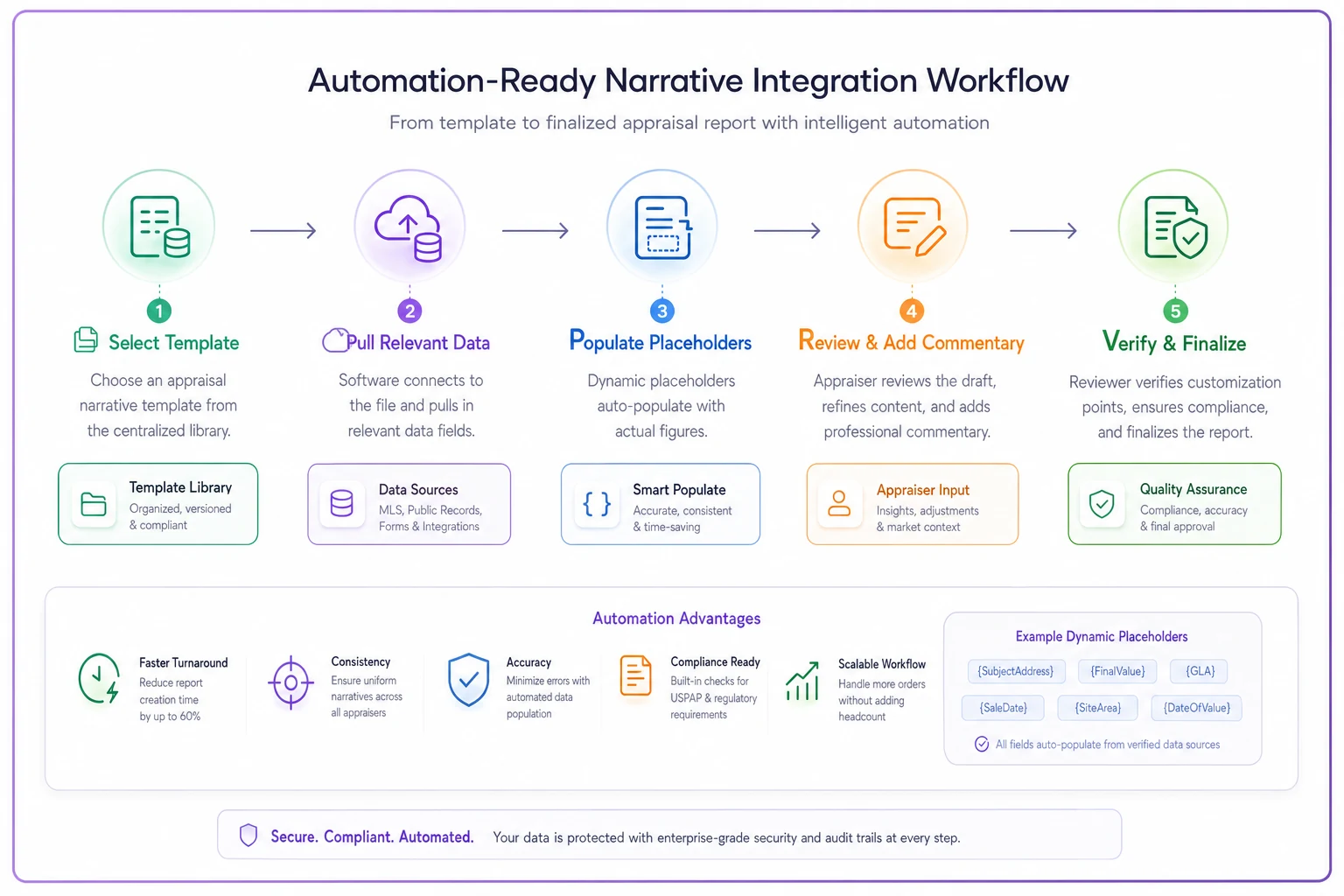
The graphic above visualizes the integration steps so teams can align on responsibility and checkpoints.
This hybrid approach—automated framework with human customization—produces the best results: consistency and efficiency without sacrificing professional judgment.
The real cost of bad narrative management
Poor narrative management costs more than just time. There's reputation damage when inconsistent reports reach clients. Liability exposure when non-compliant language slips through review. Opportunity cost when appraisers spend hours rewriting instead of completing billable assignments.
One firm tracked their narrative-related time waste across a full quarter. Between writing, rewriting, reviewing, and correcting narratives, they were burning close to 30% of production time on text management. For a five-appraiser firm, that's roughly one and a half people doing nothing but fixing words all day.
The financial hit goes beyond labor. Inconsistent narratives trigger more revision requests. Non-compliant language leads to enforcement actions. Poor explanations result in value challenges. Each of those costs money and damages client relationships in ways that take a long time to repair.
There's also the stress factor, which tends to get ignored in these conversations. Appraisers hate rewriting the same explanations repeatedly. Reviewers hate catching the same mistakes over and over. Everyone knows the system is broken, but rebuilding it feels like a project nobody has bandwidth for.
Building a proper narrative system takes real effort upfront. Most firms that commit to it see positive ROI within 60 days from time savings alone, before factoring in reduced compliance risk and improved report quality.
Making the transition without disrupting operations
You can't rebuild a narrative system overnight without grinding production to a halt. Staged implementation while maintaining current output is the only realistic approach.
Start with your most problematic narratives—usually the ones generating the most revisions or compliance issues. Build proper templates for those first. Get them into use, gather feedback, refine. Once those are working, expand to the next category.
Don't try to templatize everything. Some narratives genuinely need custom writing. Unique properties, unusual situations, complex analyses—these require appraiser judgment and creativity. The goal isn't to eliminate professional writing, it's to systematize the routine stuff so appraisers can focus their energy where it actually matters.
Training is critical and consistently underinvested in. Appraisers need to understand not just how to use templates but when. What's safe to reuse, what needs customization, what should be written from scratch. Without clear guidelines, even a well-built template system fails quickly.
Measuring success and continuous improvement
A functional narrative system needs metrics to prove it's working. Track time spent on narrative writing before and after implementation. Monitor revision requests tied to narrative issues. Count compliance findings related to report language.
Most firms see a 40–50% reduction in narrative-related time within the first quarter. Revision requests typically drop significantly. Compliance issues related to narrative language drop to near zero if the system is properly maintained.
The numbers only tell part of the story though. The real success shows up in appraiser satisfaction. When professionals can focus on analysis instead of rewriting boilerplate, work quality improves. When reviewers stop catching the same mistakes repeatedly, frustration decreases. When clients receive consistent, clear reports, relationships strengthen on their own.
The system also needs regular maintenance. Templates require updates when regulations change. New scenarios need new narratives. Old templates that nobody uses anymore should be archived. This isn't a set-it-and-forget-it solution.
For firms looking to scale or improve margins, narrative management is genuinely low-hanging fruit. The investment is reasonable, implementation is straightforward if staged properly, and the returns tend to show up quickly. In an industry where time directly equals money, saving a couple hours per report through better narrative management has real impact on the bottom line. Most firms that actually make the switch wonder why they waited so long.
Most firms that actually make the switch wonder why they waited so long.
Ready to elevate your appraisal operations?
Join 500+ appraisal firms using Rateoly to enhance accuracy, save time, and improve client satisfaction.