


Most exceptions don't come back because the appraiser was wrong. They come back because something small slipped through — a mismatched effective date, a comp that violates the lender's distance overlay, a photo caption that says "rear" but shows the side yard. Individually these are two-minute fixes. Collectively, they're why a file bounces three times and blows past your turn-time target.
The problem with most quality control in small shops is that it happens all at once, at the end, by one tired reviewer scanning a 40-page PDF with no real map of what matters. You can't catch everything in a single pass. And when you review the whole file as one blob, you review nothing well.
This is a different approach: break the report into sections, give each section its own short checkpoint, define the red flags that stop the file cold, and box each review into a fixed time so it doesn't quietly eat your afternoon. Done right, an appraisal QC checklist built this way catches exceptions before the lender ever sees them — and it plugs directly into your cycle-time and SLA metrics instead of sitting off to the side as a nice-to-have.
Why the "one big review at the end" model keeps failing
The pattern in small firms is predictable. The appraiser finishes at 6pm, hands the file to whoever does QC, and that person opens it cold with no idea which parts of the assignment were actually risky. So they either skim everything evenly and miss the one section that mattered, or they hyper-focus on adjustments and never check whether the sketch square footage matches the cost approach.
A single end-stage review has three built-in weaknesses:
-
No prioritization. Every section gets the same attention, even though 80% of exceptions cluster in comps, adjustments, and photos.
-
No stopping rule. The reviewer keeps going even after hitting something that should halt everything — like a subject that doesn't match the order.
-
No time discipline. "Review the file" is an open-ended task. It expands to fill whatever time is left, or gets rushed when the day runs out.
The fix isn't more review time. It's structured review time. When you attach checkpoints to specific sections and cap the clock, reviewers stop wandering and start hunting for the specific defects that section is prone to.
The section-by-section checkpoint map
Think of the report as a set of zones, each with its own failure modes. You're not re-reading the whole appraisal at each stage — you're doing a targeted sweep of the two or three things that section historically gets wrong.
Manage every appraisal with confidence and clarity.
Rateoly helps you coordinate inspections, generate reports, and communicate seamlessly with clients.
- Comprehensive appraisal tracking
- Automated client notifications
- Integrated scheduling & report management
No credit card required
Here's how the checkpoints break down, with the time box and the red flag that stops the file:
| Section | Time box | What you're actually checking | Red-flag trigger (stop the file) |
|---|---|---|---|
| Order & subject match | 2 min | Address, borrower, effective date, intended use all match the order | Subject address ≠ order address, or effective date wrong |
| Comparable selection | 5 min | Distance, date, GLA range, same market segment | Comp outside lender distance/time overlay with no commentary |
| Adjustments | 6 min | Support for each adjustment, net/gross within guidelines, math ties out | Gross adjustment over threshold with no explanation |
| Reconciliation | 3 min | Value lands within adjusted range, weighting logic stated | Final value outside the adjusted comp range |
| Sketch & GLA | 3 min | Sketch GLA matches cost approach and subject grid | GLA differs across the three places it appears |
| Photos & exhibits | 4 min | Required shots present, captions match images, map exhibit correct | Missing interior/mechanical shot or mislabeled photo |
| Compliance & certs | 2 min | Signatures, license dates, USPAP boilerplate, transmittal | Expired license or missing signature |
The diagram shows the reviewer moving through each timed checkpoint with clear stop triggers.
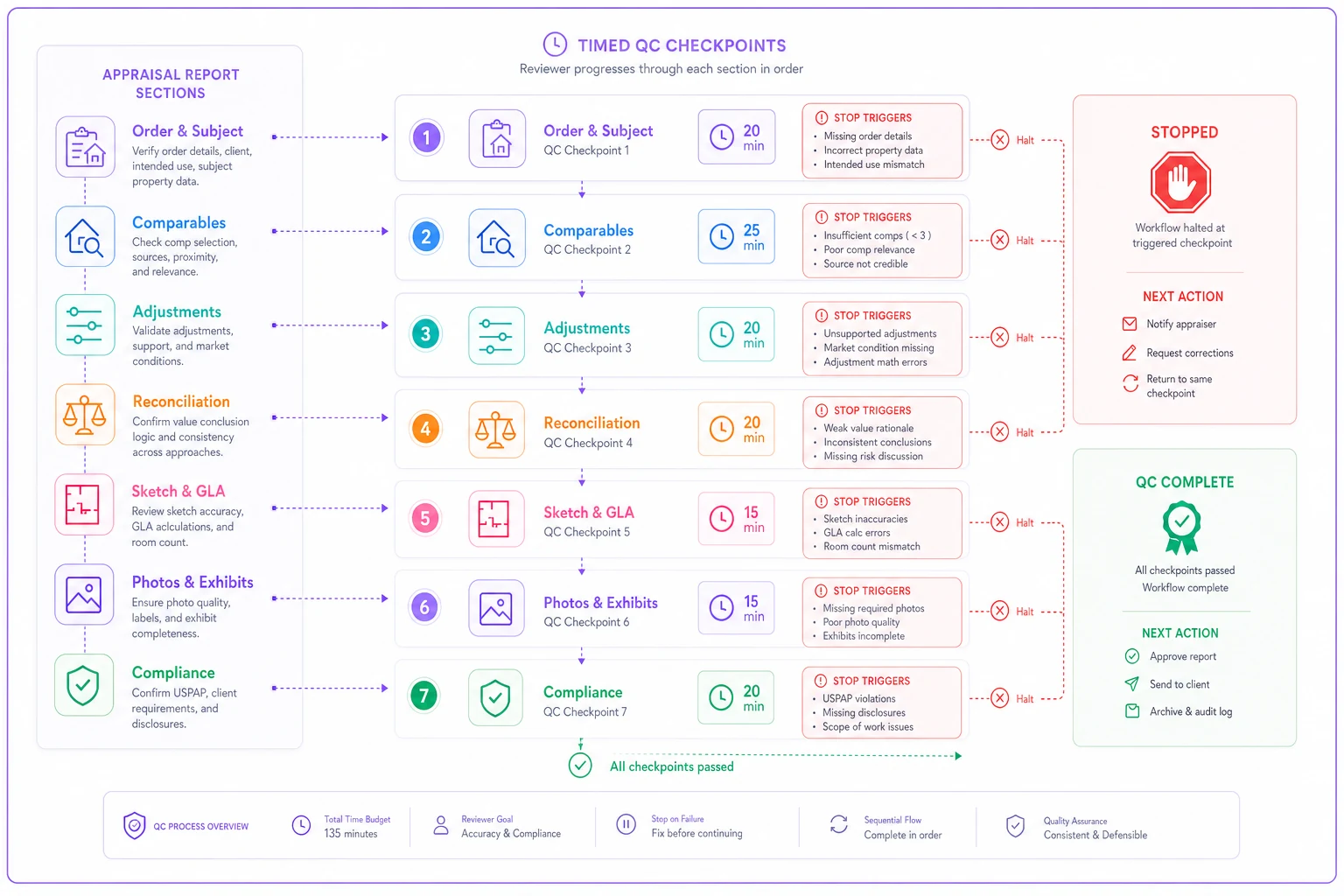
Total is roughly 25 minutes for a standard 1004. That's not more time than most reviewers already spend — it's the same time spent with a map instead of a flashlight.
The insight most people miss: the time boxes aren't there to rush you. They're there to force a decision. If you're 6 minutes into adjustments and still confused, that's not a "spend 20 more minutes" situation — that's a red flag. It goes back to the appraiser with a specific question, not into a black hole of solo reviewer effort.
Red-flag triggers: the difference between a note and a stop
Not every finding is equal. A weak adjustment comment is a note — you flag it, the appraiser tweaks it, the file keeps moving. A subject address that doesn't match the order is a stop. You don't keep reviewing. You don't fix it quietly. The file halts and goes back.
The mistake small shops make is treating everything as a note. The reviewer finds a GLA mismatch, mentally files it under "I'll ask about that," keeps going, finds two more things, and now the file has a mixed pile of corrections with no priority. The appraiser fixes the easy ones and misses the one that actually would've caused a lender kickback.
Separate your findings into two buckets and act on them differently:
Stops (review halts immediately, file returns):
-
Subject doesn't match the order
-
Effective date wrong or inconsistent
-
Final value outside the adjusted comp range
-
GLA inconsistent across sketch, grid, and cost approach
-
Comp violates the lender's stated distance or time overlay with no support
-
Missing signature or expired license
Notes (log, batch, return together):
-
Thin adjustment commentary
-
Photo caption typos
-
Formatting or exhibit polish
-
Optional-but-recommended supporting comments
The reason to split them: a stop means the whole file is suspect and you shouldn't burn review minutes on the rest until it's resolved. If the effective date is wrong, half your comp analysis might be irrelevant. Reviewing it anyway is wasted work.
A real scenario: what this changed for a three-appraiser shop
A residential firm running three staff appraisers and one part-time reviewer was averaging around 6.5 business days per file, with a meaningful chunk of that being rework. Their lender exception rate sat near 18% — almost one in five files coming back for something.
Their QC was the classic setup: reviewer opens the finished file, reads it start to finish, flags whatever jumps out, sends it back. Some files got a careful read; others got a rushed one at the end of a long day. No real consistency.
They switched to the section-checkpoint model. Same reviewer, same total review time — roughly 25 minutes per standard file — but split into timed zones with defined stop triggers. The reviewer stopped reading cover-to-cover and started sweeping section by section, halting on stops before touching the rest.
Over about two months, the exception rate dropped from around 18% to just under 9%. The less obvious win: because red flags now stopped the file early, the reviewer wasn't wasting time polishing sections on files that had a fundamental problem. Average cycle time came down close to a full day. Nothing about the appraisers' work changed — the review just got structured.
The owner didn't expect what happened next: appraisers started self-correcting. Once they saw the same stop triggers coming back repeatedly, they started checking those themselves before submitting. The checkpoint list became a submission standard, not just a review tool.
Tying it to SLA and cycle-time metrics (so it doesn't stay optional)
A QC checklist that lives in someone's head or a Word doc dies within a month. What keeps it alive is connecting each checkpoint to a number you already track.
The workflow that makes it stick:
-
Timestamp the review start and end. Every file gets a QC-in and QC-out. That gives you actual review-cycle data instead of guesses.
-
Log which trigger fired. When a file stops, record the reason — subject mismatch, GLA inconsistency, whatever. Over a month this tells you exactly which defect is eating your time.
-
Tie stops to cycle time. Files with zero stops should hit your SLA cleanly. Files with stops get tagged so you can see how much each stop type adds to turn time.
-
Feed the top trigger back to training. If GLA mismatches are your number one stop, that's a two-minute team conversation, not a systemic mystery.
This is where an operational platform earns its place. When your workflow tool timestamps each QC stage automatically and lets the reviewer tag the trigger from a fixed dropdown, you stop maintaining a separate tracking spreadsheet. The checkpoint data rolls straight into your cycle-time reporting. A bit of automation on the logging side — auto-flagging files where the effective date field doesn't match the order date, for instance — catches the obvious stops before a human even opens the file. The point isn't to replace the reviewer's judgment; it's to stop depending on whether someone remembered to look.
When this workflow makes sense — and when it doesn't
This works well when:
-
You're running multiple appraisers and need consistent review quality across all of them
-
Your exception rate is high enough to hurt (roughly 10%+ is a clear signal)
-
You have at least one dedicated reviewer, even part-time
-
You're missing SLAs partly because of rework loops
This is overkill when:
-
You're a solo appraiser doing a handful of files a week — you already know your own weak spots, and a lighter self-check list beats a formal seven-zone workflow
-
Your volume is low enough that every file genuinely gets a careful read anyway
Who should not force this: shops whose exceptions are mostly coming from data problems, not review problems — bad comps because of poor source data, inconsistent field measurements, that kind of thing. If the input is broken, no amount of end-stage QC fixes it. Tighten data reliability first, then layer this on top.
Getting started without overbuilding it
Don't try to launch all seven checkpoints polished on day one.
Pull the last 30 exceptions, sort them by cause, and you'll almost certainly find two or three categories generating most of the pain.
Build the checkpoint and stop trigger for those first.
Run it for two weeks. Log the triggers. Watch whether your exception rate on those specific issues drops. Once the habit's set, add the next section. Trying to overhaul the entire review process overnight is how these things get abandoned — the reviewer gets overwhelmed, reverts to skimming, and you're back to one big end-stage read.
The whole idea is boring on purpose. You're not adding review time. You're spending the same time with a map, a stopping rule, and a clock — so the small stuff that quietly turns into three rounds of revisions gets caught in the first pass, before it ever reaches the lender's desk.
The whole idea is boring on purpose. You're not adding review time. You're spending the same time with a map, a stopping rule, and a clock — so the small stuff that quietly turns into three rounds of revisions gets caught in the first pass, before it ever reaches the lender's desk.
Ready to elevate your appraisal operations?
Join 500+ appraisal firms using Rateoly to enhance accuracy, save time, and improve client satisfaction.