


An appraiser called me last month about a comp problem that had gotten completely out of hand. Their firm grew from 3 to 8 appraisers over two years, and the comp data turned into a disaster. Different appraisers had different versions of the same property. Square footage didn't match between reports. Sale prices changed depending on who pulled the data. One property showed up as both a 2019 and 2021 sale with different prices attached to it.
The comp database mess that quietly spirals out of control
The managing partner's solution? Have everyone email comps to an admin who'd "clean things up" in a master spreadsheet every Friday afternoon. That lasted about three weeks before the admin quit.
This wasn't a technology problem or a staffing problem. It's what happens when appraisal firms grow without building basic data governance into their operations. Trying to fix bad data after the fact is like mopping water while the pipe is still leaking.
Where comp data actually breaks inside the firm
Most appraisers blame bad MLS feeds or outdated public records for their data problems. The real breakdown usually happens inside the firm itself.
Manage every appraisal with confidence and clarity.
Rateoly helps you coordinate inspections, generate reports, and communicate seamlessly with clients.
- Comprehensive appraisal tracking
- Automated client notifications
- Integrated scheduling & report management
No credit card required
Picture a typical week in a 6-appraiser shop. Monday morning, two appraisers pull comps for properties in the same subdivision. One uses MLS, checks county records, adds field notes. The other uses a different MLS board because they work across county lines, pulls from a personal database they've built over five years, and remembers one property differently because they appraised it during construction.
By Wednesday, both have uploaded reports. A third appraiser, working on a nearby property, downloads both as work files. They notice discrepancies, make their own adjustments based on a conversation with a local realtor, and save their version.
Three appraisers. Same comp. Three different data sets.
Multiply that by 30-40 comps per week across multiple appraisers and you've got thousands of conflicting data points piling up. Most firms don't even know it's happening until an audit flags it or a lender questions why the same comp shows different numbers across two reports submitted the same month.
Manual reconciliation burns money you don't see on a P&L
A typical 5-appraiser firm processes somewhere around 600-800 reports a year. Each report averages 4-6 comps. That's roughly 3,500+ comp records flowing through the system annually.
When comp data isn't governed properly, appraisers spend 15-20 minutes per report just re-verifying data they've already pulled. The rough math: 700 reports × 17 minutes works out to close to 200 hours annually. At $75/hour for experienced appraisers, that's nearly $15,000 in pure waste — and that's before counting revision requests triggered by inconsistent data.
The hidden cost is worse. When appraisers don't trust the comp database, they start maintaining personal shadow databases. I've seen firms where every appraiser had their own Excel file with "their" version of local comps. One firm discovered their senior appraiser had maintained a personal database of 4,000+ comps for eight years, never sharing it because the office system was too unreliable to bother with.
Shadow databases create a vicious cycle. The more appraisers rely on personal data, the worse the central system gets. The worse the central system gets, the more they rely on personal data. Eventually you have eight appraisers running eight different operations under one roof.
The four-part framework that actually holds up
Forget heavy enterprise governance systems. Small appraisal shops need something that works without a full-time data manager.
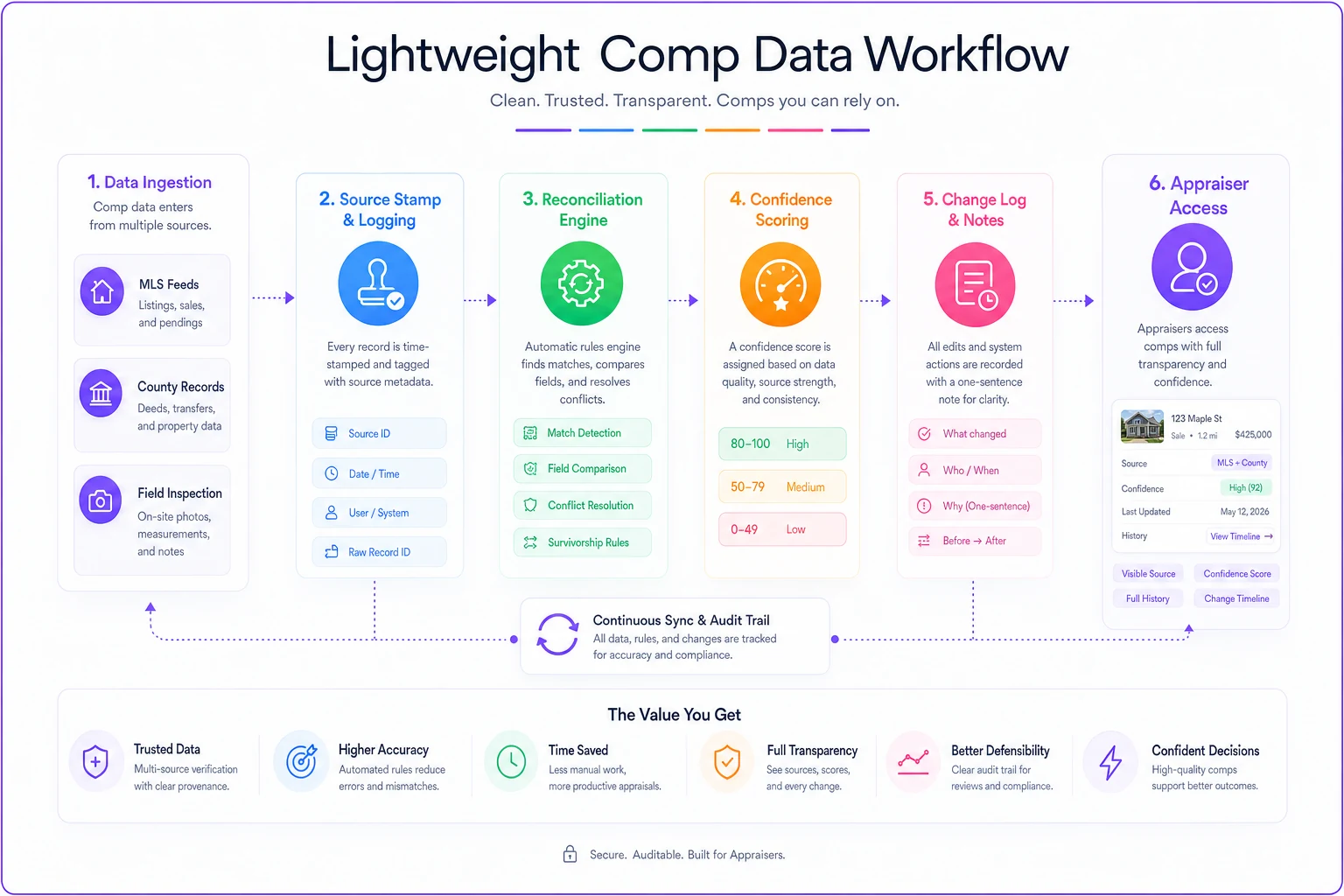
The process generally looks like this:
-
Comp data enters the system from a source (MLS, county records, field inspection)
-
The source gets stamped and logged immediately
-
If a conflict exists with existing data, reconciliation rules determine which source wins automatically
-
The comp gets assigned a confidence score based on verification and usage history
-
Any subsequent changes are logged with a one-sentence explanation
-
Appraisers access comps with full visibility into source, confidence, and change history
This diagram shows the lightweight comp-data workflow.
Here's the lightweight framework that makes this work across different firm sizes:
1. Source Mapping — Know where data comes from
-
Primary source (MLS, public record, field inspection)
-
Pull date
-
Who pulled it
This takes about five seconds to record but resolves most conflicts. When two appraisers have different square footage, you can immediately see one pulled from MLS in January and the other from updated county records in March. One firm implemented this with a simple dropdown in their report writing software. Comp conflicts dropped noticeably within two months because appraisers could identify why data differed instead of arguing about it.
2. Reconciliation Rules — Clear hierarchy when conflicts arise
When data conflicts, you need rules about which source wins. A typical hierarchy:
-
Field inspection or measurement by your own firm (highest priority)
-
Recent county records post-sale
-
MLS listing data
-
Older public records
-
Third-party data services (lowest priority)
The key is making the resolution automatic. If your system sees two versions of the same comp, it should know which to trust based on source hierarchy — not require someone to manually decide every single time.
3. Confidence Scoring — Not all comps deserve the same trust
This is where most firms leave value on the table. A confidence score doesn't need to be complicated:
| Confidence Level | Criteria |
|---|---|
| High | Field inspected, multiple source verification, used in 3+ reports |
| Medium | Single source, used in 1-2 reports |
| Low | Conflicting sources, unusual data points, or never used in a report |
A firm in Virginia built this into their process. Their high-confidence comps became a "gold standard" set — around 200 properties they knew were solid. Appraisers started there for every report, only pulling new comps when necessary. Report time dropped noticeably just from reduced research time alone.
4. Change Logs — Track what changed and why
Every data change needs a breadcrumb trail. Not a novel — just:
-
What changed
-
Who changed it
-
Why (one sentence)
-
Previous value
This isn't about policing appraisers. It's about learning. When you see the same comp getting "corrected" multiple times, that's a signal something is wrong upstream — maybe MLS has bad data, or county records haven't caught up to a recent sale.
Building it without heavy overhead
The biggest mistake firms make is trying to implement all of this at once, usually with expensive software that requires a week of training. Then they wonder why appraisers revolt and go back to their Excel files.
Start with source mapping. Just that. Add one simple field tracking where comp data came from. Do this for a month. Once appraisers see how it helps resolve conflicts, they'll want the other components.
Start with source mapping for one month and track the impact before adding reconciliation rules.
Then add reconciliation rules. Write them on one page and build it into the workflow. When conflicts arise, everyone knows which source wins. No meetings, no debates.
Confidence scoring can start as a simple binary flag: "verified" or "unverified." Let appraisers mark comps they've personally inspected or thoroughly researched. Over time, a core set of verified comps builds up that everyone actually trusts.
Change logs sound complex but can start as a plain notes field in your report software. The discipline of writing one sentence about why a change was made makes appraisers think twice before adjusting anything — which is half the point.
What changes when governance actually works
A firm in North Carolina implemented this framework about 18 months ago. They started with 6 appraisers drowning in comp chaos. Today, with 9 appraisers, their comp data is cleaner than when they were half the size.
Their revision rate dropped from around 12% to roughly 4%. Not because they got better at appraising, but because comp inconsistencies stopped triggering lender questions. Their newest appraiser was productive in two weeks instead of two months, because they could trust the database. Senior appraisers stopped hoarding personal comp files because the central system finally worked.
The unexpected benefit: they started catching market shifts faster. With clean, consistent data, patterns became visible. They noticed a pricing trend in one subdivision about three weeks before competitors, which let them adjust reports proactively instead of fielding revision requests after the fact.
Where AI-powered platforms make governance automatic
Modern appraisal operational software can handle most of this framework without constant human intervention. Source mapping happens automatically as data flows in. Reconciliation rules apply the moment conflicts arise. Confidence scores calculate based on usage patterns and verification history — no manual scoring required.
A well-built AI-assisted platform can also catch anomalies humans miss. When a property's square footage suddenly changes by 500 feet between reports, or a sale price doesn't match across sources, the system flags it before it becomes a problem in a delivered report. These platforms learn local market patterns over time and surface anything that looks off.
More practically, AI-powered governance prevents bad data from accumulating in the first place. Instead of cleaning up quarterly, the system maintains data quality continuously. Every new comp gets validated against existing records, checked for consistency, and scored before it ever hits an appraiser's screen.
The compound effect of clean comp data
Appraisal data governance isn't just about avoiding problems. The benefits stack on each other over time.
-
Month 1 Appraisers stop wasting time re-verifying data
-
Month 3 Revision rates start dropping
-
Month 6 New appraisers onboard faster with a database they can actually rely on
-
Month 12 Your comp database becomes a competitive advantage
-
Month 18 You're spotting market trends competitors miss
Each clean comp makes the next appraisal easier. Each verified property becomes a reliable reference point. Each conflict resolved properly prevents future confusion. It's the opposite of the chaos spiral most growing firms fall into.
One firm mentioned their clean comp database became their biggest recruiting tool. Experienced appraisers wanted to work there because they could focus on appraising instead of data detective work. New appraisers wanted in because they could learn from reliable historical data rather than piecing together conflicting records from scratch.
Start with source mapping this week
Don't overthink this. Don't wait for perfect software. Don't form a committee.
Add one field to track where each comp came from. That's the whole starting point. Once you see how much that single step reduces confusion and back-and-forth, the other components become obvious additions rather than burdens.
The firms still drowning in comp chaos a year from now will be the ones who kept trying to patch bad data after it accumulated. The ones in good shape will have built lightweight governance into daily workflow and turned their comp database from a liability into something worth protecting.
Your comp data is either getting better or worse every day. There's no standing still.
Ready to elevate your appraisal operations?
Join 500+ appraisal firms using Rateoly to enhance accuracy, save time, and improve client satisfaction.