

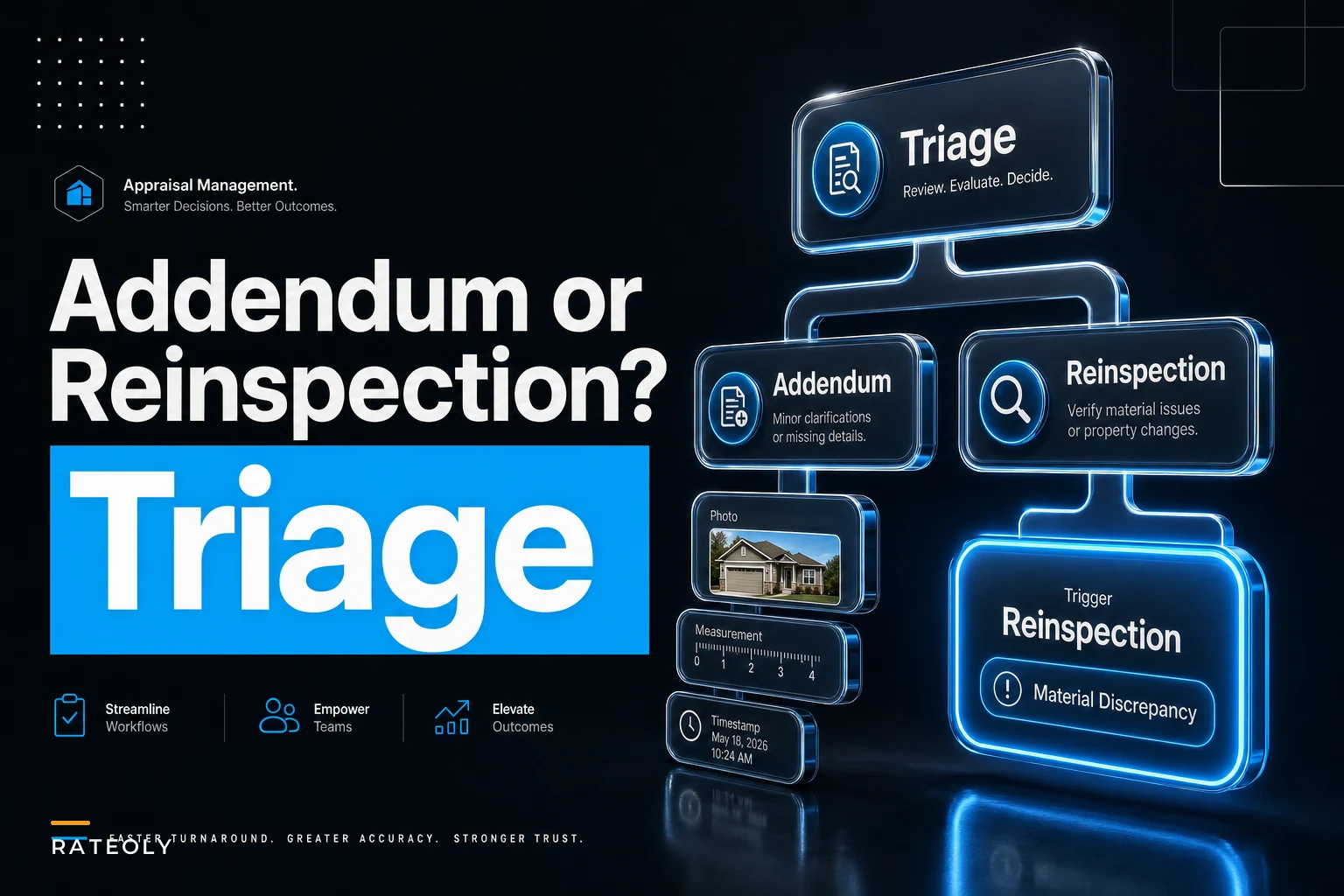

The messy part isn't the inspection itself. It's what happens two days later when the loan officer emails about a "new deck" that showed up in the seller's listing photos, or the borrower calls to say they finished the basement after you left. Now you're stuck: does this get handled with an addendum, or does it require a full trip back?
Get that wrong in either direction and it costs you. Slap an addendum on something that needed eyes on the property, and you've got a defensibility hole that surfaces in an audit or a complaint. Send an appraiser back out for something a simple statement could have covered, and you've burned a half-day of capacity plus mileage for nothing.
Most firms decide this ad hoc. One reviewer says addendum, another says re-inspect, and the standard shifts depending on who's covering the desk that afternoon. This post gives you a repeatable way to make the call, the minimum evidence each path requires, and wording you can drop straight into a report.
Start with what actually changed, not who's asking
The trap most shops fall into: they let the requester drive the decision. The lender pushes hard, so they re-inspect to keep the client happy. The borrower's annoyed and the deadline is tight, so they addendum it. Neither of those is a valuation reason.
The only thing that should drive the call is whether the new information affects something you physically observed or opined on — and whether you can support the change from evidence you already have or can obtain remotely with confidence.
-
Does the change affect the subject's physical characteristics, condition, or the basis of the value opinion? A corrected APN or a fixed typo in the legal description doesn't. A finished basement, a new roof, a foundation crack the borrower now mentions — those do.
-
Can the change be verified with documentation you can stand behind without re-observing the property? A permit, an invoice, a dated photo set from a trusted source, MLS data with a reliable date. If yes, an addendum may hold. If the only "evidence" is the borrower's word, it usually doesn't.
-
Would a reasonable reviewer expect the appraiser to have seen this in person to opine on it? This is the gut-check that keeps you out of trouble. If the answer is yes, no amount of paperwork substitutes for the trip.
Clear all three toward "addendum" and you're probably fine documenting it. If any one of them points toward re-inspection, that's your answer.
The decision matrix
Here's the framework laid out by change type. It's not exhaustive, but it covers the vast majority of what lands in your inbox after a report goes out.
Manage every appraisal with confidence and clarity.
Rateoly helps you coordinate inspections, generate reports, and communicate seamlessly with clients.
- Comprehensive appraisal tracking
- Automated client notifications
- Integrated scheduling & report management
No credit card required
| Trigger / change | Default path | Minimum evidence required | Hard re-inspection trigger? |
|---|---|---|---|
| Typo, clerical fix, corrected legal description or APN | Addendum | Source document confirming correct data | No |
| Comp swap or adjustment change (no subject change) | Addendum | Data source for new comp, updated grid | No |
| Cosmetic update (paint, fixtures) done before inspection but missed | Addendum | Dated photos from reliable source | No |
| New/finished square footage (basement, addition, attic conversion) | Re-inspect | N/A — physical measurement required | Yes |
| Roof, HVAC, or major system replacement claimed after inspection | Re-inspect or addendum with strong docs | Permit + invoice + dated photos; otherwise re-inspect | Conditional |
| Condition rating change (e.g., C4 → C3) | Re-inspect | N/A — condition is an observed opinion | Yes |
| Newly disclosed defect (foundation, water intrusion, mold) | Re-inspect | N/A — safety/soundness observation | Yes |
| Change to gross living area count or room count | Re-inspect | N/A — requires measurement/observation | Yes |
| Effective date change requested | Depends — often new assignment | Scope discussion with client | Usually |
| Photo missing or of poor quality (item was inspected) | Addendum | Re-supply from existing field capture | No |
| Photo missing for an item that was not captured | Re-inspect | N/A | Yes |
The pattern to notice: anything tied to a physical measurement or an observed condition opinion is a hard trigger. You can't paper over square footage or a condition rating with a document, because those are things you're certifying you personally assessed. That's the line that keeps reviewers and state boards satisfied.
Hard triggers that never get an addendum
These come up constantly and the temptation to shortcut them is real when a deadline's closing in:
-
Any change to gross living area or room count. Measurement is an appraiser function. A borrower saying "we have another bedroom now" is not measurement.
-
Any upward or downward condition rating change. Condition ratings are opinions formed from observation. If you rated C4 based on what you saw and someone claims it's now C3, you go look.
-
Newly disclosed material defects affecting safety, soundness, or habitability. Foundation issues, active leaks, suspected mold, missing safety systems. Even if the borrower "fixed it," you verify the current state.
-
Finished or added living area not present or accessible at inspection. A basement that was locked, an addition completed after your visit.
-
Anything where the missing evidence is because you didn't observe the item. If the reason you lack a photo is that you never saw it, a photo can't be added from thin air.
The mistake that shows up in complaint files: an appraiser accepts a permit and an invoice for a "new roof," issues an addendum raising value, and never confirms the roof actually exists in its claimed condition. A permit proves someone pulled a permit. It doesn't prove the work was completed correctly or at all. When that logic gets picked apart later, the addendum becomes the evidence against the file.
Minimum evidence for the addendum path
Thin documentation is where firms get burned on addenda. "The borrower confirmed" is not evidence. Set a floor and hold to it.
-
A verifiable source, not a claim. MLS with a reliable date, a recorded document, a permit record, a manufacturer invoice with dates.
-
Date anchoring. The evidence has to establish the condition as of your effective date, not just "at some point." A listing photo from three years ago tells you nothing about the effective date.
-
A chain you can reconstruct. If a reviewer asks where the corrected data came from, you should be able to point to it in seconds. This is the same discipline that makes files survive audits — the appraisal compliance and evidence framework approach applies directly here: every change needs a traceable source attached.
-
Consistency with the rest of the report. An addendum that contradicts your original photos or sketch without explanation is worse than no addendum. If something changed, say what and why explicitly.
A quick internal rule that works well: if you couldn't defend the addendum to a state investigator with the documents in the file today, it's not an addendum — it's a re-inspection you haven't done yet.
Sample wording for each path
Reviewers and clients respond to precise language. Vague addenda invite more questions; clear ones close the loop.
Clerical / data correction addendum: > "This addendum corrects the legal description reported on page [X]. The original entry contained a transcription error. The corrected legal description is [X], verified against [recorded deed / county assessor record], reference [document number]. This correction does not affect the physical characteristics of the subject or the value opinion, which remain as originally reported."
Comp or adjustment update addendum: > "This addendum revises the sales comparison approach to replace Comparable [#] with [new comp], sourced from [MLS #] with a settlement date of [date]. The revised adjustment grid is attached. No change to the subject's physical characteristics or effective date resulted from this revision."
Documented improvement, addendum-eligible (use only when docs meet the evidence floor): > "Subsequent to the original report, documentation was provided confirming [improvement] completed prior to the effective date of [date]. Supporting evidence includes [permit #, dated invoice, dated photographs from source]. This documentation confirms the condition present as of the effective date. [State whether value is affected and by how much.]"
Re-inspection required — client-facing response: > "The change described relates to [square footage / condition / a disclosed defect], which requires physical observation to opine on credibly. Documentation alone cannot support this revision under our standards. A re-inspection is required and has been scheduled for [date]. A revised report reflecting current observed conditions will follow."
That last one matters more than people expect. Clients accept a clear "here's why we're going back out" far more readily than a vague delay. Naming the specific reason — square footage, condition, defect — signals rigor rather than stalling.
A short real scenario
A three-appraiser shop in a suburban market was re-inspecting almost everything post-delivery, mostly out of caution. Their reviewer's default was "when in doubt, go back." It felt safe, but it was quietly eating capacity — roughly 6 to 9 unnecessary return trips a month, each one a half-day plus mileage.
After they put a written matrix in place and drew the hard-trigger line clearly, the change was mostly on the addendum side. Clerical fixes, comp swaps, and well-documented cosmetic items stopped generating field trips. Return inspections dropped to the ones that genuinely required eyes on the property — condition disputes, added square footage, disclosed defects.
The number that moved wasn't dramatic, but it added up: they recovered somewhere around 3 to 4 appraiser-days a month. More importantly, their re-inspection decisions became consistent across all three appraisers instead of depending on who caught the request. When an AMC pushed back on a "why didn't you just re-inspect" question, they had the matrix and the evidence trail to answer in one email.
When re-inspection is the wrong call
Re-inspecting isn't automatically the conservative, defensible choice. Going back out when a documented, date-anchored correction would suffice creates its own problems: you introduce a new observation date that may not match your effective date, you add cost the client didn't need to bear, and you can create inconsistencies between two site visits that a reviewer will ask about.
-
The change is purely clerical or data-based with a solid source.
-
The item was observed and documented at the original inspection and just needs a photo re-supplied.
-
A reliable, date-anchored document fully establishes the condition as of your effective date and the change doesn't touch measurement or a condition opinion.
Over-inspecting is a real failure mode, not a virtue. The goal is matching the response to what actually changed — not defaulting to the most expensive option to feel safe.
Where the photo trail feeds this decision
Half of these decisions come down to one question: did you capture it at inspection? If your field photo discipline is solid, the addendum path is available far more often, because you can re-supply or clarify from what you already have instead of driving back out. Weak photo coverage forces re-inspections that better field standards would have prevented. If that's a recurring problem, tightening field photo standards that pass lender review removes a big share of post-delivery scrambles before they start.
The connection is direct: the more completely you document at the property, the more post-delivery changes stay in addendum territory, and the fewer hard re-inspection triggers catch you off guard.
Making the call stick across the team
A matrix on paper only helps if everyone applies it the same way. A few operational habits keep it consistent:
Log the decision, not just the outcome.
-
Route hard triggers automatically. Any request touching square footage, condition, or a defect should never sit in a general queue where someone might addendum it to clear their inbox. Flag it for re-inspection scheduling on arrival.
-
Set the evidence floor once and enforce it. Don't renegotiate what counts as sufficient documentation on every file. The floor should be the same on a slow Tuesday as on a deadline Friday.
-
Firms that manage post-delivery changes inside their workflow system — where each change request forces a trigger classification and attaches its evidence before the file can move — end up with this consistency almost automatically. The point isn't the tooling; it's that the decision gets made against the same rule every time, and the trail exists whether or not anyone remembers to build it.
The core idea is simple enough to hold in your head: physical measurement and observed condition can't be papered over; verifiable data corrections usually can. Everything in the matrix flows from that one distinction. Get that line right, document which side of it each change falls on, and the "addendum vs re-inspection" question stops being a judgment call that shifts with whoever's at the desk.
The diagram below shows the decision workflow for classifying post-delivery changes.
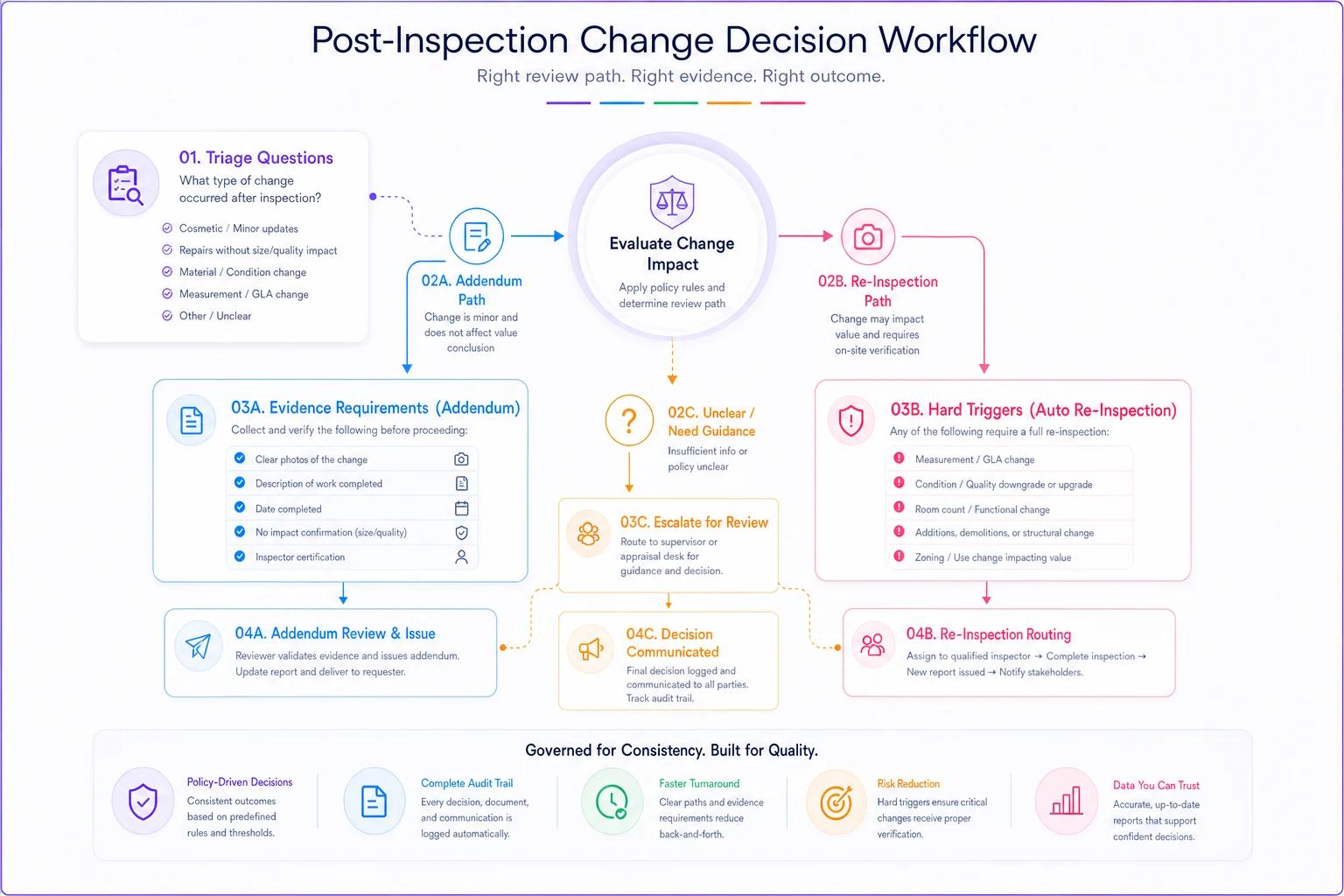
Make the line explicit, attach the evidence, and the decision becomes defensible rather than discretionary.
The core idea is simple enough to hold in your head: physical measurement and observed condition can't be papered over; verifiable data corrections usually can. Everything in the matrix flows from that one distinction. Get that line right, document which side of it each change falls on, and the "addendum vs re-inspection" question stops being a judgment call that shifts with whoever's at the desk.
Ready to elevate your appraisal operations?
Join 500+ appraisal firms using Rateoly to enhance accuracy, save time, and improve client satisfaction.