



Most E&O claims against appraisal firms don't start in the valuation. They start weeks earlier, at intake — when someone accepts an assignment they shouldn't have, takes a phone call they should have logged, or signs an engagement letter that quietly shifted all the liability onto the appraiser. By the time the actual number is in dispute, the independence problem is already baked into the file.
That's the uncomfortable part. Firms spend enormous energy defending the valuation methodology when the real exposure was an unreturned voicemail from a loan officer, a vague scope of work, or a disclosure that was never documented. The number might be perfectly defensible. The process around the number is what hangs you.
This is a systems article, not a tips list. The goal is to show how intake, independence screening, disclosures, evidence capture, escalation, and contract language all connect into one chain — and where that chain tends to snap as a firm grows from two appraisers to twenty.
Why independence fails quietly instead of loudly
Independence violations are rarely dramatic. Nobody calls up and offers a bribe. What actually happens is far more mundane, which is exactly why firms miss it.
A borrower's agent "just wants to make sure you saw the recent comps." An AMC coordinator adds a note that the deal "needs to come in around the contract price to close on time." A loan officer the owner has known for fifteen years sends a text asking for a "quick favor" on turn time. None of these are inherently fatal. But each one is a pressure point, and the exposure comes from whether the firm has a repeatable way to recognize, log, and respond to them.
In real operations, this breaks down for a predictable reason: the person receiving the pressure is usually not the person who owns the risk. An intake coordinator earning a modest hourly wage is not going to push back on a long-time client generating a third of the firm's volume. They'll absorb the pressure, smooth it over, and move the order forward. The owner never hears about it. That silence is the failure.
Firms with strong independence culture don't rely on good judgment in the moment. They remove the judgment call entirely by scripting the response. When a coordinator knows exactly what to say and exactly where to log it, the pressure stops being a decision and becomes a procedure.
The intake independence check: where the whole chain begins
Every assignment should pass through an independence screen before anyone opens a cost approach. Not a vague "does this feel okay" gut check — an actual gated step with defined questions and a defined outcome.
Manage every appraisal with confidence and clarity.
Rateoly helps you coordinate inspections, generate reports, and communicate seamlessly with clients.
- Comprehensive appraisal tracking
- Automated client notifications
- Integrated scheduling & report management
No credit card required
Here's the core logic as a decision flow you can adapt:
-
Relationship check. Does anyone at the firm have a personal, financial, or prior business relationship with the borrower, buyer, seller, agent, or property? If yes → disclose and route to review before acceptance.
-
Party-of-interest check. Is the request coming from a party prohibited from influencing value (loan production staff, borrower, agent, anyone paid on commission tied to closing)? If yes → the order does not get accepted through that channel. It gets redirected to a compliant ordering party.
-
Prior-assignment check. Has the firm appraised this property in the last few years? If yes → flag for consistency review and note the prior file.
-
Scope-and-value pressure check. Did the order include any target value, "needs to hit," predetermined conclusion, or conditioned fee? If yes → stop, document verbatim, escalate immediately.
-
Fee independence check. Is the fee contingent on the outcome, direction, or value opinion? If yes → decline. No exceptions.
The mistake most firms make is treating this as a one-time onboarding form. Independence is not a static attribute of a client — it's an attribute of each assignment. The same AMC that sends clean orders for months can slip a pressure note into order #400. The screen has to run every time, not once.
As a firm scales, this is the first thing to break. At two people, the owner sees every order. At twelve people, orders flow through three coordinators and nobody's reading the special-instructions field with a compliance eye. The screen that lived in someone's head has to become an actual gate in the workflow, with a recorded pass/fail on every file.
Visualizing the intake decision as a simple gated workflow makes it easier to build into your order management system.
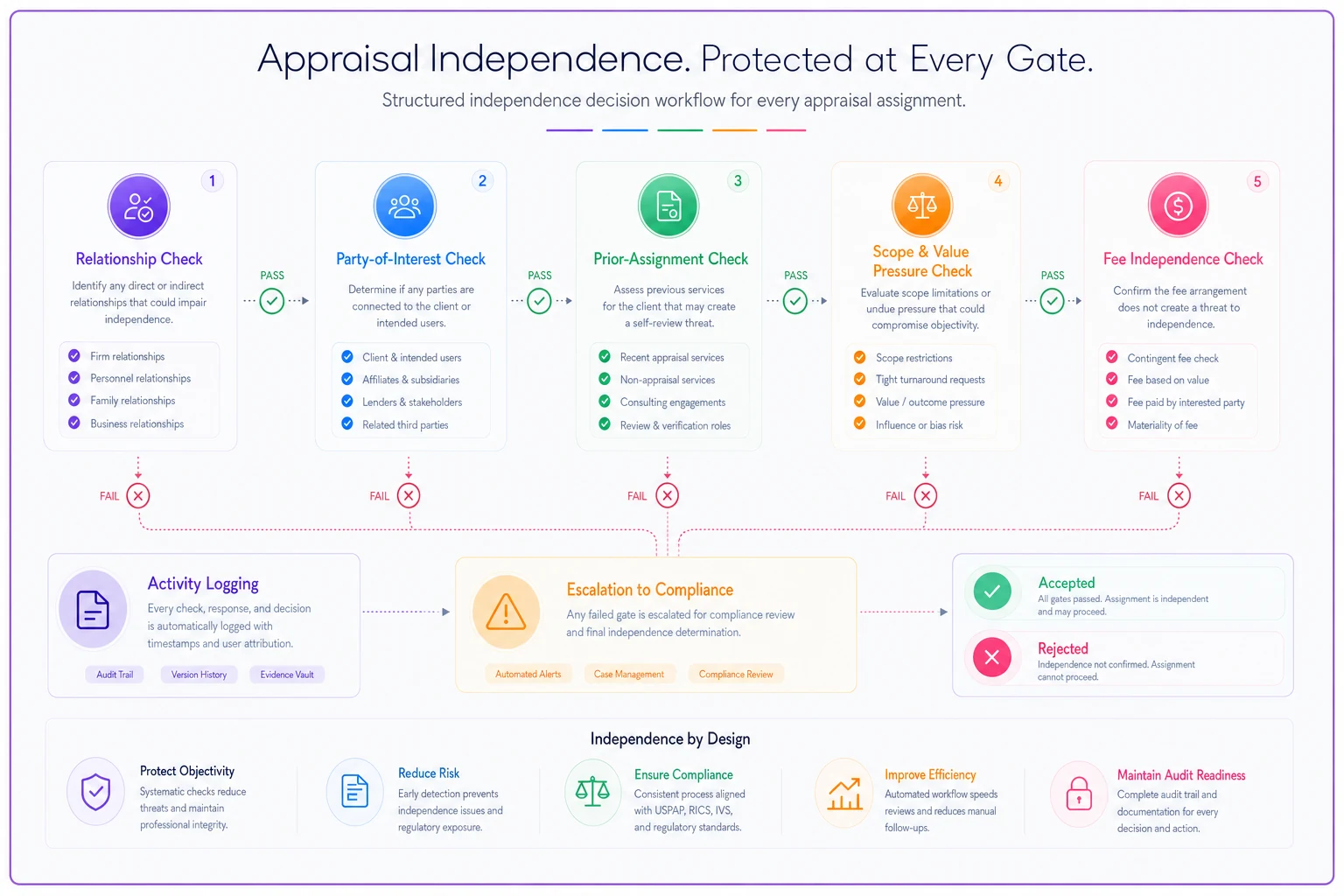
This diagram maps the decision points and the logging/escalation actions.
Disclosure templates: say it once, say it the same way every time
Disclosures are where good intentions die from inconsistency. One appraiser discloses a prior relationship in a thorough paragraph. Another mentions it in a single vague sentence. A third forgets entirely because they "handled it verbally with the client." Three different exposure levels on three similar files.
The fix is a small library of standardized disclosure blocks that get pulled in based on the intake screen results. You want pre-written, reviewed language for the situations that actually recur:
-
Prior services on the subject property within the lookback period
-
Personal or business relationship with a party to the transaction
-
A geographic or property-type competency disclosure when stretching outside a core area
-
Extraordinary assumptions and hypothetical conditions tied to access or data gaps
-
Disclosure of any scope limitations requested by the client
The operational insight here: disclosures should be triggered by the intake answers, not drafted from scratch at report time. If the relationship check flagged a prior appraisal, the corresponding disclosure block should already be attached to the file before the appraiser starts writing. When disclosure is a downstream manual task, it gets skipped under deadline pressure. When it's an upstream automatic attachment, it just happens.
A concrete example: a firm doing around 60–80 orders a month standardized six disclosure blocks. Within a couple of months, the "missing or inconsistent disclosure" category basically disappeared from their internal QC exceptions — not because appraisers got more careful, but because the language was already in the file waiting for them.
Building the insurer-ready evidence pack
When an E&O claim lands, your carrier and defense counsel will ask for the file. What they actually want is not just the report — it's proof of process. Proof that you screened for independence, documented the scope, captured the data, and handled any pressure correctly. A firm that can hand over a clean, organized evidence pack on day one is in a dramatically better defensive position than one scrambling to reconstruct what happened eighteen months ago.
An insurer-ready evidence pack should include, per assignment:
-
The signed engagement letter with scope of work, intended use, and intended users clearly stated
-
The intake independence screen results showing the file passed, with timestamps and who ran it
-
Communication logs — every inbound request, instruction, and note from ordering parties, especially anything flagged as pressure
-
The disclosure blocks that applied, as they appeared in the delivered report
-
Data and comp provenance — where the comparables came from, what was verified, and how
-
Any escalation records — if something was flagged, what happened next and who signed off
-
The final report and delivery confirmation with a timestamp
Keep a dated, read-only snapshot of the evidence pack at delivery so the contemporaneous trail can't be altered later.
The reason this matters more than people expect: memory is a terrible defense. Eighteen months after delivery, your appraiser won't remember the exact wording of a phone call. A contemporaneous log entry carries real weight. Carriers notice the difference between a firm that documents in real time and one that documents in hindsight.
This connects directly to how you archive and secure files in the first place. If your access controls and logging are weak, your evidence pack is only as trustworthy as your weakest permission setting. It's worth pairing this with a solid role-based access and lightweight logging approach so that the evidence trail itself can't be quietly altered — a file that could have been edited by anyone is a file a plaintiff's attorney will happily pick apart.
Escalation paths: the part nobody designs until it's too late
Here's a question most firms can't answer cleanly: when a coordinator receives an order with a target value in the instructions, what exactly happens in the next ten minutes?
If the answer is "they'd probably tell someone," you don't have an escalation path. You have a hope.
A real escalation path defines three things: the trigger, the route, and the authority. Who gets notified, how fast, and who has the power to decline the assignment. Without these, pressure situations get resolved by whoever is most conflict-averse, which is almost never the right person.
| Trigger event | Who handles it | Required action | Documented where |
|---|---|---|---|
| Target value / "needs to hit" in instructions | Owner or designated compliance lead | Decline or sanitize order; preserve original instruction verbatim | Evidence pack + communication log |
| Borrower/agent attempting to influence value | Assigned appraiser → compliance lead | Log contact, respond with scripted language, no scope change | Communication log |
| Prior relationship surfaces mid-assignment | Intake lead | Disclose, review, decide on withdrawal if needed | Disclosure block + file note |
| Fee pressure tied to outcome | Owner only | Decline assignment | Declined-orders register |
| Unusual client pressure on turn time affecting quality | Operations lead | Document, assess, communicate realistic timeline | SLA/exception log |
The pattern that separates firms that handle this well: escalation is fast and boring. The coordinator doesn't debate. They forward the flagged order to one named person and move on. The decision sits with someone who owns the liability and can afford to say no. The slower and more negotiable the escalation, the more likely pressure wins.
What breaks at scale is ownership diffusion. In a small shop, the owner is the escalation path. At thirty people across two offices, "escalate to the owner" means an order sits in limbo for two days while the owner is in the field. Growing firms need a named compliance role — not necessarily full-time, but a specific person with specific authority — before the volume outruns the founder's inbox.
Contract clauses that actually reduce exposure
Engagement letters and AMC agreements are where firms silently accept risk they never intended to. The clauses matter, and most small firms are using whatever template an AMC handed them years ago — which, unsurprisingly, is written to protect the AMC.
A few clause categories worth getting right, in plain terms:
-
Scope of work and reliance. State clearly what the appraisal is and isn't, who may rely on it, and that third parties outside the named intended users may not. Loose reliance language is how a firm ends up defending a report against a party it never agreed to serve.
-
Limitation of liability. Where permitted, cap liability to the fee or a defined amount. This isn't bulletproof, but it meaningfully changes the economics of a nuisance claim.
-
Independence affirmation. A clause confirming the engagement contains no predetermined value, no contingent fee, and no prohibited influence — signed by the ordering party. This flips the independence obligation back onto the client in writing.
-
Indemnification balance. Watch for one-sided indemnity clauses that make you cover the client's losses. Push for mutual or at least limited indemnification.
-
Data and confidentiality terms. Define how borrower data is handled and who's responsible for breaches. This ties directly into your retention and PII obligations.
The insight most owners miss: contract clauses and intake screens have to agree with each other. If your engagement letter affirms independence but your intake process has no way to catch a target-value instruction, the clause is a liability, not a shield — you've documented a promise your process can't keep. The paperwork and the workflow need to tell the same story.
When tightening clauses makes sense — and when it backfires
Aggressively limiting liability is smart for high-volume, standardized work with thin margins. It's a worse idea when you're trying to win a relationship with a selective client who reads every clause and interprets aggressive terms as a red flag. For high-value, low-volume specialty work, the better move is usually strong scope definition and documentation rather than hard liability caps that scare off the client. Match the contract posture to the channel.
A real scenario: where the chain held
A three-appraiser firm in a mid-size market was running close to 70 orders a month, most through two AMCs and a handful of direct lender relationships. They'd had a scare — a near-claim where a loan officer had pushed on a value and the appraiser had handled it fine, but there was almost no record of it. The only proof was the appraiser's recollection.
They rebuilt intake around a gated independence screen, attached disclosure blocks to the screen results, and gave their office manager a single, scripted escalation route to the owner for any pressure flag. Nothing fancy. The whole thing lived in their existing workflow with a few required fields and a running communication log.
Over the next several months, the screen caught two orders with soft target-value language in the instructions — both from a newer AMC. Instead of quietly proceeding, the coordinator flagged both, the owner sanitized one order and declined the other, and every step was logged. When that same AMC later disputed an unrelated valuation, the firm handed over a clean evidence pack showing a documented pattern of the AMC pushing values and a documented pattern of the firm refusing. The dispute evaporated in days instead of escalating.
The cost of the change was modest — mostly a few hours of process design and some discipline in the first month. The payoff wasn't a dramatic revenue jump. It was that two risky orders got handled correctly instead of slipping through, and the firm could prove it did everything right. In E&O terms, that's the entire game.
How these pieces hold together as one system
None of these controls works alone. An independence screen with no escalation path just generates flags nobody acts on. Escalation with no documentation produces decisions you can't prove. Disclosure templates with no intake trigger sit unused. Contract clauses that your workflow can't back up become admissions.
The system works when intake feeds disclosures, disclosures feed the evidence pack, pressure feeds escalation, and escalation feeds the record — all of it landing in a file your carrier would be happy to defend. Each step closes the gap the next step depends on.
This is also why E&O exposure tends to spike at exactly the growth stage where firms feel most successful. More volume, more coordinators, more clients, more channels — and the owner's informal oversight, which quietly held everything together at small scale, simply can't be everywhere anymore. The controls that were in the founder's head have to become visible, gated steps in the workflow, or the exposure grows faster than the revenue.
If you're building this out, it's worth connecting it to a broader compliance and evidence framework so your independence controls aren't a separate silo but part of how the firm documents everything it does.
The firms that stay out of trouble aren't the ones with the best appraisers. They're the ones whose process makes the right thing the default — and leaves a clean trail proving it happened.
Ready to elevate your appraisal operations?
Join 500+ appraisal firms using Rateoly to enhance accuracy, save time, and improve client satisfaction.