


Most platform demos look great. The sales engineer walks through a polished order lifecycle, the mobile app loads instantly on hotel WiFi, and the billing dashboard shows a clean monthly reconciliation. Then you sign, migrate 400 active orders, and discover the webhook for appraiser status changes fires inconsistently, the mobile app loses photos when a field appraiser drops to one bar in a rural subdivision, and your accounting team spends the last three days of every month chasing line‑item mismatches between what the platform billed and what your lenders were invoiced.
An appraisal platform comparison for AMCs that only scores UI and "features" misses the stuff that actually determines whether the system survives contact with real volume. This guide focuses on four procurement‑critical capabilities — integration/API maturity, evidence audit trails, offline mobile sync, and automated billing — and gives you measurable criteria, a shortlist to evaluate, the trade‑offs nobody mentions in the demo, and a pilot plan you can run in six weeks.
This is written for mid‑size AMCs. Roughly 15–80 internal staff, a panel of a few hundred to a couple thousand appraisers, monthly order volume somewhere between 1,500 and 12,000. At that scale, the wrong platform choice doesn't just annoy people — it adds a full‑time coordinator's worth of manual reconciliation and exception chasing you didn't budget for.
Start With Measurable Criteria, Not Feature Checklists
The single biggest mistake in platform evaluation is scoring "does it have X" instead of "how well does X hold up under our load." A vendor can truthfully check "API available" when the API is read‑only, undocumented, and rate‑limited to the point of uselessness.
Here's how to make each of the four capabilities measurable before you ever sit through a demo.
Integration / API maturity
-
Coverage What percentage of the order lifecycle is writable via API, not just readable? You want to create orders, reassign, update status, upload documents, and pull the full audit log — all programmatically.
-
Webhook reliability Does it push events (status change, document uploaded, inspection complete), or do you have to poll? If webhooks exist, ask about retry policy and delivery guarantees. "At‑least‑once with exponential backoff" is a good answer. Silence is a bad one.
-
Documentation age and completeness Ask for a link to live API docs. If they send a PDF from 2021, that tells you how much the API is actually maintained.
-
Rate limits and sandbox A real sandbox you can hit without a sales call is a strong signal. Published rate limits (e.g., "600 requests/min per token") mean someone has thought about scale.
-
MISMO support For lender‑facing work, native MISMO 2.6/XML export maturity matters. Ask which version and whether it's certified against the GSE UCDP/EAD paths.
A clean measurable target: 90%+ of your daily operational actions should be doable through the API without logging into the UI.
Evidence audit trails
-
Per‑artifact hashing Is each photo, video, and document hashed (SHA‑256 or better) at capture or at upload? Capture‑time is stronger.
-
Timestamp source Is the timestamp from the device (spoofable) or anchored to a server/trusted time source at receipt?
-
Geo integrity Is GPS captured and bound to the photo's hash, so a photo can't be silently swapped for one taken elsewhere?
-
Immutability Once an evidence record is written, can anyone — including an admin — edit or delete it without leaving a trace? The correct answer is no; corrections append, they don't overwrite.
-
Exportable chain Can you export the hash manifest and verify it independently later? If the audit trail only lives inside the vendor's UI, it's not defensible in a dispute.
Measurable target: every piece of field evidence has a capture‑time hash, a server‑anchored timestamp, and a geo tag, all exportable in a verifiable manifest.
Offline mobile sync
-
Resumable uploads If a 40‑photo set is 60% uploaded and the connection drops, does it resume from 60% or restart from zero?
-
Conflict resolution If an appraiser edits an order offline while a coordinator edits the same order in the office, what happens on sync? Last‑write‑wins silently? Merge? Flag for review? Silent overwrites quietly destroy field data.
-
Bandwidth controls Can the app defer large video uploads to WiFi, compress on cellular, and let the appraiser control it?
-
Queue visibility Can the appraiser see what's pending upload and confirm it actually landed server‑side?
The mechanics here deserve real attention — we went deep on the patterns that prevent silent data loss in offline‑first mobile workflows and conflict resolution for appraisers, and it's worth reading before you evaluate any mobile app.
Measurable target: a 50‑photo inspection with two forced connection drops uploads completely, in order, with zero manual re‑entry, and surfaces any conflict rather than silently resolving it.
Automated billing
-
Usage/event billing Can it bill per event (order completed, rush fee applied, re‑inspection) rather than flat monthly estimates?
-
Reconciliation Does it match appraiser payouts, client invoices, and platform fees against actual completed orders, and flag the mismatches?
-
Invoice automation Can it generate and send client invoices on your schedule with your line‑item format, and handle split billing and surcharges?
-
Exportable ledger Clean export to your accounting system (QuickBooks, NetSuite, etc.) without a fragile CSV dance.
Measurable target: month‑end reconciliation takes hours, not days, and discrepancies auto‑surface instead of being discovered by a client complaint.
A Compact Shortlist Worth Evaluating
No single platform wins all four categories, which is the whole point.
Manage every appraisal with confidence and clarity.
Rateoly helps you coordinate inspections, generate reports, and communicate seamlessly with clients.
- Comprehensive appraisal tracking
- Automated client notifications
- Integrated scheduling & report management
No credit card required
Here's a practical shortlist spanning the categories mid‑size AMCs usually land on. Treat these as archetypes to pressure‑test, not endorsements.
| Platform type | Typically strong in | Usually weaker in | Best fit |
|---|---|---|---|
| Established AMC suites (Mercury Network / Anow‑style incumbents) | API breadth, lender/MISMO integration, billing maturity | Mobile sync feel, modern webhook support | High lender‑integration needs, large panels |
| Modern mobile‑first platforms | Offline sync, evidence capture, geo/photo integrity | Deep billing automation, legacy lender connectors | Field‑heavy, inspection‑intensive volume |
| Workflow/ops platforms with appraisal modules | Automation, event‑driven billing, API webhooks | Appraisal‑specific compliance depth | AMCs wanting custom automation |
| Enterprise valuation platforms | Audit trails, compliance, reconciliation | Speed/cost of integration, agility | Regulated, audit‑heavy environments |
| SoftWorks‑style configurable platforms | Offline‑first sync, evidence hashing, API/webhook flexibility | Smaller brand footprint, fewer prebuilt lender connectors | AMCs needing custom workflows without heavy dev |
The move is not to pick the row that looks best on paper. Score each candidate against your volume on the four measurable targets above, then weigh the trade‑offs below.
Who Typically Leads Each Capability — and Why
API maturity tends to favor the established suites. They've had years of lender pressure forcing them to build writable order APIs and MISMO pipelines. The catch: their APIs often reflect their age — SOAP‑era patterns, polling instead of webhooks, documentation that assumes you already know the quirks. Modern ops platforms and configurable platforms frequently have cleaner REST/webhook designs but fewer prebuilt lender connectors, meaning you trade elegance for more integration work on the lender side.
Evidence audit trails are strongest where compliance was a founding requirement, not a bolt‑on. Enterprise valuation platforms and newer platforms built around field capture tend to hash at capture time and anchor timestamps server‑side. Older suites often treat photos as attachments with metadata rather than hashed, tamper‑evident artifacts — fine until a value is disputed and you need to prove a photo wasn't swapped.
Offline mobile sync is where mobile‑first and configurable platforms pull ahead. This capability is genuinely hard to retrofit. A platform that started as a web app with a mobile wrapper almost always has weaker resumable uploads and conflict handling than one architected offline‑first. You can usually tell within ten minutes of a field test: put the phone in airplane mode mid‑upload and watch what happens.
Automated billing favors the established suites and ops platforms. Event billing and reconciliation require a mature data model tying orders, fees, payouts, and invoices together. Mobile‑first newcomers often have thin billing and expect you to export to a separate system — workable, but it reintroduces the manual reconciliation you were trying to eliminate.
The pattern holds: the platform that's excellent at field capture is rarely the one that's excellent at back‑office billing, because those teams optimized for different users. Your job is deciding which weakness you can live with.
The Trade‑Offs Nobody Covers in the Demo
Speed of integration vs. out‑of‑the‑box features
A platform with rich prebuilt lender connectors gets you live faster but boxes you into their data model. A flexible API‑first platform takes longer to wire up but bends to your workflow. Realistically, prebuilt connectors save you roughly 4–8 weeks of integration work upfront, but cost you flexibility every time a lender changes their requirements and you're waiting on the vendor's roadmap.
Security/tamper‑evidence vs. mobile performance
Capture‑time hashing and high‑res evidence are heavier on the device and the upload pipe. A platform that hashes every photo at capture and uploads full resolution will feel slower in a dead zone than one that compresses aggressively and hashes later. The strong platforms make this configurable — you choose per‑assignment whether evidence integrity or upload speed wins. The weak ones pick for you and don't tell you.
Billing automation vs. edge‑case flexibility
Highly automated billing assumes your fee structures fit the model. The moment you have a one‑off split‑fee arrangement with a lender, rigid automation becomes a fight. Look for a platform that automates the 90% and lets you manually override the 10% without breaking reconciliation.
Breadth vs. depth
The suite that does everything adequately versus the specialist that does one thing exceptionally. For most mid‑size AMCs, the right answer is a strong core platform plus a willingness to integrate one specialist tool where the core is weakest — usually mobile capture or billing.
When a Replatform Actually Makes Sense (and When It Doesn't)
It makes sense when: your month‑end reconciliation consistently takes more than two days, you're losing field evidence or getting disputes you can't defend, or your current system can't push webhooks and your team is manually re‑keying lender status into a second system.
It's a bad idea when: your pain is really a process problem wearing a software costume. If your exceptions come from inconsistent intake or appraiser instructions, a new platform won't fix that — it'll just automate the mess faster.
Who should NOT do this right now: AMCs mid‑way through a major lender onboarding, or shops with no one who can own the integration work for 6–8 weeks. A replatform during a volume spike is how you lose both the project and some clients.
A Real Scenario
A mid‑size AMC running around 3,800 orders a month was on an older suite with solid lender integration but no real webhook support and thin billing automation. Two coordinators spent a meaningful chunk of each day re‑keying appraiser status updates into the lender portals, and month‑end reconciliation ran three to four full days because platform fees, appraiser payouts, and client invoices lived in three places that never quite agreed.
They didn't rip everything out. They kept the lender‑facing suite and added a configurable platform to handle field capture and event‑driven billing, wired together over webhooks. After roughly two months, status re‑keying mostly disappeared because events pushed automatically, and reconciliation dropped to under a day with discrepancies surfacing on their own instead of showing up as client complaints. Field evidence disputes also got easier to defend once photos were hashed and geo‑bound at capture.
The numbers weren't dramatic in a press‑release way. It was closer to recovering most of one coordinator's time and cutting a few thousand dollars a month in billing leakage from missed rush fees and uninvoiced re‑inspections. For an AMC at that volume, that's the difference between the platform paying for itself and being another line item.
Ready‑to‑Use RFP Checklist
Send this verbatim.
-
[ ] Provide live, public API documentation and a self‑serve sandbox.
-
[ ] List every order‑lifecycle action available via API (create, assign, reassign, status, upload, audit pull).
-
[ ] Confirm webhook support, event list, retry policy, and delivery guarantee.
-
[ ] State published rate limits per token.
-
[ ] Confirm MISMO version supported and GSE path certification.
-
[ ] Describe evidence hashing
algorithm, capture‑time vs. upload‑time, and what's hashed.
-
[ ] Confirm timestamp source and whether it's server‑anchored.
-
[ ] Confirm geo data is bound to the evidence hash.
-
[ ] Confirm audit records are append‑only and independently exportable/verifiable.
-
[ ] Describe resumable upload behavior after connection loss.
-
[ ] Describe conflict resolution when the same order is edited offline and online.
-
[ ] Confirm bandwidth controls (WiFi deferral, compression options, queue visibility).
-
[ ] Describe event/usage billing capabilities and manual override handling.
-
[ ] Describe reconciliation across payouts, invoices, and fees, and how mismatches surface.
-
[ ] Confirm accounting system export format and process.
-
[ ] Provide two reference AMCs at similar volume.
The quality of the answers tells you as much as the answers themselves.
The 5×5 Scoring Matrix
Score each shortlisted platform 1–5 on the five dimensions below, then weight to your priorities. The fifth row — total cost and support — keeps you honest about what you'll actually live with.
| Dimension | 1 (Poor) | 3 (Adequate) | 5 (Excellent) |
|---|---|---|---|
| API maturity | Read‑only, no docs | Writable, polling only | Full writable + reliable webhooks |
| Evidence audit trail | Metadata only | Upload‑time hash | Capture‑time hash + geo + exportable |
| Offline sync | Restarts uploads, silent overwrites | Resumable, basic conflict flags | Resumable + explicit conflict review |
| Billing automation | Manual export only | Partial automation | Event billing + auto reconciliation |
| TCO & support | Hidden fees, slow support | Clear pricing, standard support | Transparent TCO, responsive, named contact |
Multiply each score by your weight (e.g., if offline sync matters most to your field‑heavy operation, weight it 3×). The highest weighted total is your lead candidate — but only pilot the top two, never commit off the matrix alone.
Implementation Milestones
Work through these in order.
-
Weeks 0–2 Finalize data model mapping, confirm lender connector requirements, provision sandbox.
-
Weeks 2–4 Build and test the top three API/webhook integrations. Verify event delivery under simulated load.
-
Weeks 4–5 Field‑test the mobile app with 3–5 real appraisers in known dead zones. Force connection drops.
-
Weeks 5–6 Run parallel billing on one week of real volume. Reconcile against your current system line by line.
-
Week 6+ Go/no‑go review against the measurable targets, then phased migration by client, not all at once.
Skipping ahead, especially on the field testing, is how pilots fail.
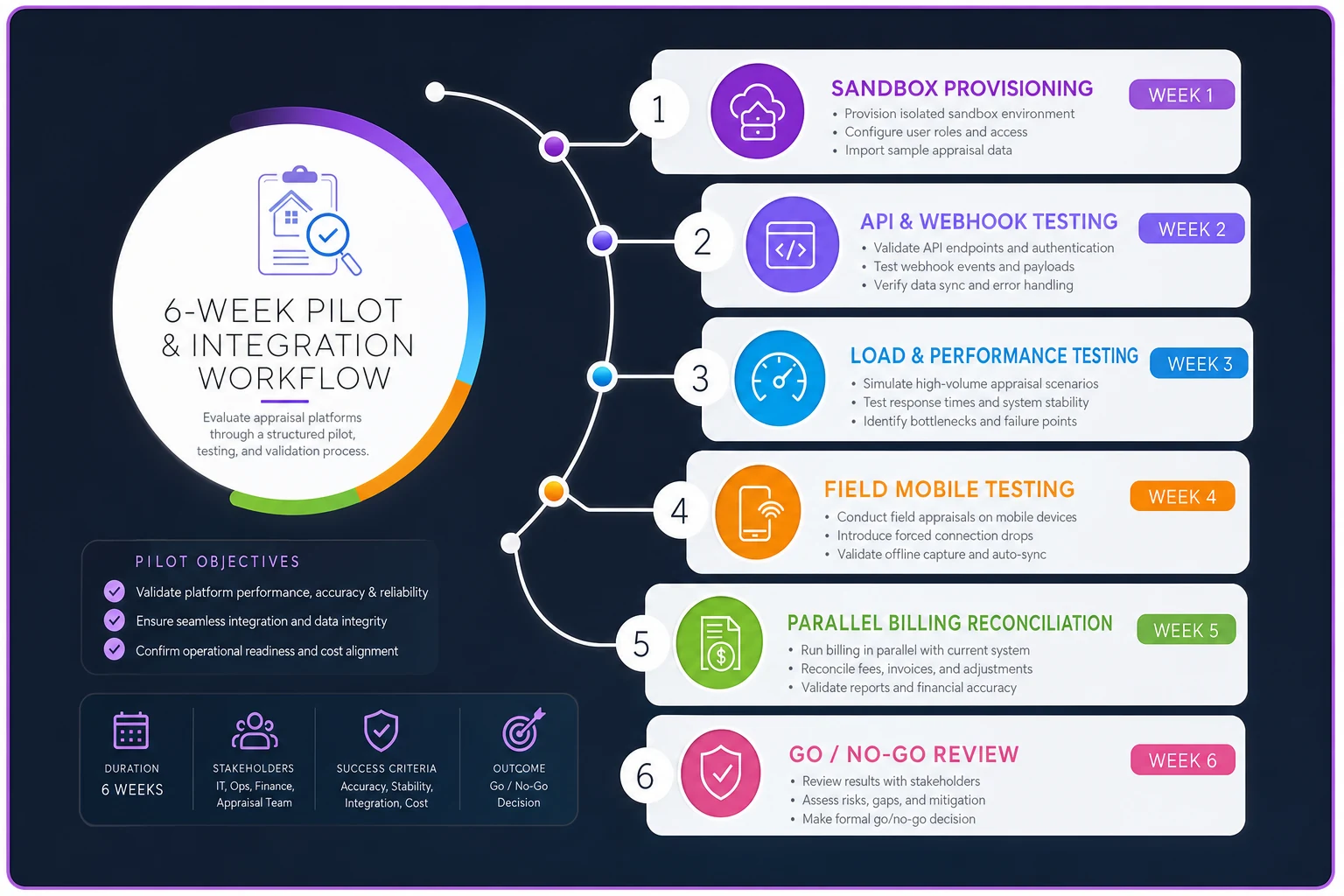
A simple visual of the six‑week flow helps align teams on who owns each step and when the go/no‑go decision happens.
Recommended Pilot Plan
Run a six‑week pilot on a contained slice: one or two lender clients, 150–300 real orders, and a handful of appraisers who actually work rural territory. The goal isn't to prove the platform works in the demo environment — it's to break it on purpose.
-
Force the airplane‑mode upload test on every mobile candidate.
-
Push one full week of events through webhooks and count missed or duplicated deliveries.
-
Run real billing in parallel and measure reconciliation time and discrepancy count against your current baseline.
-
Have your compliance person independently verify an exported evidence manifest.
Force the airplane‑mode upload test on multiple devices to surface inconsistent resumable upload behavior.
A platform that survives a deliberately hostile six‑week pilot will survive production. One that only shines in the sales demo won't.
Final Thought
The right appraisal platform comparison for AMCs isn't about which vendor has the longest feature list — it's about which one holds up when an appraiser is in a dead zone with a 50‑photo multi‑family set, when a lender changes their status requirements, and when it's the 30th and someone has to close the books. Score those four capabilities with real numbers, pilot the top two against hostile conditions, and let the trade‑offs you can actually live with decide it. The demo is the easy part. Procurement is about everything that happens after.
Ready to elevate your appraisal operations?
Join 500+ appraisal firms using Rateoly to enhance accuracy, save time, and improve client satisfaction.