



Most appraisers develop their comp selection instincts over years of fieldwork. But when a lender challenges your choices or an underwriter questions why you picked one property over another, those instincts don't translate into defensible documentation. You need a systematic approach that produces consistent results and clear justification.
The playbook I'm sharing here comes from analyzing thousands of suburban appraisal reports and the revision requests they triggered. It's not about following rigid rules—it's about creating a transparent scoring system that captures what experienced appraisers already do intuitively, then documenting it in a way that satisfies review requirements.
Why traditional comp selection breaks down
The core issue isn't finding comparables. MLS systems give you plenty of options. The problem is documenting why you chose specific properties and how you weighted different factors. Without a clear framework, you end up with:
Reviewers questioning your geographic boundaries when you select a comp from 0.8 miles away instead of one from 0.3 miles. You know the closer property backs to a commercial strip while the farther one shares the subject's quiet residential setting—but that reasoning isn't captured anywhere in the report.
Underwriters flagging inconsistent adjustments because your selection logic shifts between reports. One report prioritizes age similarity, another emphasizes square footage matching, with no documented rationale for the difference.
Quality control rejections when junior appraisers can't replicate senior judgment. They select technically similar properties that miss crucial market factors because the selection criteria live in someone's head rather than a documented process.
Building a reproducible comp suitability scorecard
A functional scorecard needs to balance multiple property characteristics while staying simple enough for consistent field use. Here's the framework that works across most suburban markets:
Manage every appraisal with confidence and clarity.
Rateoly helps you coordinate inspections, generate reports, and communicate seamlessly with clients.
- Comprehensive appraisal tracking
- Automated client notifications
- Integrated scheduling & report management
No credit card required
Primary Scoring Factors (0–40 points total):
-
Location Match (0–10 points) - Same subdivision
10 points - Adjacent subdivision, similar market position: 8 points - Within 0.5 miles, comparable neighborhood: 6 points - 0.5–1.0 miles, similar demographics: 4 points - Over 1 mile or different school district: 0–2 points
-
Physical Similarity (0–10 points) - GLA within 10%
10 points - GLA within 15%: 8 points - GLA within 20%: 6 points - GLA within 25%: 4 points - GLA over 25% different: 0–2 points
-
Age/Condition Alignment (0–10 points) - Built within 5 years, same condition rating: 10 points - Within 10 years, similar updates: 8 points - Within 15 years, comparable effective age: 6 points - Within 20 years, adjusted for renovation: 4 points - Over 20 years different: 0–2 points
-
Sale Recency (0–10 points) - Within 30 days
10 points - 31–60 days: 8 points - 61–90 days: 6 points - 91–180 days: 4 points - Over 180 days: 0–2 points
Secondary Scoring Adjustments (–5 to +5 points each):
-
- Same architectural style
+3 points
-
- Similar lot size (within 20%)
+3 points
-
- Matching site influences (corner lot, cul-de-sac)
+2 points
-
- Comparable garage configuration
+2 points
-
- REO/short sale/estate sale
–5 points
-
- Across major traffic barrier
–3 points
-
- Different buyer pool (FHA vs. conventional)
–3 points
The exact point values aren't sacred—you'll adjust based on your local market. What matters is having a documented system that produces consistent selections and clear audit trails.
Stepwise adjustment logic with narrative justification
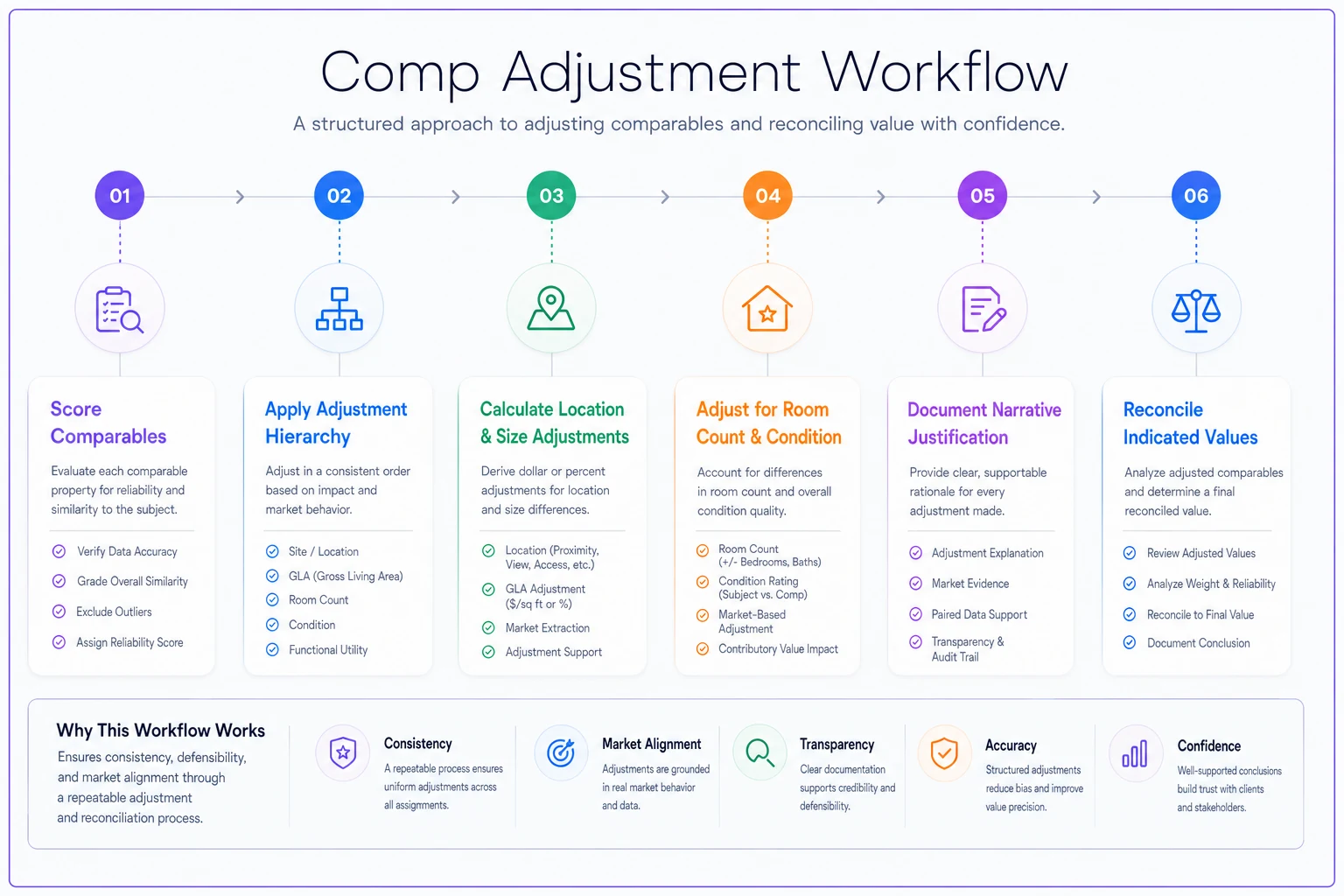
Once you've scored and selected comparables, you need reproducible adjustment methodology. Here's the stepwise process with ready-to-use narrative snippets:
Start with adjustments that have the clearest market support, then work toward more subjective factors. The hierarchy typically follows:
-
Site/location adjustments (most objective)
-
GLA adjustments (clear $/sq ft data)
-
Room count adjustments (market-derived)
-
Condition/quality adjustments (more subjective)
-
Functional utility adjustments (most subjective)
Visual workflow of the stepwise adjustment process:
"Comparable 1 is located in Willowbrook subdivision, where the median sale price over the past 12 months was $387,000 compared to $362,000 in subject's Oak Ridge subdivision. The 6.9% price differential supports a downward location adjustment of $25,000."
"Comparable 2 fronts the subdivision's main thoroughfare with 3,500+ daily traffic count per county data, while subject property sits on an interior residential street with minimal through traffic. Paired sales analysis of similar properties indicates a $15,000 negative adjustment for arterial frontage."
"Market analysis indicates GLA adjustment rates vary by size bracket. For properties 2,000–2,500 sq ft like the subject, the market recognizes $65/sq ft. For properties over 2,500 sq ft, marginal utility decreases to $45/sq ft. Comparable 3 at 2,750 sq ft exceeds subject's 2,150 sq ft by 600 sq ft, requiring adjustment of (350 × $65) + (250 × $45) = $34,000."
"Comparable 1 underwent kitchen/bath renovation in 2019 per MLS remarks and listing photos, while subject property retains original 2008 finishes. Based on local contractor estimates of $35,000–$40,000 for similar updates and 60% depreciation of 5-year-old renovations, a $22,000 upward adjustment to comparable is warranted."
"Comparable 2 features single-story layout while subject is two-story. Analysis of 47 paired sales in subject's market area over the past 18 months shows single-story homes command a 3–4% premium. Applied 3.5% adjustment of $14,000 to comparable sale price of $395,000."
Managing the gray areas
When your best comps are all dated sales:
"Limited recent market activity necessitated extending search parameters to a 6-month window. All selected comparables scored 35+ points on the suitability matrix despite sale date. Time adjustment of 0.3% per month applied based on local MLS price index data showing 3.8% annual appreciation."
When closer sales are clearly inferior matches:
"Comparable options at 0.4 miles (123 Elm St) and 0.5 miles (456 Oak Ave) scored 22 and 24 points respectively on the suitability matrix, while selected Comparable 1 at 0.9 miles scored 38 points. The closer sales involved properties with detached garages, 25%+ GLA variance, and different architectural styles, requiring excessive adjustments that would reduce reliability."
When you must use a non-arm's length transaction:
"Comparable 3 was an estate sale with limited market exposure (7 days on market vs. a 31-day area average). Included as upper boundary of value range, with Comparables 1 and 2 representing normalized market transactions. Final reconciliation weighted toward arms-length sales."
Setting up adjustment grids for different property types
Suburban markets aren't monolithic.
| Property Type | Primary Value Drivers | Adjustment Priorities |
|---|---|---|
| Entry-level ($200–350k) | Square footage, bedroom count, garage | Focus on functional utility, minimize location adjustments |
| Move-up ($350–550k) | Location, condition, lot size | Emphasize neighborhood factors, quality of updates |
| Executive ($550k+) | Unique features, setting, architecture | Document special amenities, view impacts, custom features |
| Age-restricted | Single-story, accessibility, HOA amenities | Adjust for community features, not just property |
| New construction | Builder reputation, warranties, lot premiums | Consider builder incentives, lot location within development |
Your adjustment logic needs to flex based on property type and price point:
Common reviewer challenges and your responses
"Why didn't you use the sale from the same street?"
"The sale at 789 Subject Street was reviewed but scored only 24 points on our suitability matrix due to: 40% GLA variance (1,450 sq ft vs. subject's 2,150 sq ft), different style (ranch vs. subject's colonial), and inferior lot position (adjacent to detention pond). Selected comparables scored 35+ points with significantly fewer required adjustments, increasing reliability."
"Your adjustments seem large"
"Total net adjustment of 8.3% and gross adjustment of 14.7% fall within Fannie Mae guidelines. Each adjustment is market-derived and documented. Larger adjustments reflect a conscious choice to use highly similar sales from slightly different locations rather than proximate sales requiring extensive physical adjustments."
"Sale 3 seems like an outlier"
"Comparable 3's higher value reflects superior location (cul-de-sac premium of $12,000) and recent updates ($22,000 adjustment for 2019 renovation). After adjustments, the indicated value of $388,000 aligns with other comparables at $385,000 and $391,000, confirming market consistency."
Creating efficiency through standardization
The real power of a comp selection playbook isn't just better documentation—it's operational efficiency. When everyone uses the same scoring system and adjustment logic, several things improve at once.
Training becomes systematic instead of shadowing-based. New appraisers learn the scorecard, practice scoring comparables, and produce consistent work faster. One firm cut training time from around six weeks to three after implementing a formal scoring system.
Report reviews focus on exceptions rather than re-examining every choice. If a comp scores below 30 points, it triggers automatic review. Otherwise, the selection stands. That shift alone cut senior appraiser review time by roughly 40%.
Narrative templates become reusable when based on consistent logic. Instead of writing fresh justifications for each report, appraisers select from pre-written snippets that match their scoring outcomes. A library of 20–30 snippets covers most suburban scenarios.
The compound effect is real. Appraisers spend less time second-guessing selections, reviewers spend less time questioning choices, and revision requests drop. One mid-sized firm saw comp-related revision requests fall from around 18% of reports to under 5% within four months of implementing a formal scorecard system.
Technology acceleration without losing control
The repetitive nature of comp scoring makes it a natural fit for automation assistance. Modern appraisal software can pre-score MLS results based on your criteria, flagging the highest-scoring options before you even open the file. But automation should enhance judgment, not replace it.
Set up your scoring algorithm to flag but not select. The system identifies properties scoring above your threshold—say, 32 points—but the appraiser makes the final call. This keeps professional judgment intact while eliminating the manual work of scoring every candidate from scratch.
Set up your scoring algorithm to flag but not select.
Use automated adjustment calculations as starting points, not final answers. The system might calculate a base GLA adjustment, but the appraiser adjusts for quality differences the algorithm can't detect. That hybrid approach is where the real efficiency lives.
Build in exception reporting for unusual patterns. If your selected comps average below 30 points, the system prompts for additional documentation. If adjustments exceed typical ranges, it flags for senior review. These guardrails maintain compliance without slowing operations.
Beyond individual reports
A documented comp selection playbook does more than improve individual appraisals—it builds institutional knowledge. Every report using the system adds to your pattern library. After a few hundred reports, you'll start to see which adjustments get challenged most often in your market. Maybe waterfront premiums vary more than expected, or basement finish values need better support. Those patterns are worth targeting for additional market study.
You'll also see where your scorecard needs refinement. If high-scoring comps consistently require large adjustments, your weighting might be off. And you'll identify which scenarios need special handling—certain property types or neighborhoods that warrant modified scorecards rather than one-off exceptions.
The comp selection playbook isn't about rigid rules or removing judgment from the appraisal process. It's about making expert judgment reproducible and defensible. When every appraiser in your firm can articulate exactly why they chose specific comparables and how they derived adjustments, you've built something worth keeping—a systematic approach that holds up under scrutiny while actually speeding up report production.
The suburban single-family market might seem straightforward on the surface, but consistent, defensible comp selection requires real method behind the decisions. Build your scorecard, document your logic, and watch your revision rates drop while your efficiency climbs.
Ready to elevate your appraisal operations?
Join 500+ appraisal firms using Rateoly to enhance accuracy, save time, and improve client satisfaction.