


That waterfront estate with the private helicopter pad needs more than three comps and a cost approach paragraph. The converted church turned event venue requires something beyond your standard adjustment grid. And that geodesic dome home sitting on 47 acres? Good luck defending that value with just MLS printouts.
Unique property appraisal documentation goes wrong when appraisers treat extraordinary properties like routine assignments. They apply the same evidence standards to a multi-million dollar custom-built mansion that they'd use for a subdivision home. Then the review comes back questioning every adjustment, every comp selection, every methodology choice.
The problem compounds because unique properties attract scrutiny by default. Underwriters pause. Review appraisers dig deeper. State boards get curious during audits. Without the right documentation framework, you're defending your work months after the fact with whatever scraps you saved in the file.
The evidence hierarchy for high-risk valuations
Unique properties demand layered documentation that anticipates challenges before they arise. Not every unusual property needs the full arsenal, but understanding which evidence actually carries weight helps you build defensible files without overdoing it.
Primary support pillars:
The cost approach often anchors unique property valuations, especially when comparable sales are sparse or require massive adjustments. But raw cost calculations alone won't hold up under review. You need contractor estimates, architect assessments, or quantity surveyor reports that validate your replacement cost new figures. Screenshots from Marshall & Swift aren't enough when you're valuing a 12,000 square foot log mansion with hand-carved details.
Paired sales analysis becomes crucial for extracting specific adjustments that don't exist in your normal market. That private airstrip adds value, but how much? Finding two otherwise similar properties—one with an airstrip, one without—gives you concrete support for your adjustment. Document these pairs thoroughly: property details, sale dates, verification sources, and calculation methodology.
Market participant interviews carry surprising weight in review situations. Real estate agents who specialize in luxury properties, contractors who build custom homes, or property managers who handle unique rentals provide context that pure data can't capture. Document these conversations with dated notes, contact information, and specific insights about marketability and buyer expectations.
Secondary documentation layers:
Engineering reports matter when structural elements affect value. That converted warehouse might have amazing exposed brick, but if the foundation shows settlement issues, you need documentation beyond your visual inspection. Environmental assessments, soil reports, and structural evaluations provide technical backing for condition adjustments or feasibility conclusions.
Historical sales data extends your timeline when current comps are scarce. That Gothic Revival mansion might not have peers on the market today, but similar properties that sold 18 months ago still provide useful context. Document why you're extending your search parameters and how you're adjusting for market conditions.
Income analysis adds another valuation lens for properties with revenue potential. The wedding venue, the vineyard with tasting room, the estate with rental cottages—these properties often trade based on income potential as much as physical characteristics. Include rental surveys, operating statements, and cap rate analysis even if you're not completing a full income approach.
Building your evidence pack structure
The key to defensible documentation isn't volume—it's organization that makes your reasoning transparent and reviewable. A structured evidence pack transforms scattered support materials into a cohesive narrative that reviewers can actually follow.
Manage every appraisal with confidence and clarity.
Rateoly helps you coordinate inspections, generate reports, and communicate seamlessly with clients.
- Comprehensive appraisal tracking
- Automated client notifications
- Integrated scheduling & report management
No credit card required
-
Start with an executive summary that explicitly states why this property requires enhanced documentation. Don't make reviewers guess why you're providing 47 pages of support materials. A simple paragraph explaining the property's unique characteristics and limited comparable sales sets the context.
-
Your methodology selection narrative comes next. Explain why you're emphasizing certain approaches over others. If you're giving 60% weight to the cost approach and 40% to sales comparison, document that reasoning. Include specific market observations: "Only three custom homes over 8,000 square feet sold in the county over the past 24 months, requiring the cost approach to provide primary value indication."
-
The comparable selection matrix shows your search process transparently. Include both selected and rejected comparables with clear reasoning for each decision.
-
Create distinct sections for each valuation approach with its own support materials. Your cost approach section includes contractor estimates, your sales comparison includes paired sales analysis, your income approach includes rental surveys.
Use this workflow when assembling the evidence pack.
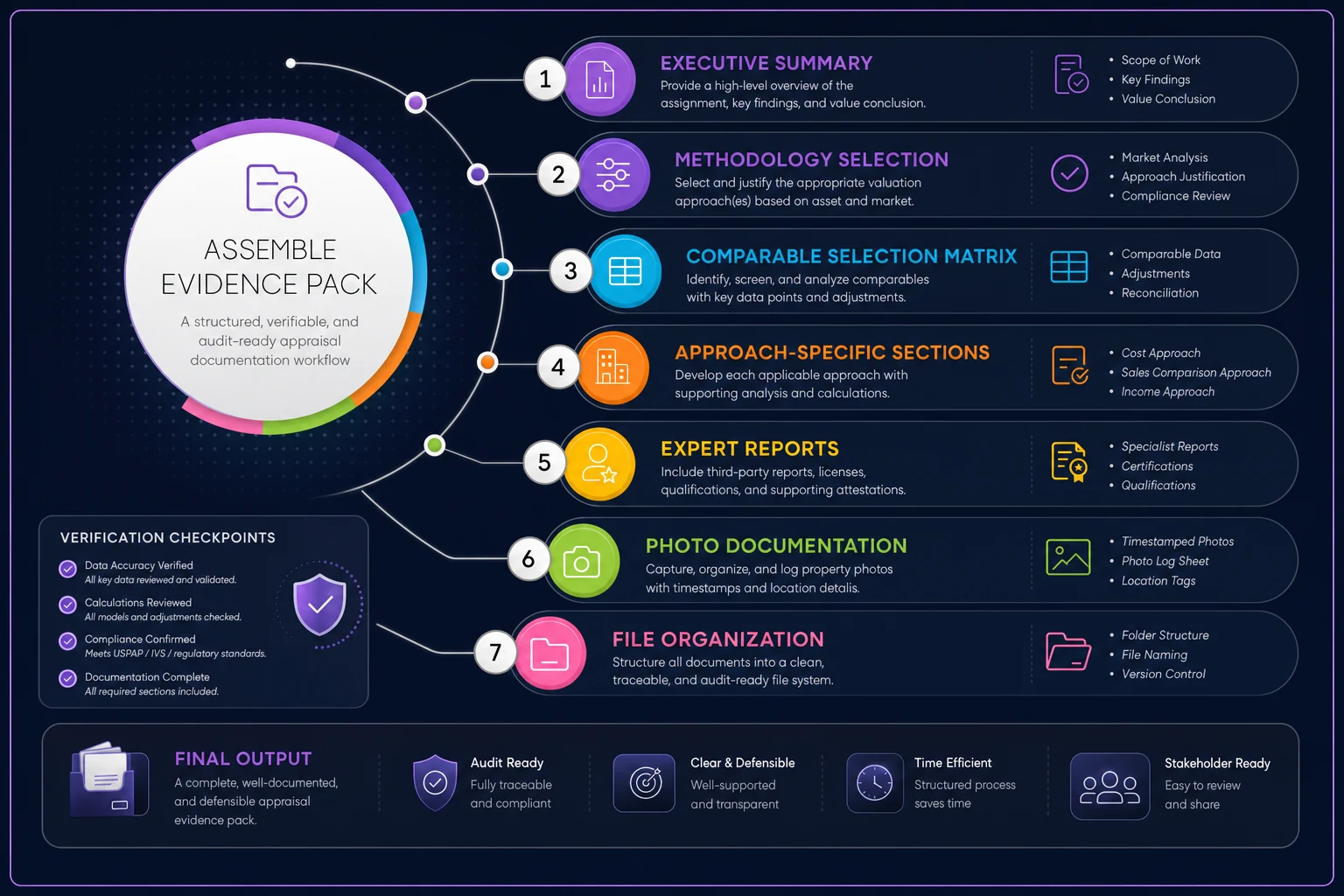
Your methodology selection narrative comes next. Explain why you're emphasizing certain approaches over others. If you're giving 60% weight to the cost approach and 40% to sales comparison, document that reasoning. Include specific market observations: "Only three custom homes over 8,000 square feet sold in the county over the past 24 months, requiring the cost approach to provide primary value indication."
The comparable selection matrix shows your search process transparently. Include both selected and rejected comparables with clear reasoning for each decision. That contemporary mansion might seem like a terrible comp for the Tudor estate, but if it's one of only four sales over $3 million, document why you considered and rejected it.
Create distinct sections for each valuation approach with its own support materials. Your cost approach section includes contractor estimates, your sales comparison includes paired sales analysis, your income approach includes rental surveys. Each section stands alone while contributing to the overall conclusion.
Critical photo documentation beyond standard requirements
Visual evidence for unique properties goes well beyond basic field photo requirements. You're not just proving the house exists—you're justifying adjustments and supporting qualitative assessments.
Capture architectural details that affect value but don't show up in room counts. The hand-painted ceiling fresco, the imported marble staircase, the custom millwork throughout—these elements justify quality adjustments that reviewers might otherwise question. Include close-ups with enough context to show scope and condition.
Document functional issues that affect marketability. That stunning great room with 30-foot ceilings looks impressive, but if it creates heating inefficiencies or maintenance challenges, capture evidence. Show the HVAC system struggling to condition the space, the specialized equipment needed for maintenance, the acoustic problems from hard surfaces.
Photograph comparable sales when possible, especially for unique features. If you're making a $75,000 adjustment for a pool house, having photos of similar pool houses from your comparables strengthens your position. Drive-by photos of comparables provide context that MLS listings often miss.
Include area and neighborhood shots that establish market position. The unique property might be extraordinary, but if it's surrounded by $400,000 homes, that affects value. Document the subject's relationship to surrounding properties, nearby amenities, and neighborhood characteristics.
Time-stamp everything and maintain photo logs with descriptions.
Time-stamp everything and maintain photo logs with descriptions. Six months later during review, you need to know exactly what each photo shows and when you took it. Your photo documentation becomes evidence only when it's properly cataloged and retrievable.
Expert affidavits and third-party validation
Sometimes your expertise alone isn't enough. Unique properties often require specialized knowledge that goes beyond typical appraisal training, and knowing when to bring in outside experts—and how to document their input—makes a real difference.
Structural engineers provide crucial support for properties with unusual construction. That earth-sheltered home might be energy-efficient, but is it structurally sound? An engineer's affidavit addressing structural integrity, drainage systems, and long-term maintenance requirements adds weight your opinion alone can't provide.
Historical architects validate restoration quality and historical accuracy for heritage properties. The difference between "period-appropriate renovation" and "authentic restoration" might be $200,000 in value. An expert affidavit distinguishing these levels gives you concrete support for quality adjustments.
Specialized contractors estimate reproduction costs for unique features. Your cost approach for that Japanese tea house or outdoor kitchen complex gains credibility when supported by contractors who actually build these features. Get written estimates on letterhead, not verbal approximations.
Document expert credentials thoroughly. Include licenses, certifications, and relevant experience. The contractor who's built three recording studios carries more weight than a general residential builder when valuing a property with professional music facilities.
Format expert input as formal affidavits when possible. A signed, dated statement on professional letterhead stating specific observations and conclusions provides stronger support than informal emails or phone notes. Include the expert's scope of inspection, methodology, and any limiting conditions.
Market-specific narrative templates that anticipate challenges
Your narrative sections need to address reviewer concerns before they arise. Generic boilerplate won't work when every sentence might face scrutiny. Develop modular narrative templates specific to unique property challenges.
Highest and best use analysis for unusual properties:
"The subject's current use as a single-family residence with commercial-grade kitchen facilities supports both residential use and limited event hosting. Market analysis indicates similar estate properties in the area generate $3,000–$5,000 monthly from occasional event rentals while maintaining primary residential use. The dual-use capability represents the property's highest and best use, as converting fully to commercial use would require rezoning unlikely to be approved given neighborhood opposition documented in planning commission minutes from March 2024."
Marketability and exposure time considerations:
"Properties exceeding $2 million in the subject market area typically require 180–270 days marketing time based on MLS data for 2023–2024. The subject's unique architectural style (Modernist) appeals to a narrower buyer pool than traditional luxury homes, suggesting exposure time toward the upper end of this range. However, the property's location within the established Riverside luxury corridor and proximity to private schools maintains marketability within the broader luxury segment."
Adjustment support narratives:
"The $125,000 adjustment for the detached guest house derives from paired sales analysis of 47 Meridian Drive (with 1,200 sf guest house, sold $1,847,000) and 52 Meridian Drive (no guest house, sold $1,720,000). After adjusting for size difference ($3,000), sale date (1.5% appreciation over 4 months), and condition ($5,000), the indicated adjustment is $127,500. This aligns with cost analysis showing $105 per square foot construction cost plus site improvements and utility connections totaling $131,000."
Layer multiple support methods to justify significant adjustments. Don't rely on cost alone or paired sales alone—use both to triangulate your conclusion.
Operational efficiency through systematic documentation
Building comprehensive evidence packs for every unique property would bury your office in paperwork. The key is creating systems that capture critical documentation without wrecking your workflow.
Develop triggered checklists based on property characteristics. When property value exceeds $1.5 million, trigger the enhanced photo protocol. When improvements exceed 6,000 square feet, trigger the contractor estimate requirement. When the property includes income-producing elements, trigger the rental survey process. These triggers keep documentation consistent without overthinking every assignment.
| Trigger | Action |
|---|---|
| When property value exceeds $1.5 million | trigger the enhanced photo protocol |
| When improvements exceed 6,000 square feet | trigger the contractor estimate requirement |
| When the property includes income-producing elements | trigger the rental survey process |
Create evidence collection templates that your field appraisers can follow. A simple form listing required photos for luxury properties, contact fields for market participants, and checkboxes for third-party reports keeps things consistent across your team. The appraiser spending three hours at the unique property knows exactly what evidence to gather.
Establish relationships with go-to experts before you need them. The structural engineer who understands appraisal requirements, the architectural historian who writes clear reports, the luxury real estate agent who actually returns calls—these relationships save you real time when unusual properties show up. Document their contact information, specialties, and typical turnaround times somewhere accessible.
Build a digital evidence library organized by property type and feature. Those paired sales proving pool house adjustments? Save them. The contractor estimates for detached workshops? File them. The market studies for vineyard properties? Archive them. Future unique properties often share characteristics with past assignments, and you shouldn't be starting from scratch every time.
Standardize your file structure for easy retrieval during reviews. Every unique property file should follow the same organization: executive summary, methodology selection, approach-specific evidence, expert reports, photo documentation, market support. Reviewers can find what they need, and you can reconstruct your reasoning months later without digging through a disorganized folder.
Balancing thoroughness with profitability
Enhanced documentation takes time, and time costs money. But inadequate documentation costs more when reviews drag on, revision requests pile up, or compliance issues surface during audits.
Price unique property assignments appropriately from the start. A standard appraisal fee won't cover the additional research, documentation, and potential revision time for a multi-million dollar estate. Build your enhanced documentation requirements into your fee quotes. Clients needing unique property appraisals typically understand the complexity—if they don't, explain it.
Front-load evidence gathering to avoid return trips. Spending an extra hour during inspection to photograph details, measure unique features, and document conditions saves the four-hour return trip when reviewers ask questions. Your evidence pack checklist ensures you capture everything during the first visit.
AI-powered operational software can help here—organizing evidence, flagging missing documentation, and maintaining consistent file structures across assignments. Digital photography with automatic geocoding and timestamps reduces manual documentation burden. Cloud storage ensures evidence stays accessible for future reviews.
Track time investment versus revision rates to see what's actually working. If properties with comprehensive evidence packs average half a revision while standard documentation averages two or three, the upfront investment clearly pays off. Monitor which documentation elements actually prevent revisions versus those that just create busy work.
Common documentation failures in unique property files
Even experienced appraisers stumble when documenting unique properties. These are the failure points that come up most often.
The comp selection trap: Appraisers force inappropriate comparables because they're recent and nearby, then try to support massive adjustments with thin documentation. Better to expand your search area or timeframe with clear explanation than to use a 2,000 square foot ranch as a comp for an 8,000 square foot estate. Document your expanded search parameters and why closer comparables don't exist.
The cost approach shortcut: Running Marshall & Swift calculations without market validation creates vulnerability. Local contractors might charge 40% more than cost service estimates for custom work. Those hand-carved corbels and restored Victorian gingerbread don't appear in standard cost manuals. Get real estimates or prepare for challenges.
The missing market context: Unique properties don't exist in isolation. A premium-priced contemporary might be architecturally significant, but if the highest sale in the neighborhood was substantially lower, you need extensive documentation explaining the gap. Market extraction, buyer interviews, and absorption studies provide context that pure comparable sales can't offer.
The revision spiral: Inadequate initial documentation leads to revision requests, which leads to scrambling for additional support, which raises new questions, which triggers more revisions. Each round erodes credibility and profitability. Comprehensive initial documentation breaks this cycle.
The technology side of evidence management
Modern appraisal operations benefit from AI-powered platforms that systematize evidence collection and organization. Instead of each appraiser developing their own documentation habits, operational software enforces consistency while adapting to property-specific requirements.
Automated triggers can identify when enhanced documentation is needed based on property characteristics pulled from initial assignment data—flagging unique properties before the appraiser heads to inspection, so they bring the right tools and allocate enough time.
Digital evidence libraries become searchable resources for the entire team. That paired sales analysis supporting a tennis court adjustment becomes available for future assignments. Expert contact information stays current. Photo documentation standards stay consistent across all appraisers.
Workflow automation handles the administrative side of evidence organization. Photos sort into categories, documents index for easy retrieval, and revision tracking maintains version control. Appraisers focus on analysis and judgment while the platform handles filing.
The real payoff shows up during review defense. When questions come in months later, comprehensive digital files with intact metadata, timestamps, and cross-references make responding straightforward. The evidence pack exists not as a scattered collection of documents but as an organized, searchable record.
Making unique property documentation sustainable
The goal isn't documenting everything—it's documenting strategically. Unique properties will always require more evidence than routine assignments, but systematic approaches make enhanced documentation something you can actually maintain.
Build your evidence collection incrementally. Start with triggered checklists for your most common unique property types. Add expert relationships as you encounter needs. Develop narrative templates through actual usage. Your documentation system grows organically based on real requirements, not theoretical completeness.
Share documentation burden across your team. The appraiser who develops solid contractor relationships shares those contacts. The analyst who creates effective marketability narratives saves templates for others. The field inspector who masters architectural photography trains colleagues. Organizational knowledge compounds individual effort.
Price your services to support proper documentation. Clients needing unique property appraisals should expect thorough analysis with defensive documentation. Those unwilling to pay for appropriate evidence collection probably aren't the right clients anyway. Quality documentation protects both your conclusions and your reputation.
Keep in mind that evidence packs serve multiple audiences: underwriters, review appraisers, regulatory auditors, and sometimes attorneys. Clear organization, transparent reasoning, and comprehensive support satisfy all of them while demonstrating professional competence.
The unique property sitting on your desk today might seem like a documentation nightmare. But with structured evidence collection, systematic organization, and appropriate technology support, even the most unusual properties become manageable assignments—and your evidence pack stops being a defensive burden and starts being proof of what you actually do well.
Ready to elevate your appraisal operations?
Join 500+ appraisal firms using Rateoly to enhance accuracy, save time, and improve client satisfaction.