


Most appraisal shops don't lose an audit or a lawsuit because they did bad work. They lose because they can't reconstruct what they did. The comps were solid, the adjustments were reasonable, the inspection happened — but three years later nobody can find the original field photos, the version that actually went to the lender, or the email where the client requested the extraordinary assumption. The work was defensible. The file wasn't.
That gap between "we did it right" and "we can prove we did it right" is where the appraisal evidence lifecycle lives. And it's not a filing problem. It's a systems problem that touches capture, storage, retention, retrieval, and export — and every one of those stages quietly leaks reliability as volume grows.
This is a walkthrough of how the whole thing works when it's built well, and where it tends to break when it isn't.
The lifecycle isn't a folder — it's five stages that hand off to each other
When people say "we keep our files," they usually mean they have a folder per assignment with a PDF and some photos. That's storage, not a lifecycle. A defensible evidence lifecycle has five distinct stages, and each one hands something to the next:
-
Capture — field data, photos, sketches, MLS pulls, public records, client instructions, engagement terms.
-
Assembly — the working file where evidence gets organized, adjusted, and turned into a report.
-
Retention — the frozen state after delivery, held under a defined schedule.
-
Archival — long-term cold storage where files age out of active systems but remain retrievable.
-
Export/Discovery — the ability to pull a complete, ordered, timestamped package on demand.
The reason firms struggle isn't that any single stage is hard. It's that the handoffs are informal. A photo captured on a phone never gets tied to the assignment ID. A revised report overwrites the delivered version. A file gets archived without its supporting emails. Each broken handoff is invisible until someone asks for the file two years later — and by then the person who could explain it has left.
Worth noting: the stages that feel least urgent — retention and archival — are the ones that determine whether the whole chain survives. Nobody gets praised for good archival. They just quietly avoid disasters.
Capture standards decide everything downstream
If capture is sloppy, no amount of good archival saves you. You can't retain what you never properly recorded.
Manage every appraisal with confidence and clarity.
Rateoly helps you coordinate inspections, generate reports, and communicate seamlessly with clients.
- Comprehensive appraisal tracking
- Automated client notifications
- Integrated scheduling & report management
No credit card required
The core issue is that capture happens under time pressure, in the field, across multiple devices and people. An appraiser shooting a rural property on their personal phone, a trainee pulling comps from MLS, an admin scanning a signed engagement letter — three different capture points, three different naming habits, three different chances to lose provenance.
-
Every artifact carries an assignment identifier the moment it's created.
-
Photos retain original metadata — timestamp, GPS where available — instead of being stripped by a text message or a resize.
-
Source pulls (MLS, public records, flood data) are captured as-of the date they were used, not re-pulled later when the data has changed.
-
Client instructions and scope changes are captured in writing and attached, not remembered.
Enforce assignment IDs at the point of capture (camera app, MLS export, scan) so provenance is automatic.
That last point trips up more firms than any technical failure. A lender calls, asks for a different effective date, the appraiser adjusts, and the only record of why lives in a phone call nobody logged. When the file gets questioned, the appraiser looks like they changed the answer on a whim.
Getting metadata and structure right at capture also pays off immediately — not just in audits. It's the same discipline that keeps files from bouncing back in automated review. The pre-send file-structure and metadata checklist covers exactly what needs to be in place before a file leaves the building.
The retention matrix: stop guessing how long to keep things
Most small firms operate on vibes here. USPAP sets a floor — the workfile retention requirement everyone knows — but real retention obligations stack on top of that: state licensing rules, lender and investor requirements, GSE guidance, and litigation windows that vary by state statute of limitations. Keeping everything "forever, just in case" sounds safe but creates its own liability: more data to search, more to breach, more to produce in discovery.
A retention matrix turns this from a memory exercise into a rule set. It maps each record type to a retention trigger and a disposition date. A simplified version looks like this:
| Record type | Retention trigger | Minimum hold | Disposition |
|---|---|---|---|
| Delivered report (final PDF) | Delivery date | Longest of USPAP / state / client req | Archive, then review |
| Workfile (comps, adjustments, notes) | Delivery date | Matches report | Archive with report |
| Field photos & sketches | Capture date | Matches workfile | Archive with workfile |
| Engagement/scope correspondence | Assignment open | Matches report | Archive with file |
| Revision/reissue history | Each version | Matches report | Retain all versions |
| Litigation-hold files | Notice date | Until hold released | No auto-disposition |
The critical column is disposition — and the litigation-hold row is the one that saves you. The moment a file is under legal hold, automated deletion has to stop for that file, even if its normal retention window has already expired. Firms that run blind auto-delete without a hold override end up destroying evidence in an active dispute, which is far worse than keeping it too long.
Retention isn't one clock. It's several clocks running on the same file, and your keep-date is the latest one. Build the matrix around "longest applicable" and you stop agonizing over which rule wins.
What breaks at scale
At 20 files a month, one organized person can hold the whole system in their head. At 150 a month across five appraisers, that person becomes a bottleneck — and then a single point of failure.
The failure points that show up as firms grow:
-
Naming drift. Three appraisers develop three conventions. Six months later a search for a property returns nothing because it was filed under the borrower's misspelled name.
-
Version ambiguity. The delivered file and the "final final v3" working file diverge. Nobody's sure which one the lender actually received. This is probably the most common thing that turns a routine question into a defensibility problem.
-
Orphaned evidence. Photos live on a phone, comps live in a spreadsheet on a desktop, the report lives in the appraisal software. Only the report gets archived. The support evidence evaporates.
-
Retention amnesia. Nobody's tracking disposition dates, so either everything gets kept forever (breach risk, discovery burden) or files quietly disappear when a laptop dies.
-
Retrieval latency. A discovery request comes in with a 10-day response window. Assembling one complete file from four systems takes half a day. Multiply by 40 requested files and you've lost a week nobody had.
None of these are individual mistakes. They're structural consequences of informal handoffs surviving past the volume they were designed for.
Archival automation: making the boring stage reliable
Archival is where discipline should stop depending on human memory. The goal is simple to state and hard to do manually: when a file reaches its retention-frozen state, the complete package — report, workfile, photos, sketches, correspondence, version history — should move to durable storage as one immutable unit, with an index entry so it can be found later.
Done by hand, this is exactly the kind of task that gets skipped on busy weeks. This is where operational platforms with built-in automation earn their place — not by doing appraisal judgment, but by handling the mechanical reliability that humans are genuinely bad at under volume. AI-assisted workflow tools can watch for the delivery event, gather associated artifacts across systems, verify nothing's missing against a required-components list, apply the retention rule from your matrix, and file the package with a searchable index — flagging a human only when something's incomplete.
The value isn't automation for its own sake. It's that the boring, defensibility-critical stage stops depending on whether someone remembered to do it after a long inspection day.
A realistic archival workflow reads like this: report delivered → system freezes the working file and captures a checksum → associated photos and correspondence are pulled by assignment ID → completeness is checked against the record-type list → retention and disposition dates are calculated from the matrix → the sealed package lands in cold storage with an index record → a disposition reminder is queued for the future review date. Nobody had to remember it, and nothing got left behind.
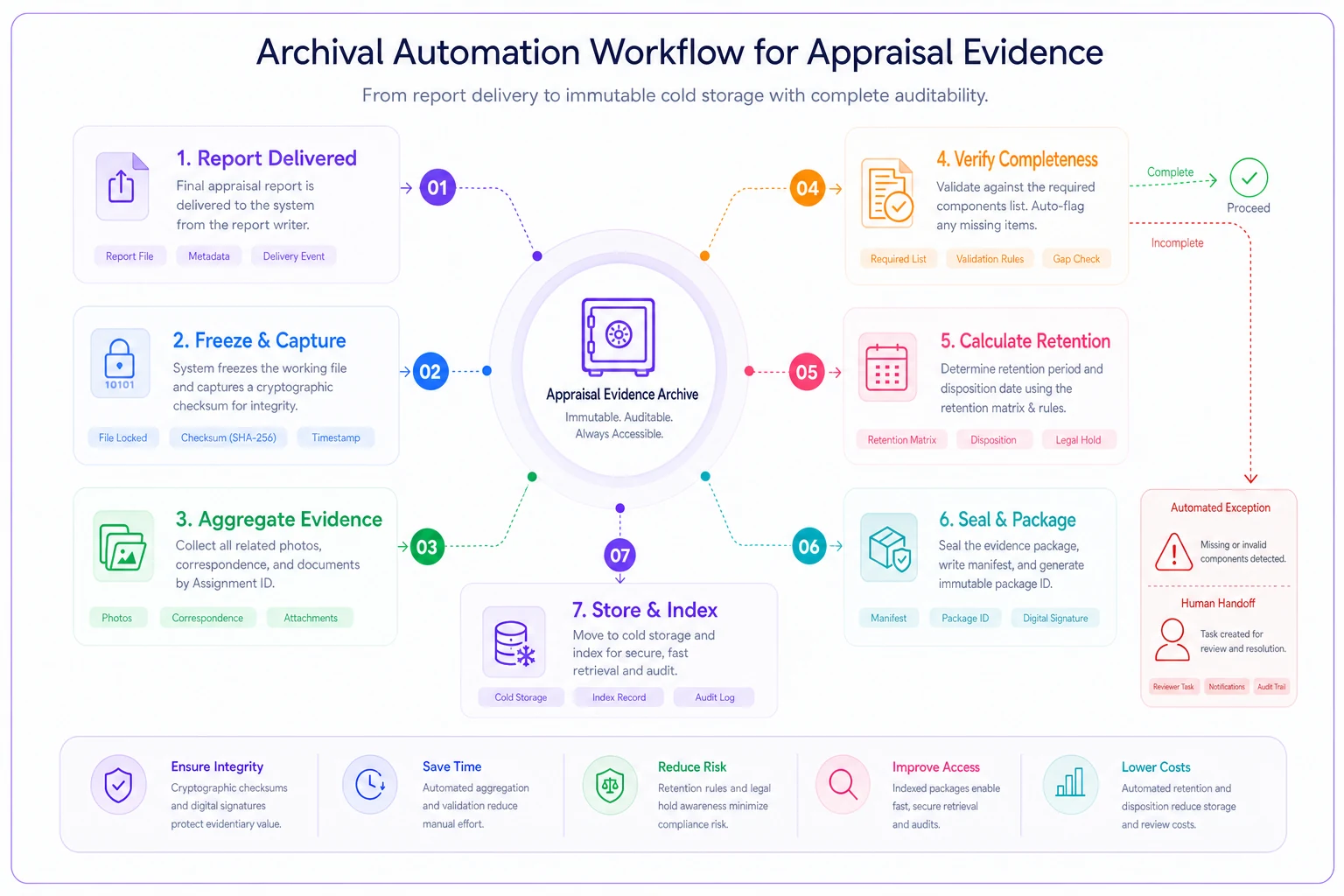
A simple visual like this makes it clear which handoffs are automated and where human intervention is required.
Export templates: the difference between a bad day and a bad month
An audit or discovery request is not the time to figure out what a "complete file" looks like. The firms that handle these smoothly have pre-built export templates — a defined package structure for each purpose.
You typically need three:
-
Audit/compliance export — organized to match how a reviewer reads: report, scope, comps and adjustments, condition support, correspondence, version history.
-
Legal discovery export — same content, but with a produced-records index, consistent timestamps, and a documented chain showing nothing was altered post-delivery. Often needs to be produced in a specific order with a privilege log for anything withheld.
-
Client/lender re-request — a lighter package, just the delivered report and its direct support.
The mistake firms make is treating all three as the same "send them the file" task. A discovery package that arrives as a jumbled folder of PDFs — photos missing metadata, no version index — looks like a firm that doesn't control its records, even when the underlying work was excellent. Presentation reads as competence in a legal context.
The broader framework around how evidence packaging fits into audit-readiness is covered in this piece on how to build an appraisal compliance and evidence framework.
A real scenario
A four-appraiser firm doing roughly 110–130 files a month got hit with a discovery request tied to a disputed valuation from about two years earlier. The request covered the target file plus a dozen "comparable assignments" the opposing side wanted to examine.
Assembling the target file took the office manager most of two days. The report was easy. The field photos were split between a retired appraiser's old phone backup and a shared drive folder named by borrower. The MLS pulls used at the time had been overwritten by fresher data, so they had to reconstruct as-of comps from screenshots someone had luckily saved. One version question — which report actually went to the lender — cost a full afternoon and an awkward call to the client. The dozen comparable files took another week and change.
Total: close to three weeks of scattered effort, plus real anxiety about the gaps.
After that experience they rebuilt around a retention matrix and automated archival: sealed packages at delivery, everything indexed by assignment ID, version history preserved automatically. The next document request — about a year later — was pulled and formatted in under a day. Not because the work was better. Because the file could defend itself without a two-week archaeology dig.
When this level of rigor makes sense — and when it doesn't
When it's clearly worth it:
-
You're above roughly 50–60 files a month, or have more than two appraisers with different habits.
-
You do lending work with GSE or investor exposure, or any assignments likely to end up in litigation.
-
You've already had one painful retrieval or a version-confusion incident. That's the warning sign.
When it's overkill:
-
A solo appraiser doing low volume with one clean naming convention and a single storage location can run a lighter version. Building enterprise-grade archival automation for 15 files a month is effort spent in the wrong place.
Who should not just bolt this on: firms whose capture is still chaotic. Automating archival on top of inconsistent capture just archives the chaos faster. Fix the front of the pipeline first — get assignment IDs, metadata, and written scope changes under control — before investing heavily in the back end. Archival can only preserve the quality that capture delivered.
The takeaway
The appraisal evidence lifecycle isn't a records-management chore sitting off to the side of real appraisal work. It's the connective tissue that determines whether your good work can still speak for itself years later, when the appraiser has moved on and the market data has changed. Capture feeds assembly, assembly freezes into retention, retention ages into archival, and archival has to surface on demand for audits and discovery. Break any handoff and the whole chain gets weaker — usually invisibly, until the day it matters most. Build the matrix, standardize capture, automate the archival step, and pre-define your export packages. Do that and audits stop being emergencies. They become a query.
Ready to elevate your appraisal operations?
Join 500+ appraisal firms using Rateoly to enhance accuracy, save time, and improve client satisfaction.