



The Fed held rates at 3.50%–3.75% and signaled possible tightening ahead. For appraisal operations managers watching their scheduling boards swing between dead zones and sudden surges, this means another quarter of operational whack-a-mole.
When stable rates create unstable operations
One mid-size firm I pulled data from last week had 47 orders Monday, 12 on Tuesday, then 58 on Wednesday. Their field crews drove 1,400 extra miles that week from routing inefficiency alone. That's not a scheduling problem—it's what happens when appraisal operations treat interest rate volatility like weather instead of something you can actually build systems around.
The Fed held rates at 3.50%–3.75% and signaled possible tightening ahead. For appraisal operations managers watching their scheduling boards swing between dead zones and sudden surges, this means another quarter of operational whack-a-mole.
The rate hold creates three operational pressure points
When the Federal Reserve announced its decision to maintain rates, most appraisal firms immediately started calculating revenue impacts. The operational impacts hit first, though, and they hit harder.
Manage every appraisal with confidence and clarity.
Rateoly helps you coordinate inspections, generate reports, and communicate seamlessly with clients.
- Comprehensive appraisal tracking
- Automated client notifications
- Integrated scheduling & report management
No credit card required
Purchase volume becomes hyperlocal and unpredictable. A firm in Phoenix told me they're seeing roughly 80% of their volume concentrated in four ZIP codes while their coverage area spans 26. Appraisers waste hours driving to scattered inspections in outlying areas, only to have those same zones flood with orders the following week when a builder drops prices.
Lenders get pickier about turn times when volumes soften. Reports that got 7-day grace periods during the 2021 rush now trigger angry emails at 48 hours. One operations manager shared their lender scorecard—average turn time requirements dropped from 5.2 days to 3.8 days over three months. Meanwhile, actual completion times crept up because appraisers spend more time per report to justify fees in a tighter market.
Fee pressure makes every operational inefficiency more expensive. When you're getting $425 instead of $475 per report, that extra 40-minute drive just ate your margin. Three revision rounds because photos weren't organized properly? You're losing money on that order.
Volume volatility exposes broken scheduling systems
Most firms still schedule like it's 2019—first come, first served, with maybe some geographic grouping when someone remembers to do it. This works fine when volume is predictable. It falls apart when Tuesday's 15 orders need completion by Friday but Thursday's 45 orders don't need to be done for 10 days.
The problem isn't the volume swings themselves. It's that traditional scheduling can't differentiate urgent from flexible orders until it's too late. Your senior appraiser drives past six routine inspections to hit one rush order, then backtracks the next day to cover what was skipped. By Thursday, Tuesday's orders are late, the Thursday surge created a backlog, and everyone's working the weekend.
Some firms try to fix this with zones or territories, but static territories assume static volume. When orders cluster in specific areas during purchase slowdowns, territory-based scheduling just guarantees inefficient coverage.
Dynamic capacity matching beats static planning
The firms handling rate volatility best stopped trying to predict volume and started building systems that adapt to it. That shift in thinking matters more than any specific tool or tactic.
Start with inspection capacity scoring. Instead of "Bob does the north side," track actual capacity by day and area. If Bob handles six inspections on Tuesdays but only four on Fridays because of longer drive times, your system needs to reflect that. When orders surge, you're routing based on real capacity, not theoretical coverage.
-
True rush 48 hours or less
-
Standard priority 3–5 days
-
Flexible 6+ days
Batching flexible orders efficiently without missing real deadlines tends to free up meaningful scheduling capacity that most firms didn't know they had. It's one of those changes that sounds almost too simple until you see the actual numbers.
Routing efficiency becomes profit protection
When fees compress, every mile matters. A typical appraisal inspection trip averages around 24 miles round trip. Poor routing adds 8–12 miles per inspection. At four inspections daily, that's roughly 40 extra miles—about $28 in vehicle costs, not counting time.
The compound effect is worse. Those 40 extra miles eat about an hour. That hour could have handled one more inspection worth $350–450. Over a month, inefficient routing costs a single appraiser somewhere in the range of $7,000 in lost revenue opportunity.
Track real drive times and update them regularly to keep routing efficient.
Smart routing isn't just about distance. Time windows matter more in practice. An appraiser might drive an extra five miles to hit a morning inspection if it means avoiding afternoon traffic that adds 30 minutes to the return trip. Property type clustering matters too—switching between residential and complex commercial inspections requires different equipment and mental gears, slowing both types down.
| Routing Issue | Daily Impact | Monthly Revenue Loss (Est.) |
|---|---|---|
| Extra miles per inspection | ~40 miles/day | ~$840 in vehicle costs |
| Lost inspection slot from wasted hour | 1 inspection | ~$7,000+ in revenue opportunity |
| Property type mismatching | Variable slowdown | Difficult to quantify, but real |
Block scheduling with dynamic routing rules handles this automatically, but even manual improvements help. Group inspections by both location and type. Set time windows based on actual traffic patterns, not estimated distances. Track real drive times and update them regularly.
Turn time compression requires work redistribution
When lenders demand 3-day turns instead of 5-day, the instinct is to push appraisers harder. This backfires almost immediately. Quality drops, revision requests pile up, and actual delivery time gets worse, not better.
The better approach redistributes work across the pipeline rather than just adding pressure at the end. Desktop review can start before field inspection—pull comparables, check zoning, verify property details. One firm cut report writing time by about 31% just by having admins pre-populate factual data while appraisers were still in the field.
Photo processing becomes a real bottleneck during compression. An appraiser spending 20 minutes organizing and labeling photos is 20 minutes not writing the report. Build a processing queue where admins handle organization using standardized naming conventions while appraisers move to the next order.
Report assembly can happen in parallel rather than in sequence. While the appraiser writes the market analysis, someone else compiles the exhibits. While they complete the improvement section, another team member formats the addenda. One firm cut average turn time from 3.8 days to 2.6 days without adding appraiser hours using this approach. It sounds obvious until you realize almost nobody actually does it consistently.
The parallel processing workflow is worth diagramming out for your team before trying to implement it—the handoffs between roles are where it tends to break down.
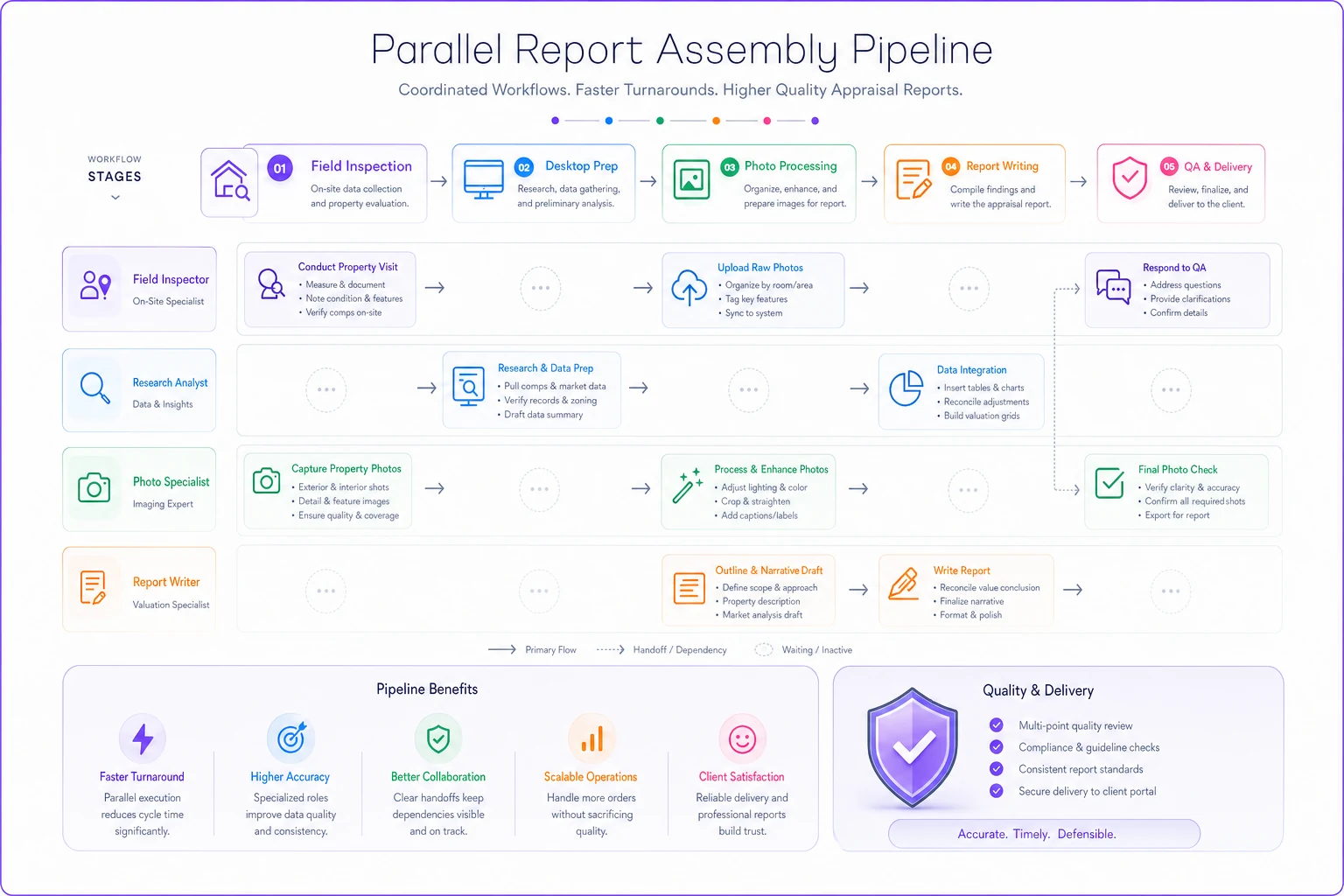
Here's a simple diagram of the parallel report assembly pipeline.
The cash flow squeeze nobody talks about
Rate holds create a specific cash flow pattern that catches unprepared firms off guard. When purchase volume concentrates in specific neighborhoods, those orders often come from the same three or four lenders. When one lender delays payment by even 15 days, it can affect 30–40% of your receivables at once.
Firms with $200k in outstanding invoices struggling to make payroll because 60% of that money is tied up with two slow-paying lenders—that's not hypothetical. Plenty of work, decent margins on paper, but unable to operate because the cash conversion cycle stretched from 35 days to 67 days.
Build payment velocity tracking into your operations. Know which lenders pay in 15 days versus 45. When volume shifts create lender concentration, adjust cash reserves accordingly. Some firms now factor receivables from slow-paying lenders immediately, absorbing the 2–3% cost to keep cash flow stable. It's not ideal, but it beats a payroll gap.
Proactive operational adjustments for Q3 2026
Based on patterns from previous rate holds, here's what typically happens in the 90 days following the Fed's decision and how to prepare operationally.
Weeks 1–3: Panic adjustment phase Order volume drops 15–25% as buyers and lenders recalibrate. Don't cut staff yet. This dip is temporary. Use the slow period for system improvements—update routing logic, clean up report templates, train on efficiency tools.
Weeks 4–8: Clustering phase Volume returns but concentrates in specific property types and locations. First-time buyer properties under $400k stay active. Luxury slows. Track these patterns daily and pre-position resources. If 70% of orders are coming from three ZIP codes, schedule your strongest appraisers there by default.
Weeks 9–12: New normal emerges Patterns stabilize but at different levels than before. Some firms see 20% less volume at slightly higher fees. Others see similar volume but faster turn time requirements. By week nine, you should know your new operational baseline and adjust staffing, systems, and cash flow accordingly.
The 90-day window is also when most firms either adapt or fall behind. The ones who use weeks one through three productively tend to handle the clustering phase much better than those who spent that time waiting for volume to bounce back.
Technology finally matters (but not how you think)
Appraisal operations in a rate-volatile environment create a specific technology need. Not automation for its own sake—you need systems that handle variation without breaking.
The firms struggling most have rigid systems. Their scheduling software assumes consistent volume. Their routing tools optimize for distance only. Their reporting systems can't parallelize work. When rates shift and patterns change, those systems become constraints rather than tools.
Modern AI-powered operational platforms built for variable demand handle this better. They track capacity dynamically, route based on multiple factors simultaneously, and distribute work more intelligently across teams. More importantly, they adapt when patterns shift without requiring manual reconfiguration every time something changes. That last part matters more than most firms realize until they've spent a Saturday afternoon rebuilding routing zones because volume moved to a different part of the coverage area.
This isn't about automation replacing appraisers. It's about building systems that match operational reality—variable volume, changing requirements, compressed timelines, and fee pressure all hitting at the same time.
Making rate holds work for your operation
The CNBC analysis of the Fed's decision focused on mortgage rate implications. For appraisal firms, the real story is operational adaptation. Rates might stay flat for months. Your operation can't afford to stay flat with them.
Start with visibility. If you don't know your true turn times by lender, actual capacity by appraiser, and real routing efficiency, you're guessing. Get those metrics in place this week, not next quarter.
Then fix the biggest leak. For most firms it's routing inefficiency eating 15–20% of capacity. For others it's turn time compression causing quality issues and rework cycles. Find your primary constraint and address it before moving to anything else.
Finally, build in adaptability. Stop creating rigid plans for uncertain futures. Build systems and processes that can absorb volume swings, requirement changes, and fee pressure without constant management intervention. The firms that hold up during rate volatility aren't the ones that predicted the future best—they're the ones that adjusted fastest when it changed.
The Fed will move rates again, probably within six months. Those inspection routes you've been meaning to optimize, the scheduling system you keep planning to upgrade, the parallel processing workflow that keeps coming up in meetings—stop planning and start implementing. When the next rate shift hits, the firms with adaptive operations will grab market share from those still running on rigid systems. Your appraisers are already good at valuation. The question is whether your operation is built well enough to actually let them focus on it.
Ready to elevate your appraisal operations?
Join 500+ appraisal firms using Rateoly to enhance accuracy, save time, and improve client satisfaction.