

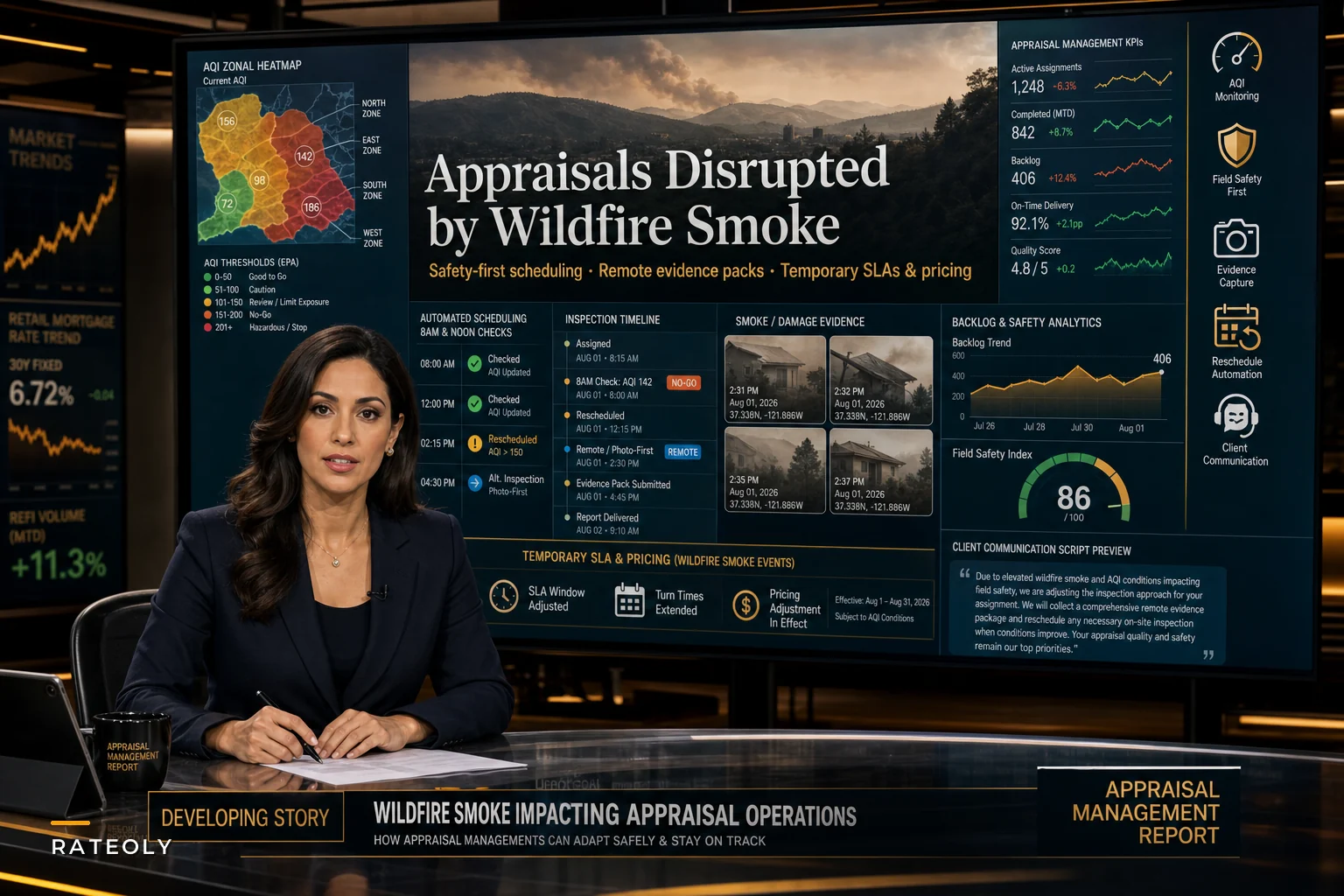

The smoke rolled into Minneapolis last Thursday morning like a thick yellow curtain. By noon, visibility had dropped to maybe half a mile, and the AQI shot past 200. Our inspection team was already out—three appraisers scheduled for exterior inspections in Bloomington, another two heading toward St. Paul for full interior walkthroughs.
That's when the texts started coming in. One appraiser felt dizzy climbing stairs. Another couldn't stop coughing during a basement inspection. A third just sat in his car, wondering if he should cancel or push through. We had no protocol. No decision tree. Just seventeen scheduled inspections and a team making it up as they went.
According to AP News, late July wildfire smoke from Canada pushed air quality into unhealthy or hazardous levels across large parts of the Midwest and East Coast. This isn't a one-week problem. The smoke clears, comes back, shifts directions. Some markets are seeing intermittent hazardous conditions for weeks at a stretch. For appraisal firms operating across affected regions—basically anywhere from Chicago to Boston, plus random pockets throughout the Great Lakes—this creates an operational mess most shops haven't planned for. Safety risks, inspection delays, evidence requirements for smoke damage claims, and client communication failures all hitting at once.
The inspection cancellation decision tree nobody built
Most appraisal operations have weather protocols. Heavy snow? Cancel. Lightning? Postpone exterior work. But wildfire smoke appraisal situations fall into this weird gray zone where nobody's quite sure what the cutoff should be.
What actually happens in the field: your appraiser shows up when the AQI is sitting at 165. Not quite "hazardous" but definitely "unhealthy." They've already driven 40 minutes. The homeowner took time off work. The lender needs the report by Friday for a closing next week. So they do the inspection anyway—rushing through the exterior, skipping the attic entirely, taking photos through hazy air that makes everything look slightly orange.
The report comes back three days later with a revision request. Exterior photos are unusable. Comp photos don't match because they were taken on a clear day two weeks earlier. Now you're sending someone back for a reinspection, eating the cost, missing the original deadline.
A basic decision matrix would have prevented the whole thing. When AQI hits 151, exterior inspections go to appraiser discretion with a supplied N95. Above 201, all inspections cancel automatically unless the property has documented HVAC filtration and the work stays interior-only. Above 301, everything stops.
Almost nobody has this documented. They're making individual judgment calls all day, and those calls vary wildly. Your cautious appraiser cancels at AQI 120. Your ex-Marine pushes through at 250. That inconsistency creates massive scheduling problems downstream.
Why "just wear a mask" doesn't solve the liability question
The knee-jerk response from management is usually some version of "give them N95s and keep going." This completely misses the bigger risks.
Manage every appraisal with confidence and clarity.
Rateoly helps you coordinate inspections, generate reports, and communicate seamlessly with clients.
- Comprehensive appraisal tracking
- Automated client notifications
- Integrated scheduling & report management
No credit card required
First, there's the worker's comp exposure. An appraiser develops breathing problems after a week of inspections in hazardous air? That claim lands on your desk, and your insurance carrier starts asking uncomfortable questions. Did you provide proper respiratory protection? Was it fitted correctly? Did you mandate its use or just suggest it? Were breaks required?
Then there's the E&O side. You complete an inspection during heavy smoke and miss visible fire damage on the north-facing siding because visibility was compromised. Six months later, the buyer discovers $30k in smoke remediation costs. They go after the lender, who comes after you. Your inspection photos show obvious haze. The timestamp corresponds with a day when Reuters reported air quality warnings across the entire region. Now you're explaining to your E&O carrier why you were running field inspections in conditions government agencies were telling people to avoid.
Real liability management requires documented protocols that protect both your team and your business—written policies on when inspections halt, what PPE is required at different AQI levels, mandatory break schedules for outdoor work, and specific documentation requirements when inspections proceed in degraded conditions.
Evidence requirements for smoke-affected properties
Properties you're inspecting during these events fall into three distinct categories, each with completely different evidence requirements.
Category 1: Properties with potential smoke damage. These are typically insurance-related appraisals or purchases where the buyer wants to understand smoke impact. You need photos showing:
-
Siding and exterior surfaces from multiple angles in good light
-
Attic spaces with clear shots of any discoloration
-
HVAC filters pulled and photographed
-
Window sills and frames where smoke residue accumulates
-
Garage interiors, especially around door seals
Most appraisers capture maybe half of this. They take their standard photos and move on. Then the underwriter comes back asking for evidence of smoke remediation or lack thereof, and you're scheduling a return trip.
Category 2: Regular appraisals conducted during smoke events. Even when the property itself has no damage, you need to document that your inspection happened under compromised conditions. This means:
-
Screenshot of AQI readings for that time and location
-
Notes in the report about visibility limitations
-
Explicit statements about any areas not fully inspected due to conditions
-
Supplemental clear-day photos for comparison, especially for exterior condition ratings
The firms getting burned are treating these like normal inspections. Three months later, someone questions the condition rating, and there's no documentation explaining why certain observations might have been limited.
Category 3: Properties in fire-adjacent areas. These need the full unusual valuation evidence pack treatment. Even if the property is ten miles from the nearest fire, you're documenting:
-
Distance to fire perimeter with mapped evidence
-
Prevailing wind patterns during the fire period
-
Local evacuation history
-
Utility disruption documentation
-
Comparable sales analysis showing market impact, or lack thereof
Even if the property is ten miles from the nearest fire, you're documenting: Distance to fire perimeter with mapped evidence, prevailing wind patterns, local evacuation history, utility disruption documentation, and comparable sales analysis showing market impact, or lack thereof.
The scheduling nightmare of intermittent hazardous conditions
Smoke events aren't like storms—they don't hit and leave. Air quality bounces between moderate and hazardous throughout the week, sometimes changing dramatically within a few hours.
Monday morning: AQI 85, schedule full. Monday afternoon: AQI shoots to 180, cancel everything. Tuesday morning: AQI 95, rush to reschedule Monday's cancellations. Tuesday afternoon: back to 165, cancel again. Wednesday: clear all day. Thursday: hazardous from sunrise.
Your scheduling coordinator is playing whack-a-mole with forty inspections, sending constant updates to appraisers, homeowners, and agents. Appraisers are driving to properties and turning around when conditions deteriorate. Clients are getting "weather delay" explanations that sound increasingly hollow after the third postponement.
The firms handling this better have built buffer scheduling specifically for smoke seasons. Instead of booking at 95% capacity, they drop to around 75% during high-risk periods. They batch inspections geographically tighter so appraisers can pivot quickly when conditions change. They've also designated specific team members for moderate-condition work—people with proper PPE training—while others focus on interior-only or desktop assignments.
Communication protocols that actually work
The communication failure cascade during smoke events follows a predictable pattern. Appraiser texts the coordinator about unsafe conditions. Coordinator tells the appraiser to use their judgment. Appraiser cancels. Coordinator scrambles to notify the homeowner but can't reach them. Homeowner shows up anyway, calls the agent angry. Agent calls the lender. Lender calls your office. Now you've got four people upset about one inspection.
A functional protocol looks completely different. At 6 AM, your operations software automatically checks AQI levels across all scheduled inspection zones. Any zone exceeding threshold triggers immediate notifications—not just to the appraiser, but templated messages to all parties. "Today's inspection at [address] may be postponed due to an air quality index of [X] in your area. Final decision by 8 AM. If proceeding, inspection will be exterior-only with supplied safety equipment."
By 8 AM, decisions are locked. Go or no-go, everyone knows. If conditions deteriorate mid-day, there's another decision point at noon with the same automated cascade. No individual judgment calls, no inconsistent communication, no surprised homeowners.
Integrate real-time AQI checks into your scheduling system to trigger automated multi-party notifications and lock decisions at set times.
This requires your scheduling system to integrate real-time AQI data and automated communication workflows. Shops still using spreadsheets and manual texting are drowning in coordination overhead while their competitors run smooth operations through the same chaos.
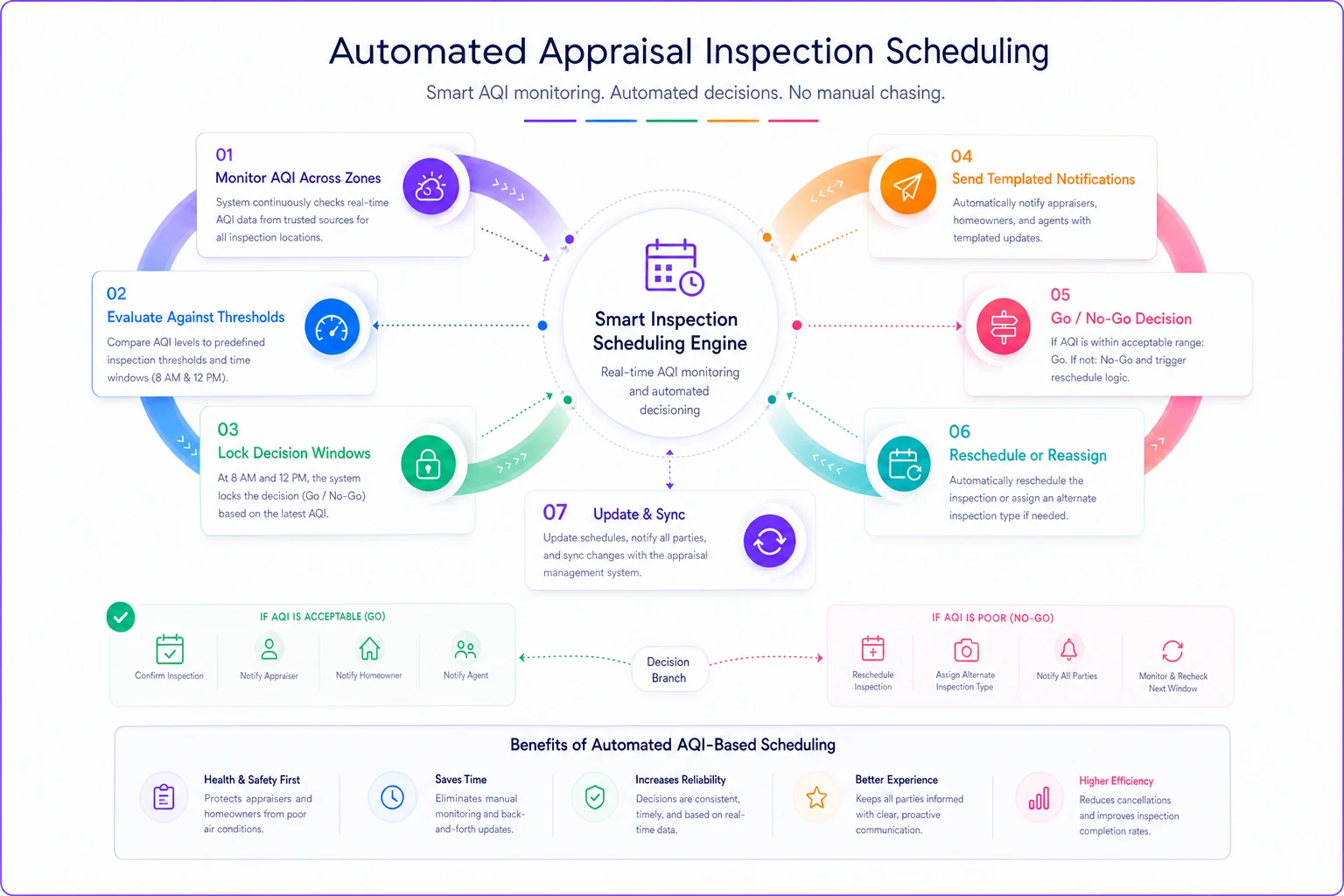
A simple visual of the automated cascade helps operations teams explain the flow to stakeholders and justify system changes.
Repricing and SLA adjustments during extended smoke events
The hidden cost of wildfire smoke appraisal disruptions isn't just the rescheduling—it's what it does to your pricing and SLA assumptions.
Standard 48-hour turn time on a routine residential appraisal? It becomes 5-7 days when you're rescheduling for smoke three times. Your base fee assumes one trip, 90 minutes on-site, a couple hours writing. During smoke events, you're making multiple trips, spending extra time on documentation, adding supplemental photos, writing detailed condition addendums.
What kills margins is that most firms don't adjust pricing or SLAs until they're already underwater. They eat the extra costs for weeks, hoping conditions improve, watching margins disappear. Appraisers start cherry-picking assignments, avoiding anything in smoke-affected zones. Quality slips as everyone rushes to catch up during clear windows.
Better operations implement temporary smoke-event pricing immediately. Add $75-100 for smoke documentation requirements. Extend SLAs by 2-3 days automatically for affected zones. Build in reinspection fees upfront if visibility is compromised. Clients might grumble, but they grumble a lot less than when you blow through deadlines with no warning.
Remote inspection pivots and hybrid approaches
When physical inspections become impossible, most firms default to full cancellation or pushing through unsafe conditions. There's a middle ground that works better for many scenarios.
Hybrid inspections split the process based on conditions and urgency. The homeowner or agent captures exterior photos and video during clear conditions using specific shot lists you provide. Your appraiser handles the interior when AQI allows indoor work. You supplement with street-view imagery, aerial photography from clear days, and municipal records for verification.
This isn't the same as a full desktop appraisal—you're still getting eyes on the property, just restructuring when and how. The key is having pre-built protocols for what's acceptable. Which photo angles are mandatory? What video walkthroughs replace which inspection elements? How do you verify the photos are current?
The biggest resistance comes from appraisers who think remote assistance means lower quality. But compare a rushed inspection in hazardous air—appraiser skipping the attic, barely seeing the roof—against a hybrid approach with clear photos and a careful interior inspection. The hybrid often produces better data.
Building long-term resilience into operations
These smoke events aren't going away. Appraisal firms treating this as a temporary inconvenience will struggle more each season.
| Topic | Details |
|---|---|
| Seasonal capacity planning | that assumes roughly 15-20% inspection disruption during fire months. Staff accordingly, build schedule buffers, and set client expectations before the smoke even arrives. |
| Technology infrastructure | that handles coordination complexity. Your scheduling system needs real-time environmental data integration. Your communication platform needs automated multi-party notifications. Your photo management needs to handle supplemental documentation without creating versioning nightmares. |
| Training programs | that cover safety protocols, documentation requirements, and hybrid inspection methods. Every appraiser knows exactly what to do at different AQI levels. Every coordinator can execute the communication cascade without thinking. |
| Pricing models | that account for seasonal complexity. Some firms are moving to dynamic pricing that automatically adjusts based on environmental conditions. Others build smoke-season surcharges into base rates for affected regions. Either way, you're not eating costs every time air quality degrades. |
This is where AI-powered operational software makes a real difference. Instead of manually checking air quality, calling appraisers, rescheduling inspections, and sending updates, the system handles the entire workflow. It monitors conditions, triggers protocols, reschedules optimally, notifies all parties, tracks additional costs, and documents everything for compliance. The firms still coordinating this manually are spending 3-4 hours daily just managing smoke-related logistics. Automated operations handle it in minutes.
The evidence pack that prevents revision requests
Submit an appraisal conducted during smoke conditions without bulletproof documentation, and revision requests are basically guaranteed. Underwriters see hazy photos and immediately question whether the inspection was thorough. They wonder about condition ratings when visibility was limited. They ask about market impact from the fires themselves.
A complete smoke-condition evidence pack includes:
Environmental documentation:
-
AQI readings for inspection date and time
-
Visibility measurements or estimates
-
Wind direction and speed data
-
Distance to active fires
-
Local evacuation or warning status
Inspection limitation statements:
-
Specific areas where observation was limited
-
Alternative data sources used
-
Supplemental photos from clear conditions
-
Third-party verification where applicable
Market impact analysis:
-
Recent sales in smoke-affected areas
-
Days on market trends
-
Price adjustments in comparable sales
-
Insurance claim activity in the neighborhood
Condition assessment support:
-
Multiple photo angles despite haze
-
Interior evidence of exterior condition
-
Historical photos from MLS or Google Street View
-
Maintenance records when available
Most reports include maybe 20% of this. Then firms wonder why revision requests keep coming. The revision usually isn't about the value conclusion—it's about confidence in inspection quality. When underwriters see comprehensive documentation despite challenging conditions, they trust the analysis. When they see standard reports with hazy photos, they assume corners were cut.
Making the operational pivot
The difference between firms struggling with wildfire smoke appraisal challenges and those managing smoothly comes down to preparation and systems. Struggling shops treat each smoke event as a new crisis. Prepared ones have protocols that kick in automatically.
This isn't about buying expensive equipment or hiring more staff. It's about building the right operational infrastructure before you need it. Clear decision trees. Documented safety protocols. Communication templates ready to go. Schedule buffers built in. Pricing adjustments that protect margins. Technology that handles coordination complexity.
The smoke will keep coming. The firms building systematic responses now will have real advantages over competitors still hoping this is temporary. When the next wave hits—and it will—they'll execute smoothly while others cancel, reschedule, and apologize their way through another chaotic season.
The wildfire smoke isn't just an environmental challenge. It's an operational test. The question isn't whether to adapt, but how quickly you can build the systems and protocols that turn seasonal chaos into manageable complexity.
Ready to elevate your appraisal operations?
Join 500+ appraisal firms using Rateoly to enhance accuracy, save time, and improve client satisfaction.