

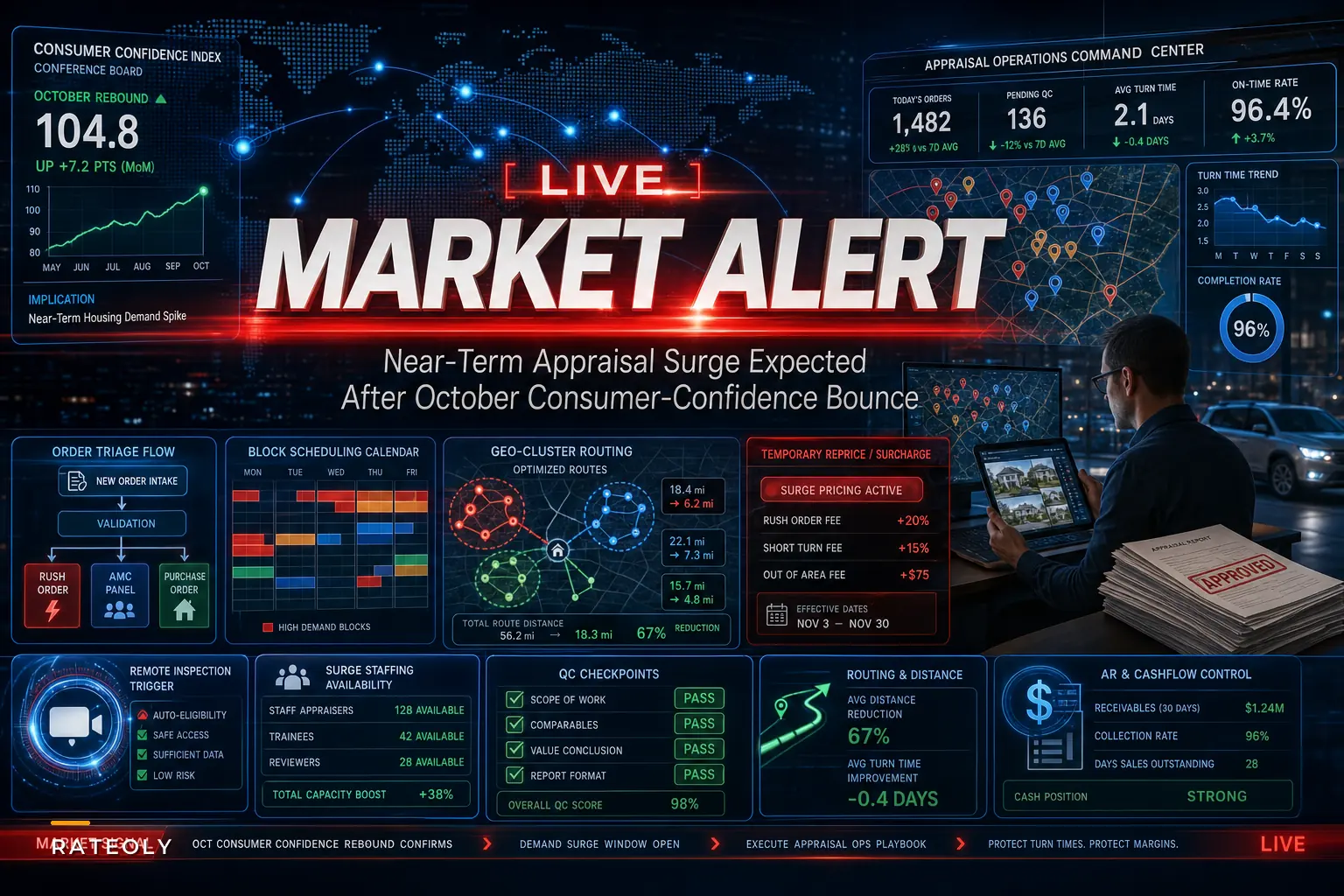

The Conference Board's consumer confidence index climbed to 91.7 in October 2026, up from 84.2 the month before. That's not a small wobble — it's one of the sharper month‑over‑month moves in recent memory, and a recent Reuters report tied it to easing gas prices and calmer inflation expectations. AP's coverage made a similar point about households feeling more comfortable about near‑term spending.
What most people miss is that confidence doesn't convert to closings — it converts to applications. And applications convert to appraisal orders faster than almost any other step in the lending chain. When sentiment ticks up, the first operational pressure in the housing machine tends to land on inspection calendars, not loan docs. You feel it before the headlines catch up.
This isn't about what the index number means for the broader economy. It's about the three to six weeks after a sentiment jump, when your intake queue starts filling faster than your field capacity can absorb — and whether your shop is actually set up to handle that without blowing turn times.
Why the surge lands on appraisal firms first
Mortgage demand responds to sentiment with a lag, but the appraisal step inside that demand is front‑loaded. Once a borrower is under contract or a refi gets locked, the appraisal order often goes out within 24 to 72 hours. The backlog arrives at your door well before the loan closes — and well before anyone downstream is feeling any strain.
What this creates is a timing mismatch. Lenders and AMCs see a pipeline building. You see a sudden spike in orders with the same SLA expectations as a slow month. Nobody renegotiates turn times just because volume jumped overnight. The 48‑hour inspection window doesn't stretch to 72 because October sentiment improved.
-
Week 1–2
order volume climbs 15–30% over the prior month's baseline
-
Week 2–3
scheduling density tightens and routing gets messy
-
Week 3–4
turn times slip, revision requests start piling up, and rush fees get thrown around
-
Week 5+
cashflow lumpiness as rushed files generate more exceptions and slower payment
The firms that get hurt aren't the ones that lack appraisers. They're the ones whose scheduling and routing can't flex fast enough when the curve bends upward.
The real problem a surge exposes: capacity isn't the bottleneck — coordination is
When volume jumps, the instinct is to say "we need more appraisers." Sometimes that's true. But what breaks first is almost never raw field capacity. It's the coordination layer sitting on top of it.
Manage every appraisal with confidence and clarity.
Rateoly helps you coordinate inspections, generate reports, and communicate seamlessly with clients.
- Comprehensive appraisal tracking
- Automated client notifications
- Integrated scheduling & report management
No credit card required
Think about what actually has to happen when 40 new orders hit in a week:
-
Someone has to geo‑sort them so inspections cluster instead of scattering across three counties
-
Someone has to match assignment complexity to the right appraiser's skill level
-
Someone has to sequence appointments so an appraiser isn't crisscrossing a metro area burning two hours in the car between stops
-
Someone has to catch the orders missing gate codes, contact info, or access instructions before they become reschedules
In a normal month, a scheduler can hold most of that in their head. During a surge, that human buffer collapses. The scheduler becomes the bottleneck, not the field team. You end up with appraisers sitting idle in the morning and overloaded by afternoon because the routing fell apart.
The hidden cost is brutal and invisible at the same time. A single poorly routed day might only "cost" an hour or two of windshield time per appraiser. Multiply that across a surge week with six field staff and you've quietly burned 50–60 billable hours that should have gone to clearing the backlog. That's not a staffing shortage. That's a planning failure wearing a staffing‑shortage costume.
Where turn‑time risk actually comes from during a spike
Turn time degrades in predictable ways under volume pressure. Each failure point has a different fix, so it's worth being specific about what you're looking at.
| Failure point | What it looks like during a surge | What it actually costs |
|---|---|---|
| Scattered scheduling | Appointments booked in order received, not by geography | 1–2 hrs/day lost to driving per appraiser |
| Intake gaps | Missing access info discovered at the door | Full reschedule, 2–4 day slip per file |
| Flat prioritization | Rush and standard orders treated identically | Rush SLAs missed, penalty exposure |
| Complexity mismatch | Hard assignments routed to the wrong appraiser | Rework, peer‑review bottlenecks |
| QC compression | Reviewers rushed, defects slip through | Revision loops that eat the time you "saved" |
Only one of these — complexity mismatch — is really a people problem. The rest are scheduling and prioritization problems. During a demand surge, the firms that stay profitable are the ones that treat routing and sequencing as a system, not as something the scheduler improvises on a busy Tuesday.
A practical pre‑surge playbook
You can't hire your way out of a four‑week spike. Hiring takes longer than the surge lasts. What you can do is tighten the operational machine before the orders peak.
-
Rebaseline your normal. Pull your average daily order count from the last 60 days. If October orders start running 20%+ above that, treat it as surge conditions and switch modes — don't wait until turn times have already slipped.
-
Lock in geographic clustering. Stop scheduling in order‑received sequence. Group inspections by zone so each appraiser's day is a tight loop, not a star pattern across the region.
-
Set a prioritization rule, in writing. Rush orders, SLA‑sensitive AMC clients, and purchase transactions get sequenced ahead of flexible‑deadline work. Make this a rule, not a judgment call made under pressure.
-
Front‑load intake validation. Every order gets checked for access details, contact numbers, and property specifics before it enters the schedule. Catching a missing gate code on day one is free. Catching it at the front door costs you a reschedule.
-
Pre‑identify overflow coverage. Line up fee‑panel or contract appraisers now, with onboarding done, so you're not scrambling to credential someone mid‑surge.
-
Protect QC capacity. Don't let review get compressed. A file that bounces back for revision costs more total time than one reviewed properly on the first pass.
Front‑load intake validation to catch missing gate codes before they cause reschedules.
Clustering and prioritization do the heavy lifting on turn time, and they cost nothing but discipline. The staffing moves are your backstop, not your first lever.
The scheduling discipline that actually moves turn times
The single highest‑leverage change most firms can make before a surge is how they build the daily schedule. Instead of booking appointments as orders arrive, you batch them into geographic and time blocks — then route within those blocks so drive time collapses. It's the difference between an appraiser doing five inspections across 90 miles and five inspections across 25.
This is exactly the terrain covered in our deeper walkthrough on cutting inspection turn times with block scheduling, optimized routing, and rule‑based prioritization. The core idea: when volume spikes, the schedule should be built around geography and priority rules, not arrival order. During a normal month you can get away with sloppy sequencing. During a surge it's the first thing that falls over.
Below is a simple workflow for building a surge-ready schedule.
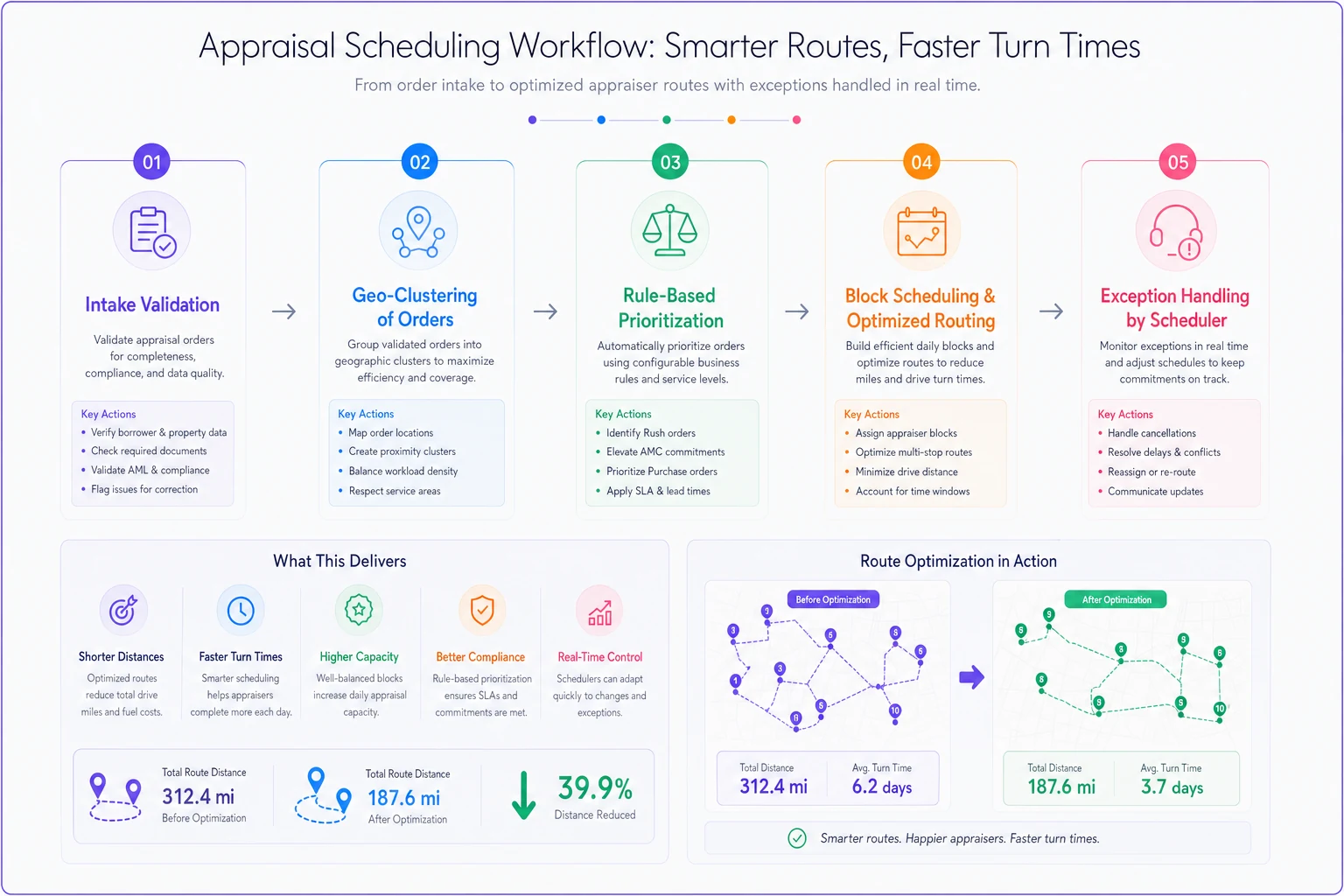
For firms running this manually, the practical ceiling is somewhere around 25–35 orders a week before the scheduler starts dropping balls. Beyond that, the coordination load outgrows what one person can juggle. Workflow platforms with rule‑based routing help here — not by replacing judgment, but by handling the geo‑sorting and prioritization math so the scheduler can focus on exceptions that actually need a human decision. The goal isn't automation for its own sake. It's keeping the coordination layer from becoming the bottleneck when orders double.
When surge repricing makes sense — and when it backfires
A demand bounce tempts a lot of firms to raise fees across the board. Sometimes right, often clumsy. Repricing works when you've got genuine capacity constraints and clients who value speed over cost. It backfires when you raise rates on your steady AMC partners who track your pricing closely and remember it during the next slow stretch.
When surge pricing or rush fees make sense:
-
True capacity shortage where you're turning away work regardless
-
Rush assignments that demand you reshuffle an already‑full day
-
Clients who've explicitly asked for expedited service
When it's a mistake:
-
On your reliable, high‑volume partners who send steady work year‑round
-
Applied bluntly across the board with no tie to actual complexity or urgency
-
When you haven't fixed your routing first — because then you're charging more for a slow service, which clients notice
The cleaner play during most surges is tiered rush pricing on genuinely expedited work, not a blanket increase. It lets you capture premium on the orders that actually cost you more to accommodate, without souring the relationships that carry you through the quiet months.
A short real scenario
A three‑appraiser shop in a mid‑size metro ran around 110–120 orders a month comfortably. After a sentiment‑driven demand bump, intake jumped to roughly 150 orders over a few weeks. Same three appraisers. Nothing changed about field capacity.
What broke first was the schedule. They were booking in order‑received sequence, so appraisers were zigzagging across the metro. Turn times slipped from about 4 days to just over 7, and two AMC clients flagged missed SLAs. Revision requests climbed because files were getting rushed through review.
They didn't hire anyone. They switched to zone‑based scheduling, put a written rule in place prioritizing rush and purchase orders, and moved intake validation to the front of the process so missing access info stopped causing reschedules. Within about three weeks, turn times settled back near 5 days even at the higher volume — and the reschedule rate dropped noticeably. Same people, same cars. The fix was coordination, not headcount.
The takeaway for the next few weeks
A confidence bounce is an early warning, not a reason to panic. There's a short window between the sentiment read and the order surge landing on your calendar — use it.
Tighten your scheduling discipline, write down your prioritization rules, validate orders at intake, and line up overflow coverage before you actually need it. The firms that struggle during a surge aren't short on appraisers. They're short on a system for turning rising volume into clean, well‑sequenced days. Fix the coordination layer now, while orders are still climbing — not after turn times have already slipped and clients have started counting the days.
Ready to elevate your appraisal operations?
Join 500+ appraisal firms using Rateoly to enhance accuracy, save time, and improve client satisfaction.