


The assignments that end up in disputes are rarely the cookie-cutter tract homes. It's the log cabin on 40 acres with a private airstrip. The converted church. The waterfront parcel where the only three "comparables" sold two years apart and none of them had matching water frontage. When one of these valuations gets questioned — by a borrower, an AMC review desk, a litigating attorney, or a tax appeal board — the narrative report suddenly isn't enough. Somebody wants a sworn statement.
That's where a lot of firms get caught flat. The report was fine. The methodology was defensible. But nobody had a clean, notarized affidavit ready, nobody knew exactly what the certifying language should say, and now there's a scramble to draft something under deadline pressure while an attorney on the other side is picking at every missing element.
This post is about fixing that specific gap: having a set of appraisal expert affidavit templates ready for the high-risk, atypical work, plus the objective triggers that tell your team when to require one before the file ever closes.
Why the affidavit gap shows up at the worst possible time
The pattern is pretty consistent. A unique-property assignment goes out the door with a solid report. Months later — sometimes a year or more — a challenge lands. Divorce case needs testimony. Property tax appeal. A lender's buyback demand. The appraiser is now being asked to swear to the work, often in a format they've never produced before.
What usually happens next:
-
The appraiser drafts something from memory or copies a template a colleague emailed years ago.
-
The certifying language is weak or missing entirely — "I believe the value is..." instead of properly sworn language.
-
The credentials block is incomplete
no license number, no expiration, no statement of qualifications.
-
The scope and limitations language doesn't match what's in the original report, which hands opposing counsel an inconsistency to exploit.
-
Nobody thought about chain of custody for the photos, so the field images can be challenged as unauthenticated.
Most firms treat affidavits as a one-off document instead of a standardized deliverable. For routine work, that's fine — you'll probably never need one. For atypical assignments, it's a predictable failure point. The valuation gets harder to defend not because it was wrong, but because the sworn document supporting it was thin.
The five affidavit types worth pre-building
You don't need forty templates. For unique and high-risk work, five cover the vast majority of situations. Each serves a distinct defensive purpose, and the mistake firms make is trying to cram all of them into one generic document.
Manage every appraisal with confidence and clarity.
Rateoly helps you coordinate inspections, generate reports, and communicate seamlessly with clients.
- Comprehensive appraisal tracking
- Automated client notifications
- Integrated scheduling & report management
No credit card required
| Affidavit type | When you reach for it | What it specifically defends |
|---|---|---|
| General expert affidavit | Baseline for any sworn testimony or appeal submission | Appraiser's qualifications, scope of assignment, conclusion, certification |
| Cost-approach affidavit | Special-use or no-comp properties where cost approach carries the value | Reproduction/replacement cost basis, depreciation methodology, land value derivation |
| Paired-sales / adjustment-defense affidavit | When specific adjustments are the thing being attacked | The derivation and support behind each contested adjustment |
| Photo / chain-of-custody affidavit | Any case where field evidence authenticity could be questioned | That the photos are originals, unaltered, taken by the stated person on the stated date |
| Third-party engineer / amenity-specialist affidavit | Properties relying on outside expertise (septic, well, structural, specialty amenities) | The qualifications and findings of the specialist you relied on |
The pairing matters. A cabin-on-acreage tax appeal might need the general affidavit plus the cost-approach affidavit plus the photo chain-of-custody affidavit. A litigation file where the opposing appraiser is attacking your location and condition adjustments needs the general plus the paired-sales defense.
Build them as modular pieces that stack, not as one monster document.
Required elements checklist — what every affidavit must contain
An affidavit missing any of these can be excluded, discounted, or used to undermine the whole valuation. Run every sworn document through this before it gets notarized.
Opening and identity
-
Full legal name of the affiant
-
Statement that the affiant is of legal age and competent to testify
-
The property address and the assignment/file reference number
Credentials block
-
License/certification type and number
-
State(s) of licensure and expiration dates
-
Years of experience and relevant specialty experience (e.g., "approximately 12 years appraising rural and special-use properties")
-
A statement of qualification to render opinions on this property type
Scope of work
-
What the appraiser was engaged to do
-
The effective date of value and the date of the report
-
The intended use and intended users as stated in the original report
-
Confirmation the affidavit is consistent with the original report (this line matters — it preempts the "your sworn statement contradicts your report" attack)
Methodology
-
Which approaches to value were developed and which were excluded, with the reason
-
For the atypical element driving the challenge, a plain-language explanation of the method used
-
Data sources relied upon
Limitations and assumptions
-
Extraordinary assumptions and hypothetical conditions, restated
-
Any limiting conditions relevant to the contested issue
-
Reliance on third-party information, if applicable
Certifying language
-
Properly sworn language ("I declare under penalty of perjury..." or state-equivalent)
-
Statement that opinions are the affiant's own and independently reached
-
Statement of no undisclosed interest in the property or parties
Signature and notary
-
Affiant signature line with printed name and date
-
Jurat / notary acknowledgment block appropriate to your state
-
Space for notary seal and commission expiration
Print this and keep it in your QC workflow. The single most common defect isn't a wrong opinion — it's a missing certification line or a credentials block that forgot the license expiration date. Small omissions, big openings for opposing counsel.
Objective SOP triggers: when to require an affidavit *before* the file closes
Waiting until a challenge arrives to think about affidavits is backwards. The smarter move is deciding at intake and QC whether a file is affidavit-prone, and flagging it then — while the appraiser's memory is fresh and the data is live.
-
Property type flag — special-use, no-standard-comp, or any property your fee scorecard already classifies as high-complexity.
-
Intended-use flag — the assignment is for litigation, estate/probate, divorce, tax appeal, or any purpose where testimony is foreseeable.
-
Comp-scarcity flag — fewer than three true comparables, or comps requiring gross adjustments above a threshold you set (many firms use 25% net / 40% gross as a line).
-
Cost-approach-dependent flag — the value conclusion leans primarily on the cost approach.
-
Third-party-reliance flag — the report relies on an engineer, environmental, septic/well, or amenity specialist report.
-
Prior-dispute flag — the client, property, or parties have a history of challenging valuations.
The point of objective triggers is to remove the judgment call under pressure. If the file hits two or more flags, your QC checklist should require the affidavit template be attached to the file and the chain-of-custody photo language prepped before archiving. You're not notarizing it yet — you're making sure the raw material is captured while it's easy.
This pairs naturally with how you're already documenting the harder files. If you've built out an evidence-pack template for defensible unique-property appraisals, the affidavit triggers should fire off the exact same intake flags. One flag set, two deliverables — the evidence pack and the pre-staged affidavit.
Attach affidavit templates automatically when a file hits two or more flags to avoid missing critical elements.
One flag set, two deliverables — the evidence pack and the pre-staged affidavit.
Sample narrative language you can adapt
Templates are worthless if the language is vague. Below are usable fragments for the contested situations that actually come up. Adapt wording to your state's requirements and your own report — don't copy blindly.
> "I declare under penalty of perjury under the laws of the State of [___] that the foregoing is true and correct and reflects my independent professional opinion, developed in conformity with the Uniform Standards of Professional Appraisal Practice in effect on the effective date of value."
> "The opinions stated in this affidavit are consistent with, and do not expand or alter, the scope of work, extraordinary assumptions, and limiting conditions set forth in my appraisal report dated [___], a true copy of which is referenced herein."
> "The [+$] adjustment applied to Comparable [#] for [characteristic] was derived from a paired-sales analysis of [#] matched transactions identified at [data source], which isolated the contribution of [characteristic] within a range of [$ to $___]. I selected the midpoint of this range as reasonable and supportable given [reason]."
> "Due to the limited availability of comparable market transactions for this special-use property, I developed the cost approach as the primary indicator of value. Replacement cost new was estimated using [source], with physical depreciation of [__%] derived from the effective age / total economic life method, and land value derived from [method]."
> "The photographs attached as Exhibit [__] are true and accurate depictions of the subject property as it appeared on [date]. I personally took these photographs using [device/camera]. The images have not been altered, edited, or manipulated except for [none / cropping for format], and the original files with their embedded metadata remain in my secure file for this assignment."
> "In forming my opinion I relied upon the report of [specialist name], [credential], dated [_], regarding [subject]. I confirmed [his/her] qualifications and found the findings reasonable and appropriate to rely upon. [His/Her] separate affidavit is attached as Exhibit []."
A short workflow for getting affidavits into evidence packs cleanly
The affidavit doesn't live alone. It has to slot into the broader file in a way that holds up. A simple sequence keeps it defensible:
Below is a workflow image to illustrate the sequence.
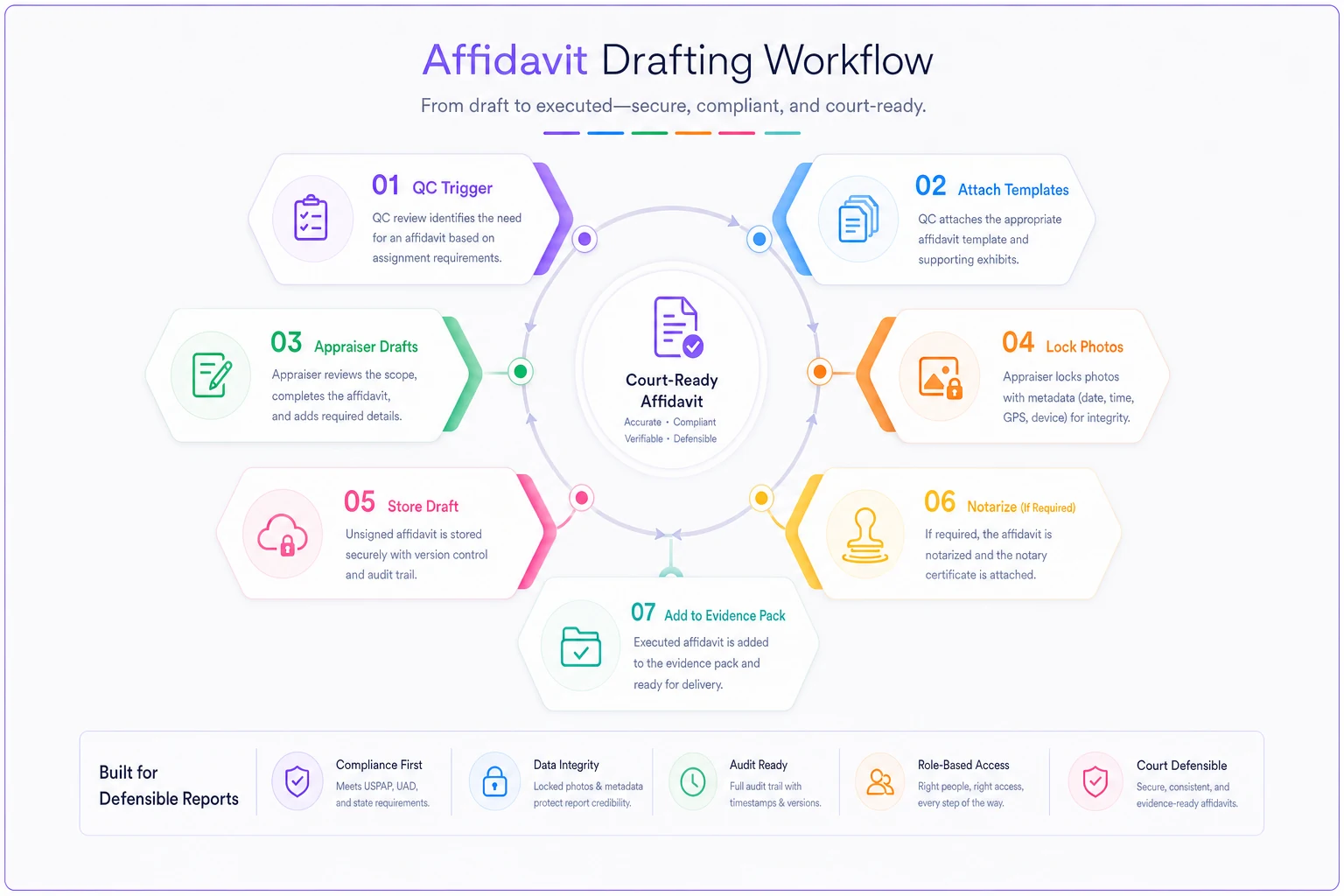
The reason for pre-drafting but delaying signature is practical. The hard part of an affidavit isn't the signing — it's reconstructing the methodology accurately months later. Capture it at the source; execute at the deadline.
-
At QC, the affidavit triggers fire and the appropriate template(s) are attached to the working file as drafts.
-
The appraiser completes the drafts while the assignment is fresh — scope, methodology, and adjustment derivations filled in against the actual report, not from memory.
-
Photos are locked — original files with metadata are preserved in a read-only location, and the chain-of-custody affidavit references their exact storage path and hash if you're using file verification.
-
The draft affidavits sit unsigned in the archive until a challenge or testimony request actually arrives. No point notarizing something that may never be needed.
-
When needed, the appraiser reviews the draft against the current situation, updates nothing substantive, signs before a notary, and the executed version is added to the evidence pack with its own index entry.
-
The evidence pack ships with the affidavit, the referenced report, the exhibits it cites, and any third-party affidavits, all cross-indexed.
Operationally, this is also where a workflow platform quietly earns its keep. When your file-management system can fire the affidavit triggers automatically off the same intake flags you already use for complexity pricing, attach the right template, and keep the unsigned draft bundled with the locked photo originals, the whole thing stops being a fire drill. The firms that handle challenges calmly aren't drafting from scratch — they're pulling a prepared document that's been sitting in the file the whole time.
Retention and redaction — the quick version
Executed affidavits are part of your workfile and should follow the same retention clock as the underlying report — generally the longer of USPAP's minimum (five years, or two years after litigation involvement concludes) or your state's rule, whichever is longer. For files tied to active or foreseeable litigation, don't let the clock run until the matter is fully resolved.
On redaction: affidavits often get filed into public records, especially with tax appeals. Before anything goes into a public filing, strip what doesn't need to be there — borrower Social Security numbers, loan numbers, interior photos showing personal belongings or identifiable people, and any third-party PII that isn't material to the opinion. Keep an unredacted master in your secure workfile and release only redacted copies externally. Note on the file which version went where.
A real scenario
A two-appraiser firm doing a lot of rural and special-use work took on a tax appeal file for a horse property — custom barn, indoor arena, roughly 60 acres, maybe two defensible comps in the entire county. The original report was solid. Nine months later the county assessor challenged the value and the firm got a hearing date with about three weeks' notice.
The first time they'd dealt with something like this, they lost close to two full days drafting an affidavit from scratch, chasing down the specialist's credentials, and hunting for the original field photos to prove they hadn't been altered. The affidavit came out thin, and the hearing officer gave their position less weight than it deserved.
This time they had the templates and triggers in place. The affidavit had been pre-drafted at QC when the file first flagged as litigation-foreseeable and comp-scarce. The barn engineer's affidavit was already bundled. The photos were locked with metadata intact and the chain-of-custody language already referenced the storage path. Prep for the hearing took a few hours instead of two days — mostly reviewing and executing before the notary. The valuation held. The difference wasn't a better appraiser or a better opinion. It was having the sworn documentation ready instead of reconstructed.
When this is worth building — and when it isn't
It makes sense if you do any meaningful volume of unique-property, litigation, estate, or tax-appeal work. For those firms, challenges aren't rare events — they're a known cost of the specialty, and template readiness directly reduces exposure.
It's probably overkill if you're running almost entirely conforming residential refinance and purchase work through AMCs. You'll rarely get asked to swear to anything, and maintaining five affidavit templates for a situation that comes up once every few years isn't a good use of QC time. Keep the general template on hand and skip the rest.
Who should be cautious: firms that would be tempted to let templates replace judgment. An affidavit is a sworn statement, and boilerplate that doesn't precisely match the specific file is worse than no template at all — it creates the exact inconsistencies opposing counsel wants. The templates are a starting structure. The content still has to be true, specific, and tied to the actual assignment every single time.
The atypical valuations are where your expertise shows — and they're also where you're most exposed if a sworn document has to be assembled under pressure. Having the affidavit types, the required-elements checklist, and the objective triggers built into your process ahead of time means the defense is already written by the time anyone asks for it.
The atypical valuations are where your expertise shows — and they're also where you're most exposed if a sworn document has to be assembled under pressure. Having the affidavit types, the required-elements checklist, and the objective triggers built into your process ahead of time means the defense is already written by the time anyone asks for it.
Ready to elevate your appraisal operations?
Join 500+ appraisal firms using Rateoly to enhance accuracy, save time, and improve client satisfaction.