

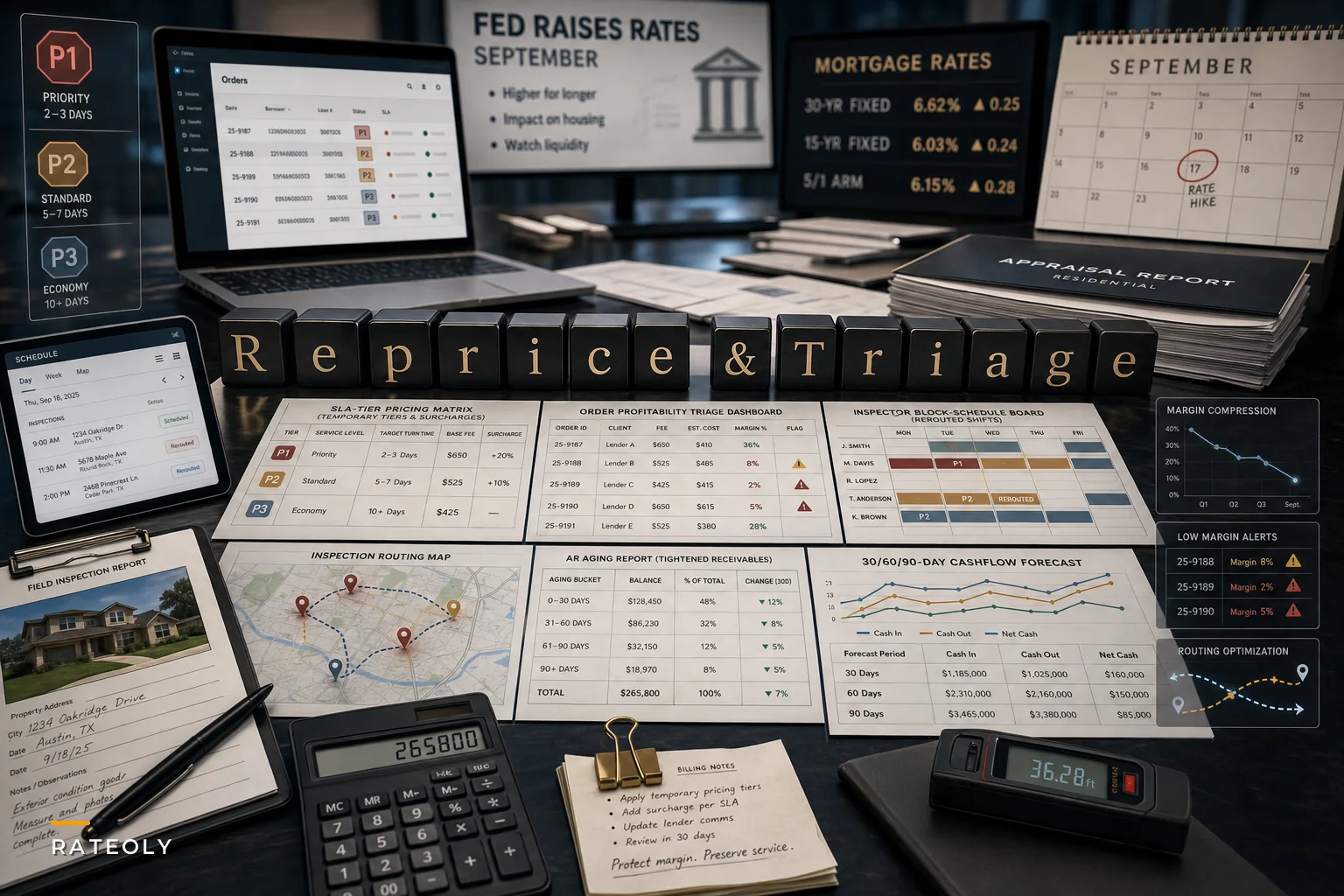

The FOMC bumped the target range to 3.75%–4.00% on September 16, and the projections released alongside the statement left the door open for another hike before year-end. CNBC's coverage of the decision framed it as cautious tightening — the Fed signaling it isn't done yet. For appraisal shops, the policy nuance matters less than the mechanical result: mortgage rates drift up, refi pipelines thin out, and purchase applications slow within a few weeks.
You already know the volume story. What catches most firms off guard isn't the slowdown itself — it's the shape of it. Orders don't just decrease. They get lumpier, more cancellation-prone, and skewed toward assignments nobody wants: rural comps-starved files, rush orders from panicked loan officers trying to close before the next rate move, and low-fee AMC work that was marginal even in a strong quarter.
This article is about repricing and triage as a combined discipline. Not just "raise your fees" — that advice is useless without a method. The real question is which assignments to reprice, which to decline, how to protect turn times when your schedule goes soft, and how to redeploy people without burning them out or losing them to a competitor.
Start with triage, because repricing without it just prices the wrong work
The mistake that shows up repeatedly after a rate move: a firm sees margins compressing, announces an across-the-board fee increase, and watches their best AMC relationships quietly reroute volume to competitors while the problem files keep coming. They raised the price on the work they wanted and did nothing about the work dragging them down.
Appraisal repricing only works when you've first sorted your order flow by profitability and strategic value. Those two things aren't the same. A $425 suburban tract-home refi your team closes in two days with zero revisions is more valuable than a $650 complex assignment that eats a senior appraiser's afternoon and comes back with lender exceptions anyway.
Triage means putting every incoming order into one of a few buckets before you decide what to charge:
-
Keep and protect — profitable, fast-turning, from clients you want to retain
-
Keep and reprice — profitable only if the fee reflects actual complexity and time
-
Accept conditionally — take it only with a surcharge, extended SLA, or scope clarification
-
Decline or refer — assignments where the realistic margin is negative or the client relationship isn't worth defending
Most firms have never formally built these buckets. Orders come in, someone eyeballs them, and the fee is whatever the AMC's grid says or whatever was quoted last year. In a soft market, that passivity quietly kills you.
One pattern worth naming: rush orders spike right after a rate hike because borrowers and LOs are racing to lock before the next move. Those files feel like a revenue lifeline when your schedule has holes. But rush work in a sparse-comp environment is exactly where quality slips and exceptions multiply. Price the urgency honestly, or pass.
A fast complexity-and-margin screen you can run at intake
You don't need a data science project. You need a repeatable screen that any intake coordinator can apply in under two minutes. The point is consistency — the same assignment type gets sorted the same way every time, regardless of who's at the desk.
Manage every appraisal with confidence and clarity.
Rateoly helps you coordinate inspections, generate reports, and communicate seamlessly with clients.
- Comprehensive appraisal tracking
- Automated client notifications
- Integrated scheduling & report management
No credit card required
Here's a screening table that works as a starting framework. Adjust the thresholds to your market and cost structure.
| Signal at intake | Low friction | Moderate friction | High friction |
|---|---|---|---|
| Comparable availability | 3+ recent, within 1 mile | Some search required | Sparse, rural, or unique property |
| Turn-time demand | Standard SLA | Slightly compressed | Rush / same-week |
| Client exception history | Clean | Occasional revisions | Frequent kickbacks |
| Property type | Conforming SFR | Multi-unit, minor issues | Complex, mixed-use, atypical |
| Fee vs. true cost | Comfortable margin | Thin margin | Below cost at quoted fee |
An order that lands mostly in the left column is a keep-and-protect. Anything with two or more "high friction" flags is either a conditional accept with a surcharge or a decline. The firms that handle a rate-driven slowdown well are the ones who stop treating every order as equally worth taking.
Start with conservative thresholds and tighten them weekly as you see actual aging and exception patterns.
One pattern worth naming: rush orders spike right after a rate hike because borrowers and LOs are racing to lock before the next move. Those files feel like a revenue lifeline when your schedule has holes. But rush work in a sparse-comp environment is exactly where quality slips and exceptions multiply. Price the urgency honestly, or pass.
Repricing moves that actually hold up
Blanket increases invite pushback and look arbitrary. Targeted repricing tied to visible complexity factors is defensible — to AMCs, to lenders, and to your own team when they ask why the fee grid changed.
A few repricing structures that survive scrutiny:
-
Complexity surcharges, not base-rate hikes. Keep your conforming base fee stable and layer defined surcharges for rural location, sparse comps, atypical property, or compressed turn time. Clients accept a $75 rural surcharge far more easily than a $75 increase on everything.
-
Rush tiers with real SLA differentiation. If a client wants a three-day turn in a market where five days is standard, that's a service tier, not a favor. Charge for it and commit to it.
-
Scope-clarification repricing. A lot of margin leaks through assignments that balloon in scope after acceptance. Build a reinspection or expanded-scope fee into your engagement terms so you're not eating that cost silently.
-
Floor pricing per assignment type. Set a hard minimum below which you simply don't accept, regardless of volume pressure. This is the single most protective rule in a soft market.
The deeper logic here connects directly to how you package and sell your service. If you haven't built out tiered offerings yet, this is the moment — a rate-driven slowdown exposes exactly which tiers are worth keeping. We walked through the mechanics in detail in our guide to designing SLA-linked pricing and service tiers, and the SKU-matrix approach there pairs naturally with the triage buckets above. Triage decides what you accept; tiered pricing decides what you charge for it.
When repricing is a bad idea
Not every slowdown calls for higher fees. If your exception rate is already high, raising prices before fixing quality just gives clients a louder reason to leave. If you're sitting on a single dominant AMC relationship that represents the majority of your volume, a unilateral repricing letter can detonate it. And if turn times are already slipping, adding rush-tier premiums you can't actually deliver will cost you more in blown SLAs than you'll gain in margin. Fix delivery first, then price.
Protecting turn times when the schedule goes soft
This sounds backwards. Fewer orders should mean faster turns, right? In practice the opposite often happens. When volume drops, firms let appraisers go part-time or redeploy them, block scheduling falls apart, and the remaining orders get handled in an ad hoc way that's actually slower per file than when the pipeline was full and disciplined.
The underlying problem a slowdown exposes is that most small firms' efficiency was propped up by volume, not by process. When you're running 200 orders a month, the rhythm forces discipline. Drop to 120 and the rhythm disappears — and so does the consistency.
A workflow that holds up through the slowdown looks roughly like this:
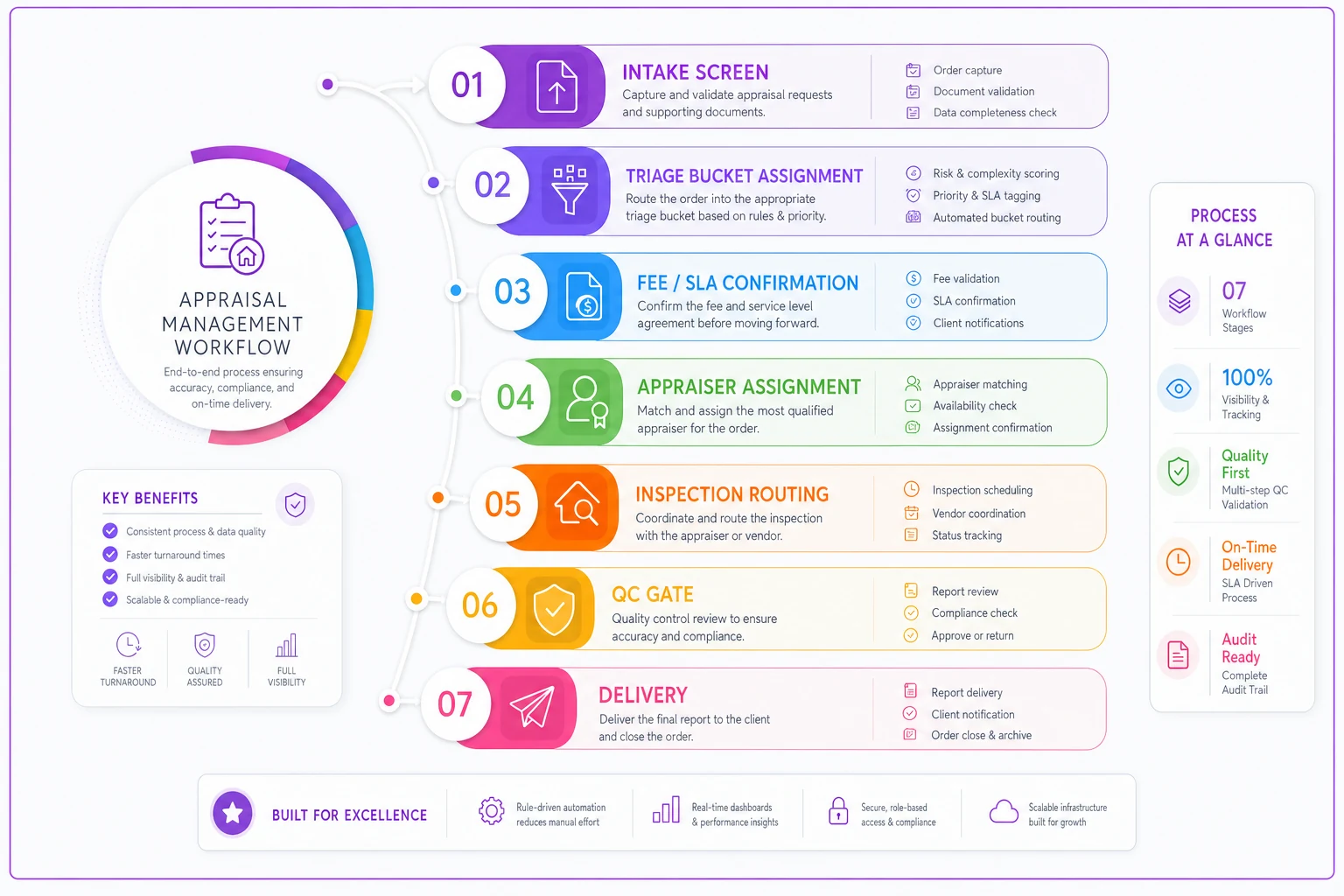
Beyond the sequence itself, a few operational habits matter:
-
Consolidate inspection days even at lower volume, so an appraiser isn't driving across the county for a single file. Fewer, fuller routing days beat scattered one-offs.
-
Hold your intake-to-assignment handoff standard regardless of volume. The temptation is to get sloppy because "we have time now." That's exactly when files sit.
-
Keep QC gates intact. Firms cut peer review first when they're trying to save hours. Then exception rates climb, rework eats the time they saved, and net turn time gets worse.
-
Track aging daily, not weekly. With fewer orders, a single stalled file is a bigger share of your throughput and more visible to the client.
The firms that keep turn times tight through a downturn treat process as independent of volume. That's more of a mindset shift than a tooling problem — though having a system that enforces handoffs and flags aging files makes it far easier to hold the line when you're running lean.
Staffing: redeploy before you reduce
The instinct when orders drop is to cut hours. Sometimes that's necessary. But the appraisers you shed in a downturn are the ones you'll scramble to rehire — at a premium — when rates ease and volume snaps back. And it does snap back, often faster than anyone expects, because pent-up purchase demand releases quickly on the first sign of lower rates.
Before cutting, look at redeployment:
-
Shift senior appraisers toward complex assignments and review. If you're taking fewer but harder files, your most experienced people should be on them and mentoring QC.
-
Use slow weeks to close operational debt — template libraries, comp databases, client-facing documentation, process standards you never had time to write down.
-
Cross-train on intake and client communication. In a soft market, firms that communicate proactively about turn times and scope keep clients. The ones that go quiet lose them.
-
Build or refresh AMC and lender relationships. Quieter periods are actually when those conversations get real attention.
If reduction is unavoidable, be surgical. Cut the capacity tied to low-margin volume you've already decided to decline through triage. Don't cut capacity tied to the work you want to keep and grow.
A realistic scenario
Consider a mid-size firm running roughly 180 orders a month before the hike, split across a couple of AMC relationships and a modest direct-lender book. Within about three weeks of the rate move, monthly volume slides toward 130, cancellations tick up, and the mix shifts — more rural files, more rush requests, fewer of the clean suburban refis that had been the bread and butter.
Their first instinct was a 10% across-the-board fee ask. Instead they ran the triage screen on a recent month of orders and found something uncomfortable: close to a quarter of their volume was at or below true cost once you accounted for revision time and senior-appraiser hours. That segment wasn't just low-margin — it was absorbing the capacity they needed for better work.
The adjustment wasn't dramatic. They held base fees flat, added defined surcharges for rural and compressed-turn assignments, set a hard floor below which they declined, and consolidated inspection routing to two or three days a week. They declined or referred out the chronically unprofitable bucket. Net volume dropped a bit further — but margin per assignment improved meaningfully, turn times on retained work tightened, and they kept their full appraiser roster intact. When the next easing cycle arrives, they're positioned to absorb the rebound without a frantic rehire.
The numbers aren't really the point. The sequence is: triage first, reprice the right segments, protect delivery, hold your people. Firms that did it in that order came out of the slowdown structurally stronger. Firms that led with a blanket price hike mostly just shrank.
The 30-day action checklist
Pull the last 60–90 days of orders and sort them into the four triage buckets
-
Pull the last 60–90 days of orders and sort them into the four triage buckets
-
Identify your at-or-below-cost segment and decide what to decline or refer
-
Replace any planned across-the-board increase with targeted complexity and rush surcharges
-
Set hard per-assignment floor fees by type
-
Consolidate inspection routing into fewer, fuller days
-
Keep QC and peer-review gates in place — do not cut them to "save time"
-
Switch to daily file-aging review while volume is low
-
Map which capacity is tied to kept work vs. declined work before any staffing decision
-
Draft proactive turn-time and scope communications for your top clients
-
Use slow weeks to close operational debt
templates, comp data, documented standards
Use slow weeks to close operational debt: templates, comp data, documented standards
The real lesson a rate hike teaches
A slowdown doesn't create new problems. It makes the ones you were already carrying impossible to ignore. The unprofitable AMC segment you tolerated because volume was good, the process discipline that only existed because the pipeline forced it, the fee grid you hadn't touched in a year — those were liabilities the whole time. The hike just removed the cover.
Firms that treat this as a repricing-and-triage exercise, done in the right order, don't just survive the soft stretch. They walk into the next rate cycle with a cleaner order mix, defensible pricing, and a team still intact. That's the actual opportunity buried in a quarter that looks, on the surface, like bad news. The work is uncomfortable and the timeline is short, but it's far less painful than rebuilding from scratch when volume returns and you're not ready for it.
Ready to elevate your appraisal operations?
Join 500+ appraisal firms using Rateoly to enhance accuracy, save time, and improve client satisfaction.