


Most appraisal firms still quote the same flat fee whether they're promising a 48-hour turnaround or a two-week delivery. That disconnect between price and service level creates a mess—AMCs squeeze you on rush orders, lenders complain about turn times, and your team works nights and weekends without seeing extra revenue for it.
The fix isn't complicated. You need an appraisal pricing strategy that links directly to your service levels, with clear tiers that protect your margins on rush work and give clients predictable options. Firms that implement SLA-based pricing tend to see their rush order margins jump significantly while actually reducing client complaints about turn times. Not because they got better at appraisals—but because they stopped treating every order the same.
Why Flat Pricing Breaks Your Operation at Scale
When you're doing 20 appraisals a month, a single price point works fine. You manage each order personally, adjust schedules on the fly, and absorb the occasional rush request without much pain. But around 60-80 monthly orders, that model starts cracking.
Coordinators spend hours juggling priorities because every order looks equally urgent on paper. Appraisers burn out from constant fire drills. AMCs learn they can demand 24-hour turns without paying extra, so they do—constantly. Meanwhile, clients who are totally fine with a standard turnaround keep getting pushed to the back of the queue because someone louder called in.
The operational cost of rush orders is brutal and usually invisible. A standard residential appraisal might take 8-10 hours of total work time spread across 5-7 business days. That same appraisal compressed into 48 hours requires overtime pay, disrupted schedules, and often means pulling a senior appraiser off something more complex. Yet most firms charge maybe $50 extra, if anything at all.
At 150+ monthly orders, without clear service tiers, your entire operation becomes a series of exceptions. Every order needs individual negotiation. Your team can't plan more than two days ahead. Quality starts slipping because everyone's rushing everything.
The Three-Tier Structure That Actually Works
After testing dozens of pricing models across different markets and firm sizes, three tiers consistently deliver the best balance of simplicity and profitability.
Manage every appraisal with confidence and clarity.
Rateoly helps you coordinate inspections, generate reports, and communicate seamlessly with clients.
- Comprehensive appraisal tracking
- Automated client notifications
- Integrated scheduling & report management
No credit card required
Standard Service (5-7 business days)
This is your baseline tier, priced at your current standard rate. Most orders should fall here—typically 60-70% of volume. The key is being disciplined about the timeline. Five business days means five business days, not "usually five but sometimes three if the client asks nicely."
Priority Service (3 business days)
Price this at 125-135% of standard. This tier absorbs most of your "somewhat urgent" requests without forcing your team into crisis mode. You're essentially charging for queue-jumping privileges and the operational flexibility to rearrange schedules.
Express Service (24-48 hours)
Price at 150-175% of standard, sometimes higher for complex properties. This tier needs to feel like a real decision for the client—it should make them think twice about whether they actually need it that fast. The pricing must cover overtime, the opportunity cost of delayed standard orders, and the stress on your operation.
The shift happens when you hold to these timelines consistently. Clients learn quickly that faster service costs more. Your team can actually plan their week. And those AMCs who've been demanding everything be treated as a rush? They either start paying the right fees or they find someone else to squeeze.
Building Your SKU Matrix Without Overcomplicating It
A clean SKU matrix makes quoting instant and kills negotiation fatigue. Here's a working example from a mid-sized firm doing roughly 120 appraisals a month:
| Property Type | Standard (5-7 days) | Priority (3 days) | Express (24-48 hrs) |
|---|---|---|---|
| SFR under 3,000 sq ft | $425 | $550 | $650 |
| SFR 3,000-5,000 sq ft | $475 | $625 | $750 |
| SFR over 5,000 sq ft | $575 | $775 | $950 |
| Condo/Townhouse | $400 | $500 | $600 |
| 2-4 Unit | $650 | $850 | $1,050 |
| Rural/Acreage | $525 | $700 | $875 |
| Complex/Unique | Quote | Quote +30% | Quote +60% |
Notice how the multipliers increase with complexity. A rush condo is relatively straightforward—you're mainly paying for schedule disruption. A rush acreage property with no good comps is a completely different operational problem. That requires your best appraiser to drop what they're doing, and the pricing should reflect it.
Some firms add a fourth "Same Day" tier at 200-250% of standard, but only offer it for simple properties where template libraries are already in place.
This works well if you've already built out modular narrative templates that speed up report writing.
Cost-Per-Assignment Math That Keeps You Profitable
Understanding your true cost per assignment at each service level is what stops you from accidentally losing money on rush orders. Here's how the math typically breaks down:
Standard Service Cost Structure:
-
Base appraiser fee/salary
$200-250
-
Inspection and travel
$40-50
-
Report writing and review
$60-80
-
Admin and coordination
$30-40
-
Technology and overhead
$35-45
-
Total cost
$365-465
-
Target margin at $425-475 price
15-25%
Express Service Cost Structure:
-
Base appraiser fee (with rush premium)
$300-375
-
Inspection and travel (disrupted schedule)
$60-75
-
Report writing (overtime/priority)
$90-120
-
Admin and coordination (intensive)
$50-65
-
Technology and overhead
$35-45
-
Opportunity cost of delayed orders
$40-60
-
Total cost
$575-740
-
Target margin at $650-750 price
12-20%
The express tier margins look thinner, and that's intentional. You're not trying to maximize profit off rush orders—you're pricing them high enough to limit volume while actually covering your costs. The real profit comes from moving more orders into your efficient standard tier where your processes are dialed in.
One pattern that shows up repeatedly: firms that ignore opportunity cost underprice their express tier. When you rush Order A, Orders B and C get delayed. If B and C are from important long-term clients, you've just created two new problems to solve one. That coordination overhead needs to be priced in.
Negotiation Scripts That Protect Your Margins
Even with clear tiers, clients will push for discounts or try to get faster service at standard pricing. Having ready responses helps your team hold the line without damaging the relationship.
When an AMC demands standard pricing for priority service:
"I understand you need this by Thursday. Our priority service tier ensures dedicated resources for that timeline. The standard tier follows our normal 5-7 day queue. If Thursday is a hard deadline, I can confirm the priority tier at $625. Otherwise, I can add it to our standard queue with an estimated delivery of next Tuesday. Which would work better for your client?"
When a regular client asks for "just this once" rush service at standard price:
"I appreciate your situation, and you're absolutely a valued client. To deliver by tomorrow, I'd need to pull an appraiser off other commitments and likely pay overtime for the report completion. Our express tier pricing covers those additional costs. I can offer you our priority tier at $550 if you can wait until Thursday, or the express service with a 10% courtesy discount since you're a regular client, bringing it to $585. Would either of those work?"
When someone claims competitors don't charge rush fees:
"You're right that pricing varies across firms. Our tiered structure ensures we can maintain quality and reliability at each service level. Firms that don't charge rush fees often handle those requests by deprioritizing other orders or delivering less predictably. Our clients generally prefer knowing exactly when they'll receive the appraisal and that we have the resources allocated to meet that commitment. Would you like to proceed with our standard timeline, or is the faster turnaround worth the priority investment?"
The goal isn't to win an argument. It's to explain the operational reality without being defensive about it.
SLA Penalties and Performance Guarantees
Once you're charging premium prices for faster service, clients expect reliability. Missing an express deadline after charging 75% extra destroys trust fast. SLA penalties create accountability on both sides.
-
Standard tier
5% discount per day late after the 7th business day
-
Priority tier
10% discount per day late after the 3rd business day
-
Express tier
25% discount for any delay beyond promised delivery
Some firms go further with performance guarantees:
-
Express orders delivered late are automatically refunded to priority tier pricing
-
Three late deliveries in a quarter triggers a service credit
-
Consistent on-time delivery (95%+ for a quarter) unlocks preferred pricing for repeat clients
But the critical part is having systems that actually let you hit these SLAs. Manual tracking and coordination won't get you there. This is where automation helps reduce those time-consuming manual tasks that eat into your ability to maintain consistent turn times.
Implementation Timeline and Change Management
Rolling out SLA-based pricing requires some patience. Shocking your clients with a new structure overnight creates chaos and defections. Here's a rollout that tends to work:
Weeks 1-2: Internal Preparation Calculate your true costs per tier. Build your SKU matrix. Train your team on the new structure and negotiation approaches. Get a sense of what percentage of your current orders would fall into each tier under the new model.
Weeks 3-4: Soft Launch with New Clients Start quoting the new structure to new prospects only. This lets you test your pricing and scripts without risking existing relationships. Track win rates and pushback carefully.
Weeks 5-6: Client Communication Send existing clients a clear announcement about the new service tiers. Frame it as adding options, not raising prices. Emphasize that standard tier pricing stays consistent. Offer a 30-day grace period.
Weeks 7-8: Full Implementation Switch all quotes to the new structure. Monitor volume shifts between tiers closely. You want roughly 60-70% in standard, 20-25% in priority, and 5-15% in express. If express creeps above 20%, your pricing is too low.
Week 9 Onward: Optimization Adjust pricing based on tier distribution and operational stress. If your team is still scrambling despite tier pricing, express needs to go higher. If you're losing too many standard tier deals, revisit that base price.
Visualizing the rollout process helps get buy-in and keeps the team aligned.
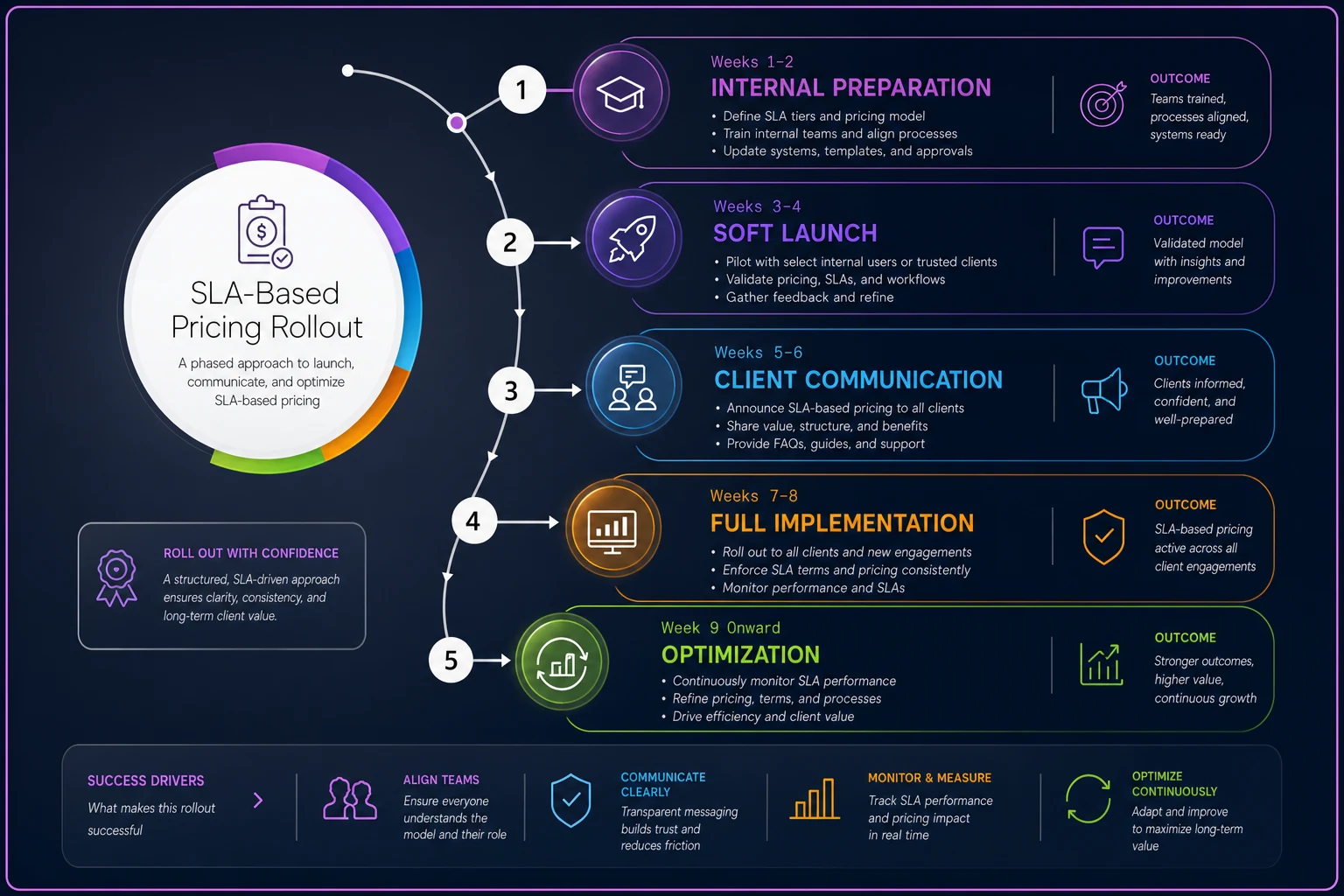
The gradual rollout minimizes churn and gives you data to tweak pricing before a full switch.
Common Pitfalls and How to Avoid Them
Pitfall 1: Making too many exceptions Once exceptions become routine, the tiers stop meaning anything. Every client becomes a negotiation. Set a firm rule: exceptions require manager approval and get documented with a reason. Track exception rates monthly—anything above 5% means your pricing or policies need work.
Pitfall 2: Not accounting for complexity A rural property with no comps shouldn't cost the same to rush as a suburban cookie-cutter home. Build complexity multipliers into your matrix from the start. Some firms use a simple 1.2x multiplier for complex properties, others build separate SKUs. Either works if applied consistently.
Pitfall 3: Underestimating operational disruption The true cost of rush orders isn't just overtime. It's delayed standard orders, a stressed team, and higher error rates. Until you factor in those indirect costs, express will stay underpriced. Track revision rates by tier—if express orders are coming back twice as often, that's a real cost you're absorbing quietly.
Pitfall 4: Weak communication with AMCs AMCs are used to leaning on appraisal firms on both price and timeline. Clear upfront communication about your tiers sets boundaries before things get contentious. Share your tier structure when you onboard them. Put it in your engagement letters. When they push, reference the agreed-upon structure rather than negotiating from scratch each time.
Track these pitfalls and address them proactively so the tiers remain meaningful and enforceable.
Measuring Success and Adjusting Your Model
After three months of SLA-based pricing, measure these:
Revenue per order by tier: Standard should deliver your baseline margin, priority should add 25-30% to revenue, express should add 50-75%. If the gaps are smaller, pricing needs to adjust.
Tier distribution: That roughly 60/25/15 split (standard/priority/express) is your target. Too many express orders means you're underpriced or your standard timeline is too slow. Too few might mean you're pricing yourself out of legitimate urgent work.
On-time delivery rates: You need 95%+ on-time delivery to maintain credibility on this model. If you're regularly missing SLAs, either your operations need work or you're over-promising on timelines.
Team overtime hours: Some overtime on express is expected. If your team is working late every week, the volume is too high or the pricing still too low.
Client retention: You'll lose some price-sensitive clients. That's fine. The question is whether you're keeping the ones who actually value reliability and consistent quality.
One firm saw their monthly revenue go from roughly $51,000 to $64,000 within four months of implementing tiers, with the same number of appraisers and actually fewer total orders. They weren't doing more work—they were just finally capturing the real value of rush orders and moving low-margin scrambles out of the pipeline.
Who This Won't Work For
SLA-based pricing isn't for every situation. Skip this approach if:
-
You're a solo appraiser without backup support
-
Your entire business model is being the cheapest option in the market
-
You primarily work with one AMC that controls your pricing
-
Your market is so competitive that any price increase means losing the client immediately
For those situations, focus first on operational efficiency and building client leverage before introducing tiers. Get your standard processes running cleanly, build a reputation for reliability, and then revisit pricing.
The Technology Component
Managing three service tiers manually adds complexity that can overwhelm small firms. You need clear visibility into which orders belong to which tier, reliable SLA tracking, and early alerts when express orders risk running late.
This is where AI-powered operational software makes the difference between a good concept and actual execution. Modern platforms can automatically route orders based on tier, flag SLA risks before they become failures, and suggest optimal appraiser assignments based on current availability and expertise. The same system tracking your tiers can generate margin reports by tier and by client—so you're not doing that math in a spreadsheet at the end of the month.
Without the right systems, tier-based pricing just becomes another administrative burden. With them, it becomes a real competitive advantage that protects margins and gives clients the predictability they're looking for.
Making the Switch
The transition from flat pricing to SLA-based tiers feels riskier than it actually is. The alternative—continuing to subsidize rush orders while your team grinds down—is what's unsustainable. Start with a pilot for new clients. Test your pricing assumptions. Refine your scripts. Build confidence in the model before going all in.
Most firms find that clients actually prefer having options. The clients who demanded everything be both cheap and fast tend to filter themselves out. The ones who value reliability self-select into appropriate tiers. Your operations become more predictable. Your team can plan more than two days ahead.
The appraisal pricing strategy outlined here isn't theoretical—it's based on patterns from real firms making this transition. The specific numbers will vary by market, but the structure holds: create clear tiers, price them to reflect actual costs, and hold to your SLAs consistently.
Firms thriving right now aren't racing to the bottom on price. They're the ones who've figured out how to align pricing with service delivery, giving clients real options while protecting their own operations. That starts with accepting that not all appraisals are created equal—and their pricing shouldn't be either.
Ready to elevate your appraisal operations?
Join 500+ appraisal firms using Rateoly to enhance accuracy, save time, and improve client satisfaction.