

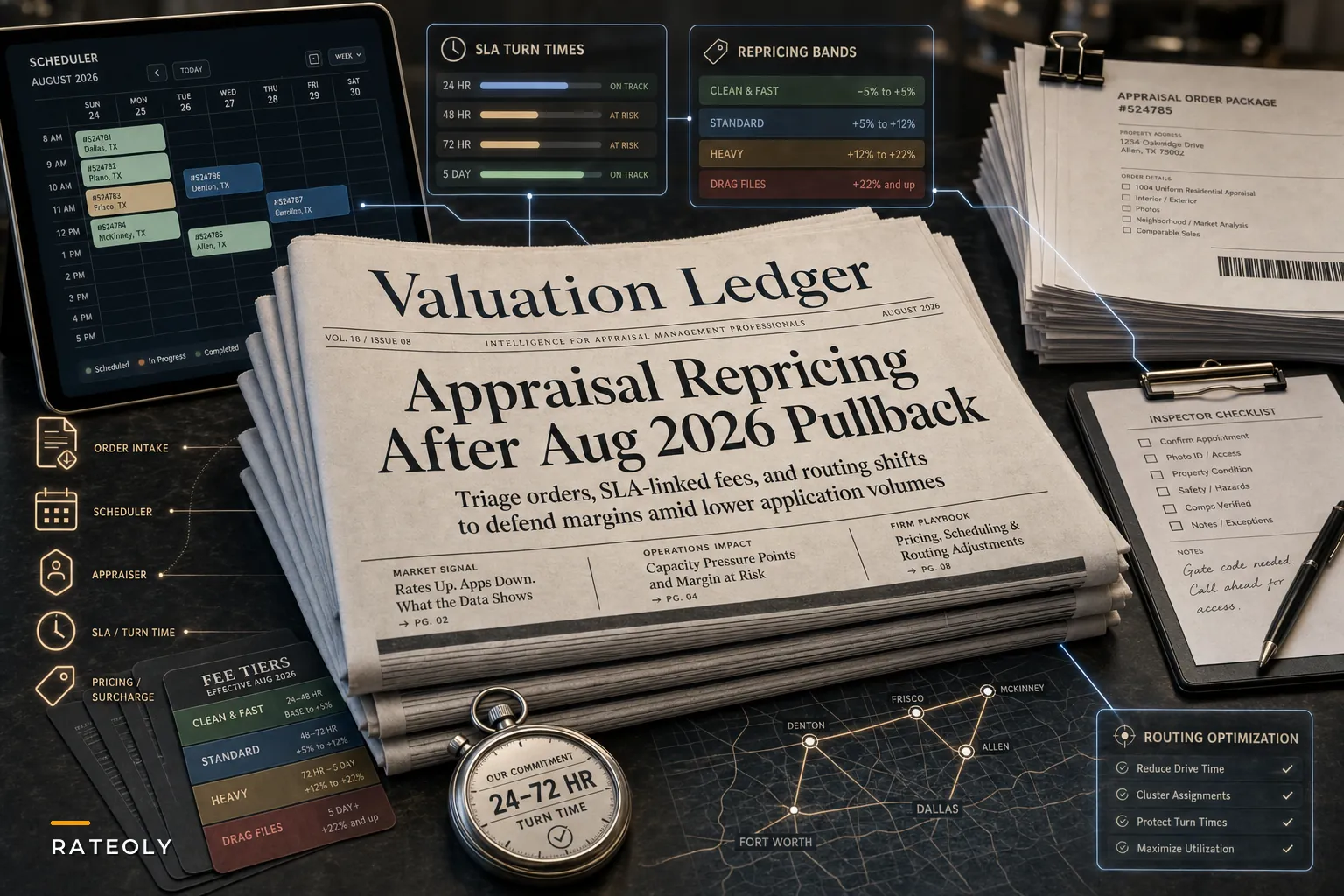

The rate move at the end of August wasn't dramatic on paper. Freddie Mac's weekly PMMS put the 30-year fixed back into the mid-6% range for the week of August 27, and CNBC reported that both refinance and purchase applications slid again. A few tenths of a point. Nothing that makes headlines.
But if you run an appraisal shop or manage vendor panels at an AMC, you already know the lag. Application softness shows up on your desk two to four weeks later as a thinner order pipe, and the mix skews before the volume does. Refis dry up first. What's left leans toward purchases, cash deals, and the occasional relo or estate file that doesn't care about rate sheets.
The firms that get hurt aren't the ones that see a volume drop — everyone sees that. The ones that bleed margin are the ones that keep running a full-volume cost structure against a partial-volume order book for six or eight weeks while they wait it out. This post is about not doing that.
The mix change is the real problem, not the volume
Volume declines are visible. Easy to talk about in a Monday meeting. The mix shift is quieter and does more damage.
Refi assignments tend to be your cleanest, fastest, most predictable product. Interior access is easier, the borrower is motivated, the property is usually owner-occupied and in decent shape, and turn times are tight because nobody's chasing a closing date. Those files carry your operation. They're the ones that let you quote a blended turn time and actually hit it.
-
Purchase files come with hard closing dates and agent coordination, which eats scheduler time.
-
Cash and portfolio work often involves odder properties or rush conditions.
-
Estate, divorce, and relo files carry more documentation overhead and higher revision risk.
So your average handling time per assignment goes up at the exact moment your volume goes down. Revenue drops faster than headcount, and per-file cost creeps because your fixed overhead — software seats, panel management, office, insurance — is now spread across fewer, heavier orders.
A pattern worth naming: firms watching only the order count feel a 20% volume dip and assume a roughly 20% revenue problem. The actual margin hit is usually worse, because the remaining assignments are the expensive kind and the clean fast ones were the first to vanish.
Triage the pipe before you touch pricing or staffing
Repricing and staffing decisions made against a messy queue just move the mess around. Sort first.
Manage every appraisal with confidence and clarity.
Rateoly helps you coordinate inspections, generate reports, and communicate seamlessly with clients.
- Comprehensive appraisal tracking
- Automated client notifications
- Integrated scheduling & report management
No credit card required
-
Clean and fast — standard SFR, easy access, cooperative point of contact, no unusual conditions. These subsidize everything else. Protect their turn times.
-
Heavy but normal — purchase with a tight close, minor complexity, agent coordination required. Fine to take, but they need to be scheduled deliberately, not squeezed between two other stops.
-
Drag files — unique property, access problems, incomplete order data, or a client with a history of revisions. These quietly consume disproportionate capacity.
The mistake that shows up most often during a slowdown is actually the opposite of what you'd expect. Firms get nervous about volume and start accepting every drag file that comes in, at standard fee, because "work is work." Two weeks later half their capacity is tied up in low-margin, high-revision assignments while the clean files that actually pay the bills sit a day longer than they should.
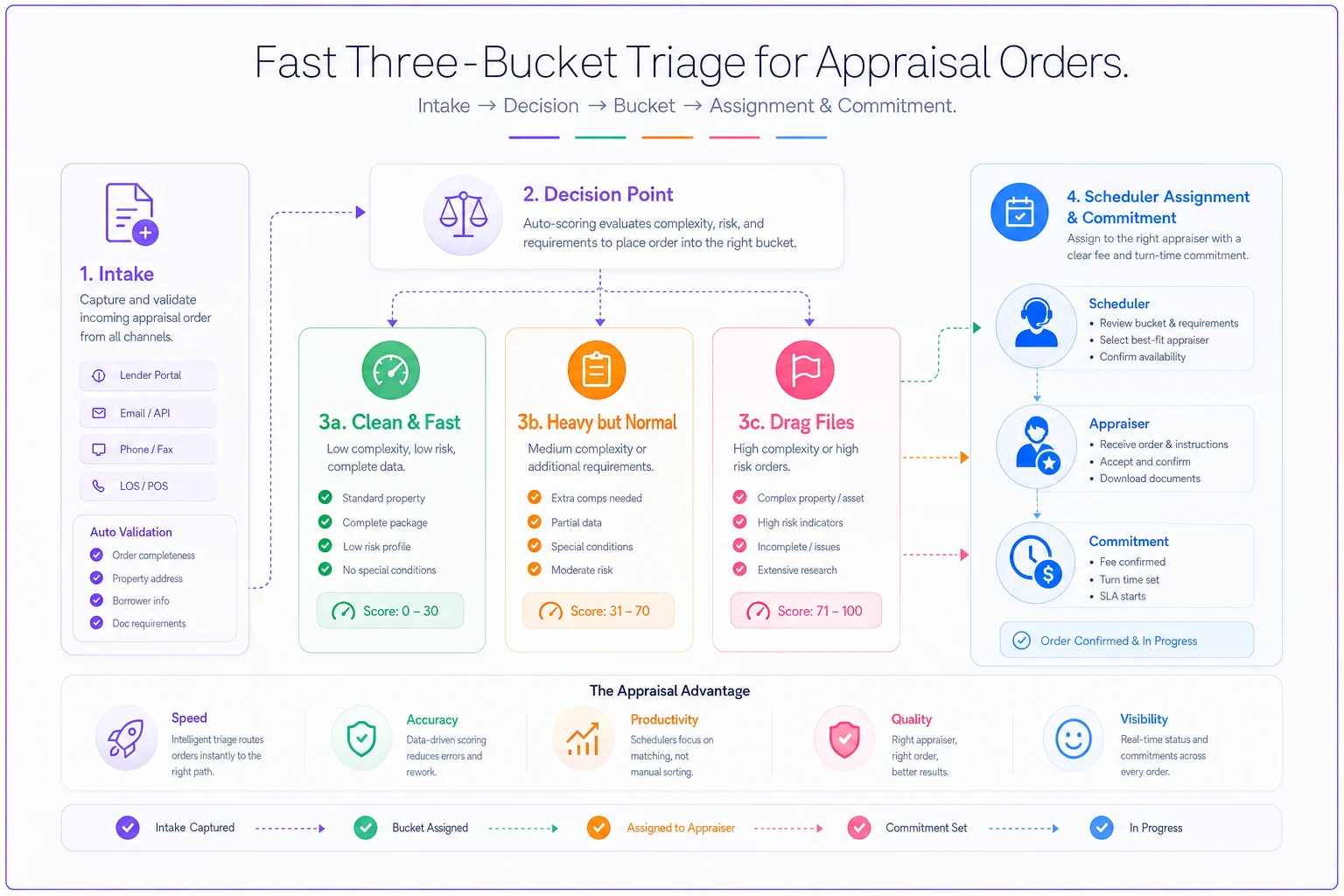
Triage isn't about turning work away. It's about knowing which bucket a file is in before you commit a turn time or a fee to it.
Reprice the low-volume services, not the whole sheet
The instinct during a demand drop is either to cut fees to win volume or freeze everything and hope. Both are usually wrong.
Cutting your standard SFR fee to chase a shrinking pool of orders is a race you win by going broke slower than the next firm. It trains your best clients to expect the lower number and it's brutally hard to walk back when volume returns. Meanwhile, the services that actually deserve a pricing look during a slowdown are the low-frequency, high-effort ones — the exact files now making up a bigger share of your book.
When mix shifts toward complex and rush work, your fee schedule should reflect that those files are no longer the exception. A rush surcharge that made sense when 5% of orders were rush is underpriced when rush is 20% of a thinner pipe and your scheduler is spending real time on each one.
This is where SLA-linked tiers earn their keep. Instead of one flat number per product, you're pricing the promise — turn time, communication cadence, revision handling — so the client who wants a two-day turn on a purchase-off pays for the capacity that guarantee reserves. If you haven't built this structure yet, the worked examples and SKU matrix in our SLA-linked pricing guide are a cleaner starting point than trying to invent tiers under pressure. A slowdown is actually a decent time to roll tiers out, because you're renegotiating capacity assumptions with clients anyway.
A quick look at where repricing pays off vs. where it backfires
| Service type | Reprice during slowdown? | Why |
|---|---|---|
| Standard SFR, normal turn | No — hold the line | Cutting trains clients; raising loses volume you need |
| Rush / expedited turn | Yes — often underpriced | Now a bigger share of mix, eats scheduler and appraiser time |
| Complex / unique property | Yes — surcharge or tier it | Revision risk and effort don't scale with a flat fee |
| Drive-by / exterior products | Situational | Can be a cheap capacity filler if routed well |
| Reissues / updates | Tighten scope, don't discount | Rushed updates during churn are your top audit risk |
The table above isn't exhaustive, but it covers the decisions that come up most in a soft-market period. The core principle is simple: don't reprice the files you want to keep; reprice the ones that have quietly gotten more expensive to deliver.
Reshape capacity in weeks, not quarters
Staffing to a demand drop is where firms either overreact or freeze. The goal is to shrink your committed capacity without destroying your ability to scale back up when applications recover — and they always eventually do.
Block scheduling is your main lever here, and it works differently in a slowdown than in a boom. In a busy market you build dense blocks to maximize stops per day. In a soft market with a heavier mix, you want fewer, better-planned blocks that account for longer per-file handling time. Cramming a light day full of drag files just spreads inefficiency evenly.
-
Consolidate field days. If volume supports four inspection days a week instead of five, consolidate geographically and reclaim a full day of routing and drive time rather than running five thin days.
-
Reassign, don't just reduce. Move your fastest appraisers onto the clean-and-fast bucket to keep those turn times sharp. Put your most careful reviewers on the drag files where revision risk lives.
-
Convert fixed to variable where you can. This is the moment to lean on fee-panel or contract capacity for overflow instead of carrying it as fixed cost. Keep your core team busy and profitable; flex the edges.
-
Protect QC time. Counterintuitive, but slowdowns increase exception risk, not decrease it. More on that below.
-
Watch utilization weekly. If your best appraisers drop under roughly 60–65% billable field time for two weeks running, you're carrying too much committed capacity for the current pipe.
Block-schedule your clean-file appraisers to preserve turn times while consolidating field days.
The firms that recover fastest from a demand dip are the ones that flexed at the edges while keeping the core team productive. The ones that struggle either laid off too deep and couldn't staff back up, or held everyone at full cost and watched margin disappear.
The audit trap hiding inside a slowdown
When volume drops, appraisers and reviewers have more time per file, so you'd assume quality goes up. What tends to happen is different, and it's driven by two forces.
-
Is this a new assignment or an update/reissue with proper version control and effective-date discipline?
-
Does the file's complexity match the fee and turn time you committed, or did you take a drag file at clean-file terms?
-
Have photo, metadata, and comp-support standards been met, or were they trimmed to hit a rush turn?
-
Is scope creep documented — did the client add conditions after the fee was set?
-
For any reissue
is it genuinely defensible as an update, or are you stretching an old valuation into a new market?
None of this is new work. It's the same discipline you already run — but a slowdown is exactly when the temptation to shortcut it is highest, and the mix is exactly when shortcuts cost the most.
A realistic scenario
A three-appraiser firm in a mid-sized metro was running around 90–100 orders a month through the spring, maybe 55% refi. By mid-September the pipe had thinned to the high 60s, and refi had dropped to under a third. Revenue fell noticeably, but the owner's first read was that it fell roughly in line with volume.
Digging into the actual files told a different story. Average handling time per assignment had climbed because the surviving orders were purchase, cash, and a couple of estate files. Two appraisers were sitting at maybe 55% billable field time while the office still carried the same software seats and panel costs. And they'd taken three rush updates on older files that month to plug the revenue gap — one of which came back with a lender exception that ate a full day of rework.
The fix wasn't dramatic. They consolidated field work from five thin days to four planned ones, moved their fastest appraiser onto the clean SFR bucket to hold those turn times, added a defined rush tier with a real surcharge instead of absorbing rush work at standard fee, and put a hard rule around which stale files they'd agree to update. Within about six weeks per-file margin was back roughly where it had been pre-slowdown, even though total volume stayed soft. They didn't chase the volume back. They stopped losing money on the volume they had.
When these moves make sense — and when they don't
Not every rate wiggle deserves an operational response. If you're seeing a one-week blip and your pipeline is still full four weeks out, sit tight — reorganizing capacity around noise costs you more than it saves.
These plays make sense when the signal is sustained: two-plus weeks of softer applications, a visible mix shift on your own intake, and utilization on your core team trending down. That's worth planning around. A single week of slow intake probably isn't.
They're a bad idea if you react purely on headlines without checking your own order data first. National rate averages and your local pipe don't always move together — a metro with tight inventory and heavy purchase activity can stay busy while refi-heavy markets go quiet. Reprice and restaff against what's actually hitting your intake, not what the weekly survey says.
And if you're a very small shop — one or two appraisers — skip the elaborate tier matrix and focus on two things: don't take drag files at clean-file terms, and don't turn risky updates just for cash flow. That alone protects most of your margin.
Where software actually helps here
Most of the tactical stuff above is discipline, not tooling. But two things get genuinely hard to do manually during a churn period, and that's where an operational platform earns its keep.
The first is seeing the mix shift early. If your intake, scheduling, and turn-time data all live in one place, the change in average handling time and utilization shows up in a dashboard before it shows up in your bank balance. Firms running orders across email, spreadsheets, and a scheduling calendar usually feel the margin problem a month after they could have caught it. AI-assisted intake that flags complexity and assigns a bucket at order entry means triage happens automatically instead of depending on whoever happens to be at the desk that day.
The second is repricing without breaking client relationships. Managing SLA-linked tiers, applying the right surcharge to the right file, and keeping version control clean on updates is exactly the kind of rule-based, easy-to-fumble work that automation handles well. It's not about replacing judgment — it's about making sure the tier you decided on actually gets applied consistently when everyone's stressed about a thin pipe.
None of that wins back lost volume. It just makes sure the volume you keep stays profitable, and that you're not adding audit exposure while you scramble. That's the whole game during a slowdown — protecting margin, staying defensible, and being ready when demand comes back on its own schedule.
Ready to elevate your appraisal operations?
Join 500+ appraisal firms using Rateoly to enhance accuracy, save time, and improve client satisfaction.