

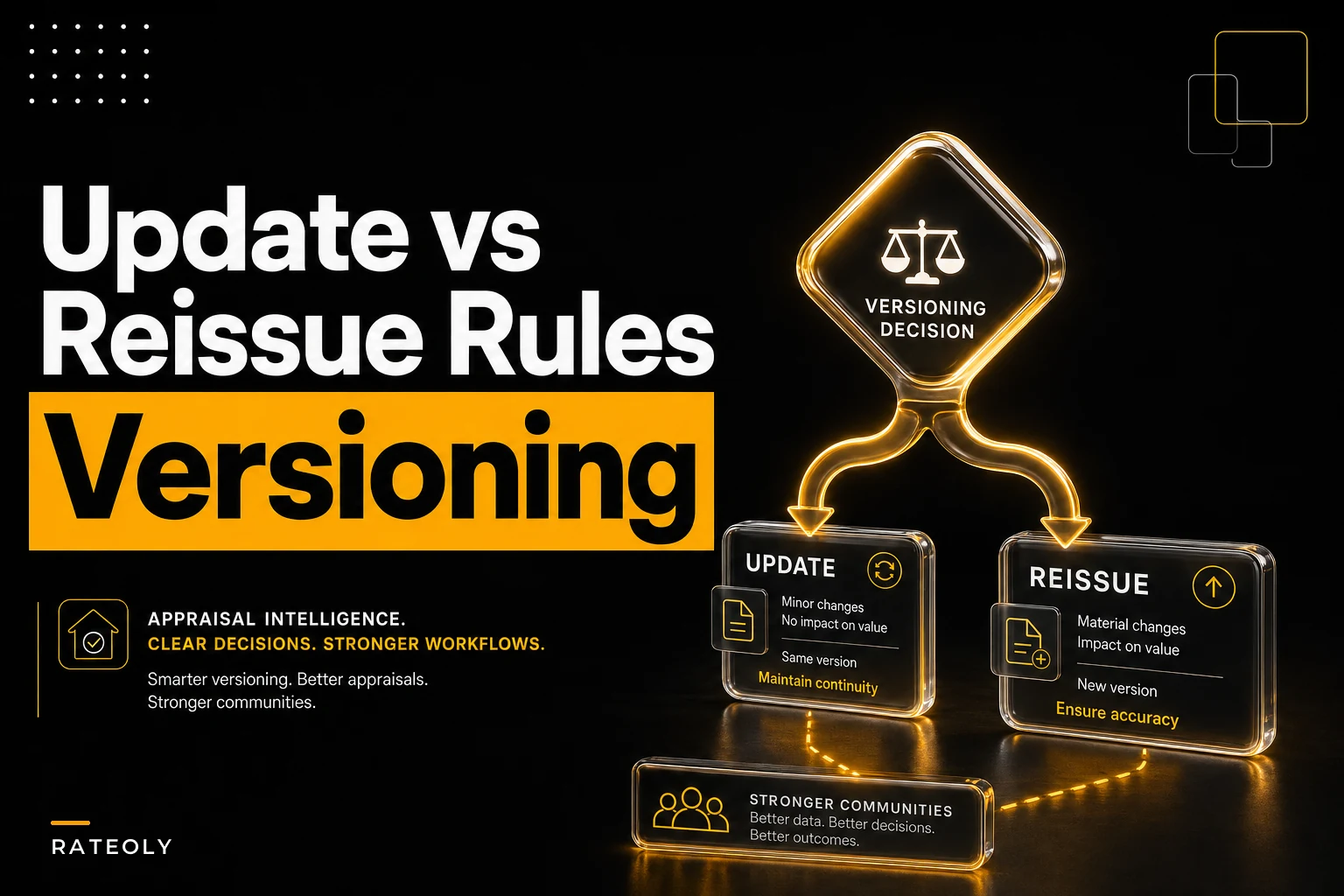

The update vs reissue distinction catches experienced appraisers off guard more often than it should. You swap out one comparable sale, figure it's a minor correction, and three days later the lender kicks it back demanding a full reissue—fresh certification dates, new photos, updated market analysis. What started as a quick fix just turned into a multi-day production problem.
Most appraisal firms handle this wrong because they treat every revision request the same way. They either default to updates, which creates compliance problems, or always reissue, which burns time and creates version confusion for clients. The right answer depends on specific triggers, and most teams don't have a clear process for identifying them.
The $475 mistake that happens when you guess wrong
A mid-sized firm in Phoenix learned this firsthand. They got a revision request to adjust a comp that had sold after the original effective date. The appraiser treated it as an update, kept the original certification date, and sent it back. The underwriter flagged it immediately—using a comp that sold after your certification date requires a reissue, not an update.
The fix took another four days. They had to pull fresh market data, update all time adjustments, get new certifications from everyone involved, and explain to their client why the "simple fix" turned into a complete do-over. Between appraiser time, admin overhead, and client management, the total cost came out around $475.
This repeats constantly because firms lack clear decision protocols. An appraiser makes a judgment call at 4 PM on a Friday. By Monday, that call has cascaded into compliance reviews, lender pushback, and scrambling to fix what should have been straightforward.
Why the decision gets murky
The confusion comes from how different parties view revision requests. Lenders think about loan processing—they want the fastest path to closing. Appraisers think about work effort—they want minimal rework. Compliance teams think about defensibility—they want documentation that holds up under review.
Manage every appraisal with confidence and clarity.
Rateoly helps you coordinate inspections, generate reports, and communicate seamlessly with clients.
- Comprehensive appraisal tracking
- Automated client notifications
- Integrated scheduling & report management
No credit card required
These competing perspectives create situations where a loan officer promises a "quick update" to their borrower without understanding USPAP requirements, an appraiser changes multiple elements thinking they're still within update territory, a compliance reviewer catches issues weeks later during quality control, and the original requester gets frustrated when their "simple change" becomes complicated.
USPAP provides general guidance on updates versus reappraisals, but the specific triggers vary by assignment type, client requirements, and state regulations. What qualifies as an update for one lender might require a full reissue for another.
Building your decision tree from real trigger points
Clear patterns emerge after watching enough revision requests flow through different firms. The decision hinges on three factors: scope of changes, certification date implications, and documentation requirements.
Scope triggers that force a reissue: When you're modifying core value conclusions or methodology, you're in reissue territory. That includes changing your highest and best use analysis, switching from sales comparison to income approach as primary, or adjusting gross living area by more than 5%. Even correcting the year built can trigger reissue requirements if it substantially affects value. Material changes to comparables also force reissues. Adding or removing more than one comp, using sales that occurred after your original effective date, or discovering a comp was actually a distressed sale—all of these require starting fresh. The threshold sits lower than most appraisers expect. Even adjusting comp selection criteria retroactively triggers reissue protocols.
Certification date complications: This is where most of the confusion lives. Updates maintain the original certification date—you're essentially saying "as of that original date, here's what I would have concluded." Reissues get new certification dates because you're creating a new appraisal as of today. That distinction matters for market data. If you're updating an appraisal from three months ago, you can't use market information that didn't exist at that time. If you're reissuing, you're required to use current market conditions, which means refreshing everything—comp searches, trend analysis, all of it.
Evidence and documentation requirements: Updates require documenting what changed and why, but within the existing report structure. You're adding an addendum or revision page that clearly marks modifications. The original report stays the primary document. Reissues need complete documentation packages. You can't just reference the original work file. You need fresh photos if significant time has passed, updated certifications from all parties, new engagement letters in some cases, and a complete audit trail showing this is a new assignment—not a modification.
The version control nightmare nobody talks about
Version control gets complicated fast when you're mixing updates and reissues. A single property might have an original appraisal, two updates, a reissue, and then an update to the reissue—five versions floating around, and different parties are almost certainly working from different ones. The seller's agent has the original. The buyer's lender has Update #2. The secondary market reviewer has the reissue. Nobody agrees on which version represents the current opinion of value.
Keep a single source-of-truth document repository and enforce read/write permissions so stakeholders aren't working from outdated copies.
One firm fixed this with strict naming conventions: PropertyAddressYYYY-MM-DDv1.0 for originals, v1.1 for updates, and v2.0 for reissues. Every document included a version history table on page two showing all previous versions and what changed. That simple system eliminated a large chunk of their version confusion—problems that had been a constant source of back-and-forth with lenders.
Your ready-to-deploy decision framework
The decision tree below works in practice. Run through these questions in order:
-
1. Does the change affect the effective date of value? - Yes → Reissue required - No → Continue to question 2
-
2. Are you changing more than one comparable sale? - Yes → Reissue required - No → Continue to question 3
-
3. Does the change alter your value conclusion by more than 2%? - Yes → Reissue required - No → Continue to question 4
-
4. Has more than 60 days passed since original certification? - Yes → Reissue required - No → Continue to question 5
-
5. Are you adding new approaches to value or removing existing ones? - Yes → Reissue required - No → Update acceptable
This framework handles the majority of cases correctly. The remainder require judgment calls based on specific lender requirements or unusual circumstances—no checklist fully eliminates that.
Template language that prevents revision ping-pong
How you phrase updates versus reissues determines how quickly they get accepted. Wrong language triggers additional review cycles.
For updates: "This update to the appraisal report dated [original date] addresses [specific issue]. The effective date of value remains [original date]. The following modifications have been made: [list changes]. All other aspects of the original appraisal remain unchanged. This update should be read in conjunction with the original report."
For reissues: "This reissued appraisal report supersedes and replaces the appraisal dated [original date]. The effective date of value is [new date]. This reissuance was necessary due to [specific trigger]. This report represents a new appraisal assignment and should be considered independently from any previous reports on this property."
Avoid terms like "revised appraisal" or "corrected report"—these create ambiguity about whether you're updating or reissuing and invite more back-and-forth.
Billing structures that match the work involved
The billing gap between updates and reissues should reflect the actual work difference. Updates typically run $150–300 since you're making targeted modifications to existing work. Reissues should bill at 60–75% of the original fee—you're completing a new assignment, just with some efficiency from already knowing the property.
| Revision Type | Fee Range |
|---|---|
| Minor update (typos, clarifications) | $150 |
| Substantial update (comp adjustment, narrative addition) | $250 |
| Reissue with same comps | 60% of original fee |
| Complete reissue with new comp search | 75% of original fee |
Setting these tiers in writing—and sharing them with clients upfront in the engagement letter—removes most of the billing friction when a reissue comes up unexpectedly.
Building this into your operational workflow
The update versus reissue decision can't rely entirely on individual appraisers making judgment calls under time pressure. It needs systematic handling.
Build an intake checklist for revision requests that routes automatically to the correct workflow. When a revision request comes in, your admin team runs through the five-question framework. Based on the answers, the request goes to the update queue or the reissue queue, each with its own turnaround expectations, fee codes, and documentation requirements. Your audit and compliance framework should include specific protocols for reviewing both. Updates get spot-checked for scope creep—making sure an update didn't quietly venture into reissue territory. Reissues get reviewed for completeness, making sure all elements were properly refreshed, including fresh photo documentation if enough time has passed since the original.
A consistent intake routing process looks like this:
-
1. Revision request received by admin
-
2. Admin runs five-question framework
-
3. Request classified as update or reissue
-
4. Routed to appropriate queue with correct fee code
-
5. Appraiser notified with classification and template language
-
6. Client notified of timeline and cost before work begins
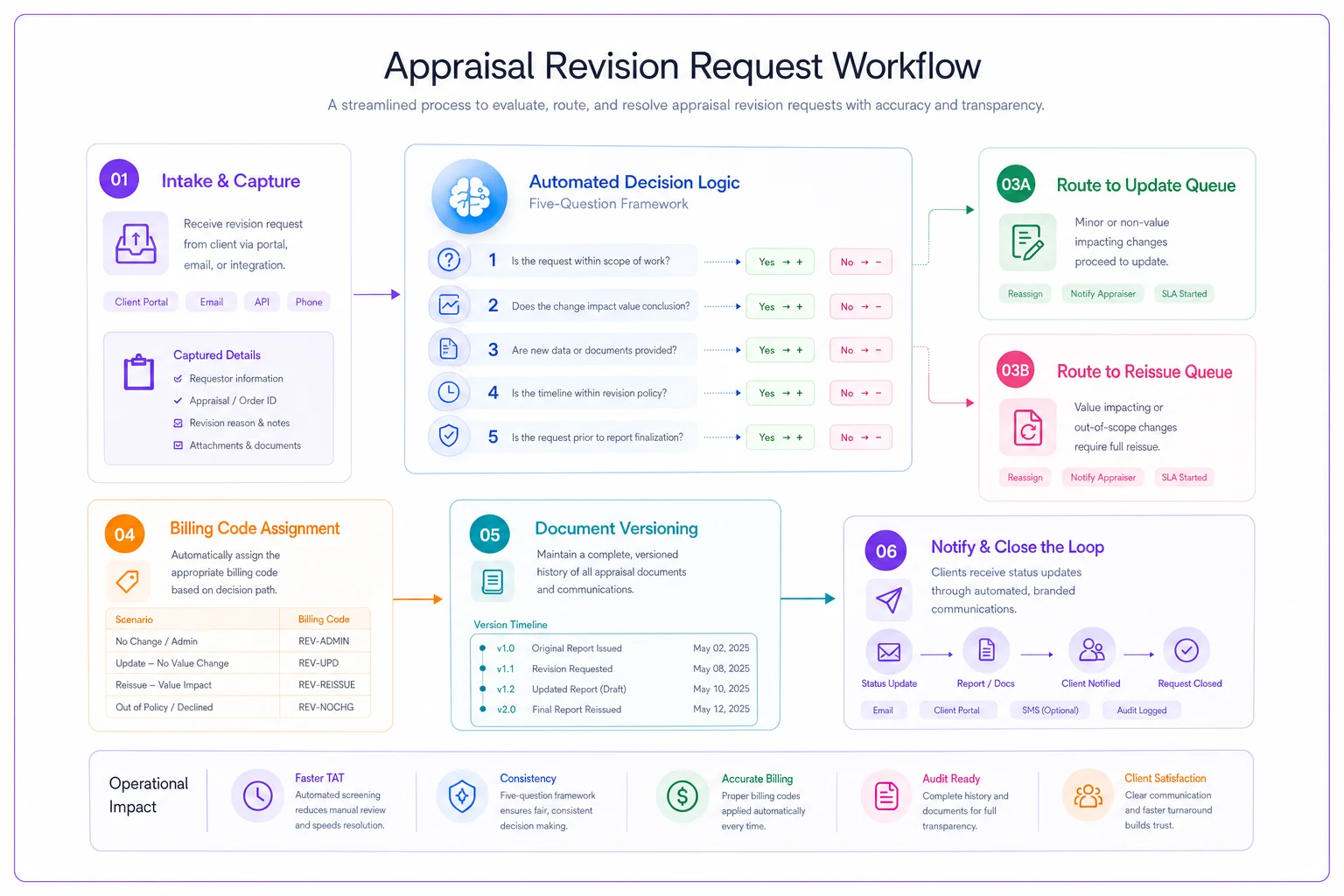
Following this sequence prevents the ad-hoc judgment calls that create problems downstream. It also gives you a paper trail if a lender or client questions the classification later.
When operational software handles the decision logic
Modern appraisal management platforms can embed this decision logic directly into revision workflows. When a revision request arrives, the system runs through the framework questions and determines update versus reissue automatically—then generates appropriate template language, sets the correct billing codes, and creates the right documentation structure.
This is where AI-powered operational software earns its keep. Not by replacing appraiser judgment, but by catching the stuff humans miss when they're busy. A request might look simple on the surface ("please correct the square footage"), but the system recognizes that changing square footage by more than a certain threshold typically triggers reissue requirements for that particular lender. Those pattern catches prevent the expensive mistakes that happen when the decision gets made at 4 PM on a Friday.
Version control also becomes more manageable. The platform maintains a complete version tree showing the relationship between all versions, who requested what changes, and which version each stakeholder is currently working from. When someone references an outdated version, it gets flagged before it becomes a problem.
The compliance buffer that keeps you protected
Documentation is your defense when questions come up months later about why something was handled as an update versus a reissue. A standard decision documentation form should capture the original request language, the framework questions and answers, trigger identification, the appraiser's recommendation, the final decision and rationale, and client confirmation.
It takes about three minutes to complete, but it creates a complete audit trail. One firm avoided a significant liability claim because they could show exactly why a particular revision was handled as an update, with client agreement documented at the time. That kind of paper trail matters more than most appraisers realize until they're actually in that situation.
Store these forms with both the original appraisal and the revision in your work files. During regulatory reviews or anything that ends up in front of a court, this documentation shows systematic decision-making rather than guesswork.
Managing client expectations around revision types
Clients rarely understand the update versus reissue distinction until it affects their timeline or their bill. Getting ahead of it prevents frustration later.
Include revision type explanations in your engagement letters. Specify what qualifies for an update (typos, minor clarifications) versus what triggers a reissue (comp changes, value adjustments, time passage). Quote both fee structures upfront so there's no surprise when a reissue costs more than expected.
When a revision request comes in, respond quickly with the determination and your reasoning. Something like: "This revision requires a reissue rather than an update because it involves changing comparables that affect the value conclusion. The reissue will take 3–4 business days and cost $450. Should we proceed?" That transparency upfront cuts most of the frustration before it starts.
Making the right call quickly
With clear frameworks, standard template language, and systematic intake handling, the update vs reissue decision becomes routine rather than stressful. The firms that handle this well treat revision requests as distinct workflows, not afterthoughts. They have documented triggers, appropriate billing, and version control that doesn't rely on memory.
The ones that struggle treat every revision as a one-off judgment call. That inconsistency creates compliance risk, billing disputes, timeline delays, and version confusion that compounds over time.
Getting the decision right means your appraisers know exactly what to do, your clients know what to expect, and your compliance team isn't second-guessing whether revisions were handled correctly three months later. That's a small operational investment with returns that show up every single week.
Getting the decision right means your appraisers know exactly what to do, your clients know what to expect, and your compliance team isn't second-guessing whether revisions were handled correctly three months later. That's a small operational investment with returns that show up every single week.
Ready to elevate your appraisal operations?
Join 500+ appraisal firms using Rateoly to enhance accuracy, save time, and improve client satisfaction.