



Most firms don't lose money on exceptions because the appraiser was wrong. They lose it because the response sits in someone's inbox for two days, then goes out as a hurried paragraph that answers the wrong question. The underwriter bounces it back, and now you're on round three of something that should have closed in one reply.
The problem isn't skill. It's that exception responses get treated as interruptions instead of a workflow with its own rules. No triage, no standard evidence, no agreed response time, no reusable language. Every exception becomes a fresh improvisation.
This post is a tight fix for exactly that: how to prioritize incoming exceptions, what a reusable evidence pack should contain, realistic first-response SLA targets, and sample scripts mapped to the exception types you actually see. If you've been searching for workable appraisal exception response templates, the goal here is to give you something you can drop into your process this week.
Why exception responses fall apart
A few patterns show up again and again in small and mid-size shops.
The first is that exceptions arrive through too many channels. One lands in the AMC portal, one comes as an email from a loan officer, one shows up as a voicemail from a processor. Nobody has a single queue, so there's no shared view of what's outstanding or how old it is.
The second is that the person writing the response isn't the person who did the work. A reviewer or admin forwards the exception to the appraiser — who's in the field — who answers three hours later with half the context, which the admin then rewrites. Each hand-off adds delay and loses detail.
The third, and most expensive, is that responses don't come with evidence. A lender asks why a comp two miles away was used instead of one across the street. The reply says "the closer comp was inferior in condition" — which may be true, but with no photo, no MLS remark, no adjustment line cited. That's not a rebuttal. That's an opinion the underwriter has no particular reason to accept.
Step one: a prioritization framework that fits in your head
You don't need a scoring model with ten variables. You need a quick way to sort every incoming exception so the urgent ones don't sit behind the trivial ones.
Manage every appraisal with confidence and clarity.
Rateoly helps you coordinate inspections, generate reports, and communicate seamlessly with clients.
- Comprehensive appraisal tracking
- Automated client notifications
- Integrated scheduling & report management
No credit card required
A simple triage that works in practice: when an exception comes in, ask two questions — Does this block the loan from closing? and Can I answer it without new field work?
That gives you four lanes:
| Blocks closing? | Needs field work? | Priority | Target first response |
|---|---|---|---|
| Yes | No | P1 — answer now | Within 2 business hours |
| Yes | Yes | P2 — schedule fast | Acknowledge in 2 hrs, plan same day |
| No | No | P3 — batch | Same business day |
| No | Yes | P4 — plan | Next business day |
The reason this works is that it separates urgency from effort. A P1 is something you can clear with a sentence and an attachment — a missing signature explanation, a clarification on cost approach, a comp distance justification. Those should never wait. A P2 blocks closing but needs a re-measure or a second interior photo, so the right move is to acknowledge immediately and give the lender a real timeline instead of going silent.
The mistake most firms make is treating everything as the same priority, which in practice means everything gets answered in the order it was opened. That's how a one-line clarification ends up sitting behind a complex re-inspection request.
Keep a one-month log of exception types to confirm which templates will actually cut the most time.
One thing worth noting: a surprising share of P1 exceptions are the same five or six questions over and over. Comp distance. Comp age. Condition rating versus photos. Gross living area discrepancy versus public records. Adjustment magnitude. Log exception types for even a month and you'll see the concentration — and that concentration is exactly what makes templating worth the effort.
Step two: build the evidence pack before you write a word
A rebuttal without evidence is just a louder version of the report the underwriter already questioned. The fix is to assemble the supporting material first, then write a short response that points to it.
An evidence pack doesn't need to be elaborate. For the common exception types, it's usually three or four items pulled from the file you already have.
Here's what a reusable evidence pack should include, by situation:
-
Comp selection challenges MLS sheets for the chosen comps, a one-line note on why nearer or more recent sales were rejected (pending, REO, superior condition, different submarket), and the map exhibit showing distances.
-
Condition or quality disputes the specific interior/exterior photos that support the rating, the exact rubric language you applied, and MLS remarks if they corroborate.
-
GLA or room count discrepancies your sketch, the measurement method note, and a short explanation of the difference from public records (which are frequently wrong — say so plainly, with the source date).
-
Adjustment questions the paired-sales or market support behind the adjustment, or a sentence citing the market data you relied on, with the figure stated.
-
Value disagreements the reconciliation logic, the weight given to each comp, and why the lender's suggested comp wasn't used.
Every exception type maps to a predictable short list of attachments. Once you know the list, assembling the pack is a two-minute task, not a research project. Firms that keep their files organized and well-documented from the start — the kind of discipline covered in building an appraisal compliance and evidence framework — find the evidence pack is basically already sitting in the file. The ones that don't end up reconstructing the reasoning after the fact, which is slower and reads defensively.
A useful way to think about the overall process before diving into response scripts:
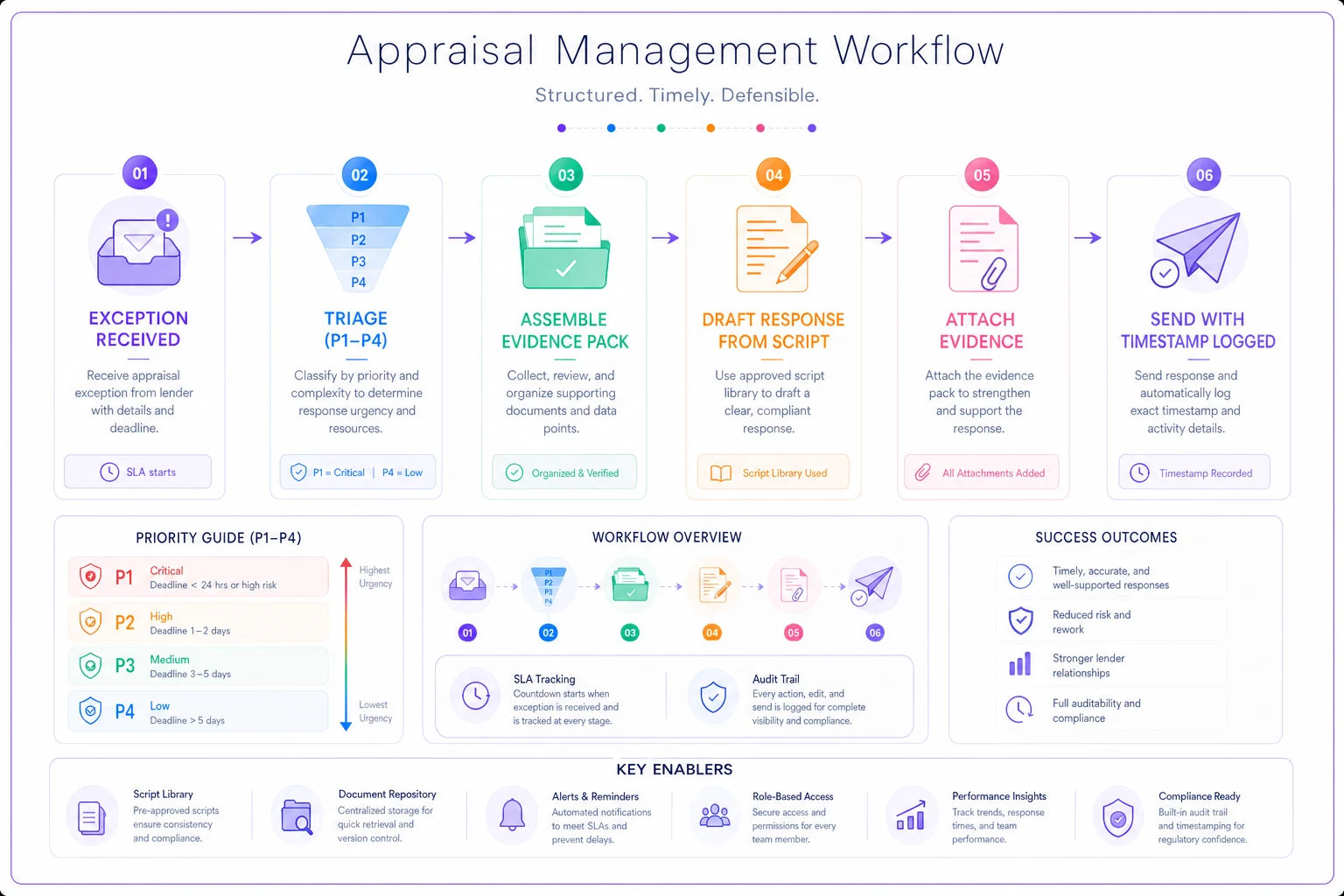
Exception received → Triage (P1–P4) → Assemble evidence pack → Draft response from script → Attach evidence → Send with timestamp logged
Step three: set a first-response SLA you'll actually hit
SLA targets fail when they're aspirational instead of operational. "Respond to all exceptions within one hour" sounds great until the first busy Tuesday.
Realistic targets look like the response-time column in the table above, and they're built around first response, not resolution. That distinction matters. You can't always resolve a P2 in two hours, but you can always acknowledge it, confirm you have it, and state what happens next. That acknowledgment alone kills most of the "any update?" follow-up emails that clog the queue.
-
Every exception gets a timestamped acknowledgment within 2 business hours, regardless of priority.
-
P1 items get a full response in the same window.
-
P2 items get a committed timeline — not a vague "soon" — in the acknowledgment.
-
P3 items clear by end of the same business day.
-
Anything aging past its target triggers a flag to whoever owns the queue.
The number that actually moves is the acknowledgment time, because silence is what lenders remember. A full, well-supported response that arrives in four hours beats a rushed one in thirty minutes that gets bounced back.
Sample response scripts mapped to exception types
These are starting points, not fill-in-the-blank forms. Keep them short, point to the evidence, and drop the arguing tone. The goal is to make the underwriter's "accept" the path of least resistance.
Comp distance / better comp available > The subject is located in [submarket]. The nearer sale at [address] was considered but not used as a primary comparable because [pending status / REO / superior condition / different school district]. The selected comparables at [addresses] are the most recent closed, arm's-length sales in the subject's market area; distances and the rejection rationale are shown on the attached location map and comp grid. Supporting MLS sheets attached.
Condition rating challenge > The C[#] rating reflects [specific observed conditions], documented in the attached interior and exterior photos ([photo references]). The rating was applied per [rubric/standard], and the MLS remarks for the subject's prior listing corroborate [detail]. No adjustment to the rating is warranted based on the file evidence.
GLA discrepancy vs. public record > The GLA of [X] sq ft is based on an on-site measurement using [method], shown in the attached sketch. The public record figure of [Y] sq ft dates to [year] and appears to predate [addition/finished area]. The appraised GLA is the more current and accurate figure.
Adjustment magnitude question > The $[amount] adjustment for [feature] is supported by [paired sales / market extraction / cost data], summarized in the attached [exhibit]. This reflects observed market reaction in the subject's area and is consistent across the comparable set.
Value disagreement / lender comp suggested > The comparable suggested at [address] was reviewed. It was not used because [superior GLA / different submarket / dated sale / non-arm's-length]. The reconciled value gives greatest weight to [comp] as the most similar in [factors]. The supporting analysis is attached; no change to the opinion of value is indicated.
Notice what these scripts don't do: they don't apologize, they don't hedge, and they don't re-open the whole analysis. They state a position and hand over proof. Applied consistently, that tone trains lenders to expect substance from your firm and cuts down on reflexive second bounces.
A short real scenario
A two-appraiser firm doing mostly AMC work was running exceptions out of a shared inbox with no triage. Average first response was somewhere around a day and a half, and a meaningful chunk of exceptions went two or three rounds before closing. The owner figured rework and back-and-forth was eating close to a full day of someone's time each week.
They did three things: put every exception into one queue, adopted the four-lane priority sort, and built five evidence-pack templates for their most common exception types. No new software at first — just a shared doc and some discipline.
Within roughly two months, first-response time on P1s dropped to two or three hours, and the share of exceptions closing on the first reply went from somewhere around half to the large majority. The owner's rough estimate was a day a week recovered, plus noticeably fewer frustrated emails from processors. Nothing dramatic — just the same work, organized.
When this is worth the effort — and when it isn't
This system pays off fastest if you're handling exceptions across more than one channel, if multiple people are touching responses, or if the same exception types keep recurring. More volume and more hands means a bigger return on standardizing.
It's less urgent if you're a solo appraiser doing a handful of reports a month through a single client who rarely pushes back. The overhead of maintaining templates might actually outweigh the savings there — though having the five scripts saved somewhere costs nothing and prevents a scramble when an exception does land.
Where it's genuinely a bad idea: using templates as a substitute for actually reading the exception. Scripts speed up how you respond, not whether you engage with the specific question. A template pasted in without the right evidence attached is worse than a thoughtful one-off — it reads as dismissive and usually invites escalation.
Keeping the system from rotting
The quiet failure mode is templates going stale while nobody maintains the exception log. Set a light cadence — once a quarter, look at what exception types actually came in, whether any new recurring ones showed up, and whether any script is getting bounced more than it should. If a particular template keeps failing, that's a signal either the language or the underlying report practice needs work.
The logging and tracking side is where this either sticks or falls apart, because manually maintaining an exception queue is exactly the kind of low-value admin that collapses under pressure. Firms that have already worked through an automation inventory for their manual chores tend to fold exception tracking into the same system, so acknowledgments get timestamped and aging items get flagged without anyone babysitting a spreadsheet.
The point of all this isn't to respond to more exceptions. It's to respond to each one once, fast, with proof attached — and to stop treating a predictable, recurring part of the job like a surprise every time it shows up. Build the queue, sort by whether it blocks closing and whether it needs field work, attach the evidence before you write, and lean on the scripts for the common cases. The first-round close rate does the rest.
Ready to elevate your appraisal operations?
Join 500+ appraisal firms using Rateoly to enhance accuracy, save time, and improve client satisfaction.