

Most appraisal firms treat their lender and AMC relationships as a pipeline: orders come in, reports go out, conditions bounce back, and everyone argues about turn times. That framing is exactly why exceptions never really go down. When both sides operate as separate silos passing files back and forth, the friction that generates rework — vague conditions, mismatched expectations, undocumented preferences — never gets addressed at the source. It just gets rediscovered on every file.
The firms that actually reduce exception volume over time do something different. They stop treating the relationship as transactional and start treating it as a joint operation with shared responsibilities, shared metrics, and shared accountability. That's what an actual partnership looks like — not a nicer master service agreement, but a structured arrangement where both parties agree on what "good" means and who fixes what when it breaks.
This is the part nobody sets up on purpose. Most partnerships evolve by accident, and accidental systems fail at scale.
Why exceptions are a relationship problem, not a file problem
If you audit a batch of recurring exceptions, most of them aren't really appraisal errors. They're expectation mismatches. The lender's underwriting overlay wanted a specific comp treatment that was never communicated. The AMC's automated review flagged a metadata field the appraiser had no idea was scored. The reviewer preferred a certain photo count that lives in someone's head, not in the engagement instructions.
This usually happens because each side optimizes for their own workflow. The appraiser optimizes for USPAP-defensible work. The AMC optimizes for a clean pass through their review engine. The lender optimizes for salability and investor overlays. None of these are wrong, but they're rarely reconciled up front. So the file becomes the negotiation surface, and every exception is a slow, expensive way of discovering a rule that could have been written down once.
What tends to show up across a lot of firms is that the top five recurring exception types account for the majority of rework volume — and almost all of them are predictable. They repeat because there's no shared mechanism to capture the fix and push it back into the intake rules on both sides. A firm fixes it on one file, the AMC never learns why, and the same condition shows up next week on a different order.
That's the core insight: an exception you fix on a single file is a cost. An exception you fix in the partnership rules is an investment. The whole point of a real partnership structure is to move fixes from the file level to the relationship level.
Partnership tiers: matching the relationship to the volume
Not every lender or AMC relationship deserves the same governance overhead. A shop doing 12 orders a year with a small credit union shouldn't build a joint scorecard with quarterly reviews — that's wasted effort on both sides. But a relationship pushing several hundred orders a year absolutely should, because the exception volume alone justifies the coordination cost.
Manage every appraisal with confidence and clarity.
Rateoly helps you coordinate inspections, generate reports, and communicate seamlessly with clients.
- Comprehensive appraisal tracking
- Automated client notifications
- Integrated scheduling & report management
No credit card required
Thinking in tiers keeps you from over-engineering small relationships and under-managing large ones. Here's a rough breakdown of how the structure should change as volume and dependency grow:
| Tier | Typical volume | Governance | What you formalize | Exception handling |
|---|---|---|---|---|
| Transactional | Under ~50 orders/yr | None beyond standard engagement letters | Turn time + fee schedule | Handle case-by-case |
| Preferred | ~50–250 orders/yr | Light quarterly check-in | Shared condition glossary, agreed photo/metadata standards | Log recurring types, review quarterly |
| Strategic | 250+ orders/yr | Joint scorecard + monthly checkpoint | Shared KPIs, root-cause loop, capacity commitments | Formal RCA with owner and due date |
| Pilot | Any, time-boxed | Weekly during pilot window | MOU with explicit exception-reduction target | Tracked against baseline, reviewed weekly |
The mistake most firms make is treating a high-volume AMC exactly like a low-volume one — same generic engagement terms, no shared metrics — and then wondering why the exception rate stays flat. Volume creates leverage. If an AMC sends you a couple hundred orders a year and 15% come back with conditions, that's not a file problem you can QC your way out of. That's a relationship worth investing governance time into.
Match governance intensity to account volume so you don't waste coordination effort on small, transactional relationships.
Your SLA-linked pricing and service tiers should map cleanly onto these partnership tiers. If you've already built pricing SKUs by service level, the partnership tier is essentially the account-level version of the same logic — it tells you how much coordination each relationship earns.
Joint governance checkpoints: the mechanism that actually moves the number
A shared KPI dashboard that nobody reviews together is just a spreadsheet. The thing that makes partnerships reduce exceptions is the checkpoint — a recurring, structured conversation where both sides look at the same data and agree on changes.
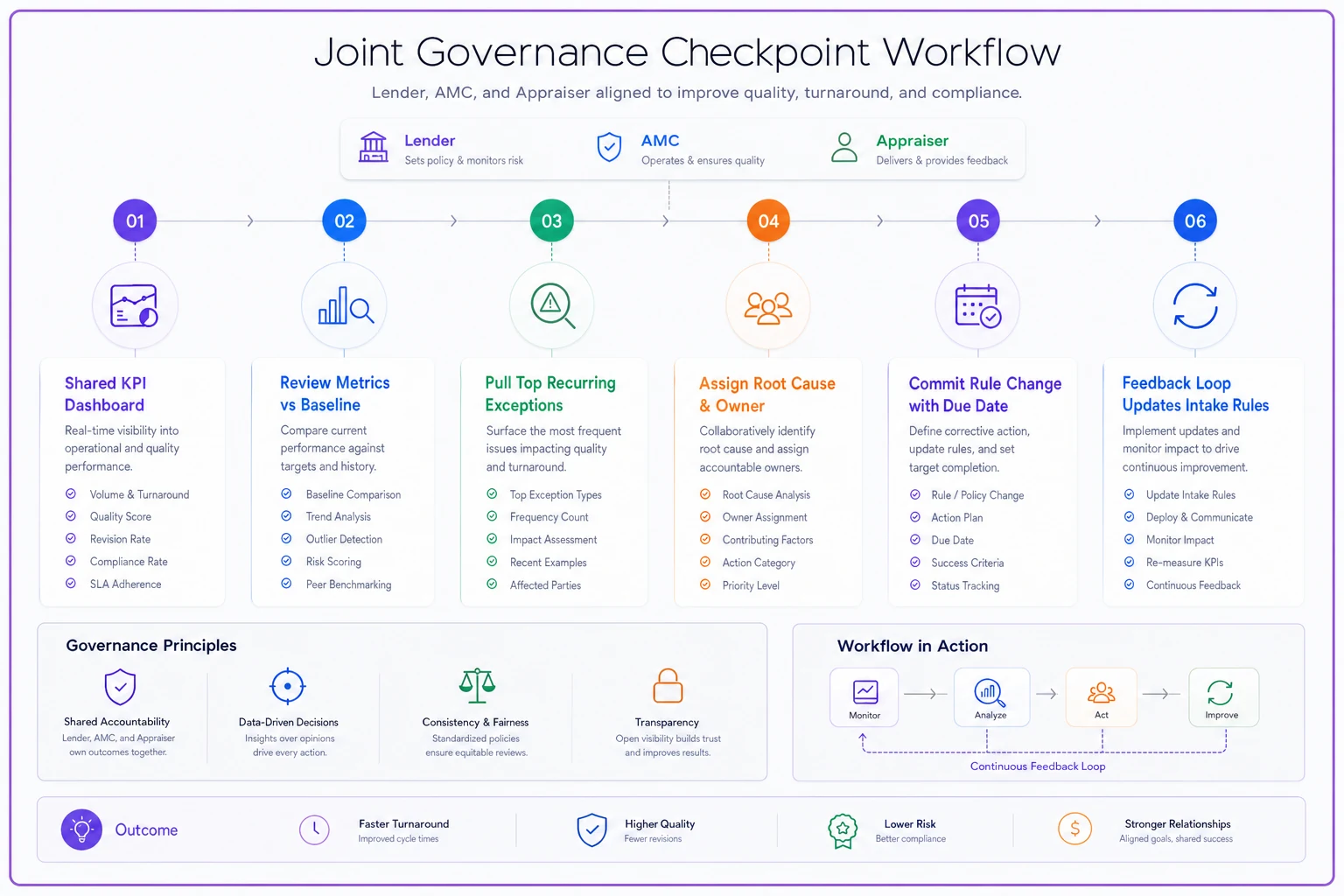
A simple illustration of the checkpoint workflow:
-
Review the shared metrics against the baseline. What was the exception rate this period versus last? Which categories moved? No storytelling yet, just the numbers both sides already agreed to track.
-
Pull the top 3 recurring exception types. Not every exception — the ones with volume. If a single condition category is responsible for a big chunk of rework, that's the one you fix.
-
Assign a root cause and an owner. This is where most partnerships fail. Someone has to own the fix, and the owner might be on the AMC side, not yours. A condition that keeps firing because the AMC's intake form doesn't capture the property type is their fix, not yours.
-
Commit to a rule change and a due date. The output of every checkpoint should be a change to the intake rules, the condition glossary, or the review criteria — something that prevents the exception from recurring, with a date attached.
This works because it forces bilateral accountability. In a normal appraiser-AMC relationship, the appraiser absorbs 100% of the fix burden even when the root cause sits upstream. A governance checkpoint puts the AMC's process on the table too. That's uncomfortable the first couple of times, which is exactly why so few firms do it — and why the ones that do end up with dramatically lower exception rates than their peers on the same client.
A realistic cadence: monthly for strategic accounts, weekly during a pilot, quarterly for preferred. Any less frequent than quarterly and the feedback loop is too slow to change behavior.
Shared KPIs: measure the friction, not just the output
Turn time is the metric everyone defaults to because it's easy to see and easy to argue about. But turn time alone hides the real cost of a bad partnership. A relationship can hit turn-time targets while generating enormous rework, because the appraiser is rushing files out and then reworking half of them.
-
First-pass acceptance rate — percentage of files that clear review with no conditions. This is the single best measure of whether your rules are aligned.
-
Exception density — average number of conditions per file, tracked by category. Rising density in one category is your early-warning signal.
-
Rework cycle time — how long a file sits in the condition-response loop. This is separate from initial turn time and often much larger.
-
Condition recurrence rate — how often the same condition type reappears after you supposedly fixed it. This is the metric that tells you whether your governance checkpoints are actually working.
-
Rescission/reissue rate — how often work gets fundamentally redone versus lightly amended.
The condition recurrence rate is the one most firms never track, and it's the most diagnostic. If you fix a condition type in a checkpoint and it drops to near zero the next period, your loop works. If it keeps reappearing, you fixed the file but not the rule — which means the root cause was misdiagnosed.
One thing worth flagging: shared KPIs only work if both sides can see the same numbers. If the AMC is tracking exceptions in their system and you're tracking them in yours, and the definitions don't match, every checkpoint turns into an argument about whose data is right. Agree on definitions before you agree on targets. A "condition" on their side and an "exception" on yours need to mean the same thing, or the whole scorecard is noise.
This connects to how you handle automated review generally — if an AMC leans heavily on model-driven review, the same governance discipline you'd apply to defensible automated valuations applies to their review engine. You want to know what it's scoring and why, not just react to the flags.
Where the whole system breaks as you scale
The reason ad-hoc relationship management fails isn't that any single relationship is unmanageable. It's that coordination cost scales faster than revenue when there's no system underneath it.
A firm with three lender relationships can hold all the preferences in the owner's head. Everyone knows this AMC wants six exterior photos, that lender's overlay hates dated comps, the third one is fussy about GLA sourcing. It works because it fits in one person's memory. Then the firm grows to fifteen relationships, hires two more appraisers, and suddenly the tribal knowledge doesn't transfer. The new appraiser doesn't know the AMC preferences, exception rates spike on their files, and nobody connects the dots because the knowledge was never written down.
-
New hires generating 2–3x the exception rate of tenured appraisers on the same accounts
-
The same conditions recurring across different appraisers because there's no shared rule set
-
Checkpoint commitments getting made and then lost because nobody owns the follow-through
-
Owner burnout from being the single point of coordination for every relationship
The fix is moving partnership knowledge out of heads and into shared, enforceable rules. The condition glossary, per-account metadata and photo standards, agreed KPI definitions — these need to live somewhere that intake, appraisers, and QC all touch. When a checkpoint produces a rule change, that change has to reach the people doing the work, or the checkpoint was theater.
This is where operational software earns its keep — not as a magic fix, but as the place where per-account rules, exception tracking, and checkpoint outcomes actually live so they don't evaporate. AI-assisted intake can flag when an order doesn't match a known account's requirements before the appraiser ever starts, and exception patterns that would take a person hours to spot across hundreds of files surface automatically. The point isn't automation for its own sake — it's that coordination knowledge stops depending on one person remembering it.
A template MOU for exception-reduction pilots
The fastest way to convert a rocky relationship into a real partnership is a time-boxed pilot with an explicit target. An MOU here isn't a legal contract — it's an operational agreement that both sides sign to align on what you're testing and how you'll measure it.
-
Scope and duration. Which order types, which volume band, and how long (usually 60–90 days is enough to see a trend).
-
Baseline. The current exception rate, first-pass acceptance, and recurrence rate — measured before the pilot, agreed by both sides. Without a baseline, you can't prove anything moved.
-
The explicit target. Something concrete
"reduce first-pass conditions on this order type by a meaningful margin over the pilot window." Vague goals produce vague results.
-
Shared rules being tested. The condition glossary, photo/metadata standards, and intake fields both sides commit to using during the pilot.
-
Checkpoint cadence and owners. Weekly review during a pilot, with named people on both sides who own follow-through.
-
What happens after. If the pilot hits its target, the relationship graduates to a strategic tier with the rules made permanent. If it doesn't, you both look at why before deciding to continue.
The value of writing this down is that it forces the AMC or lender to commit to their half. A pilot MOU that only obligates the appraiser is just an SLA with extra steps. The whole point is bilateral: both sides agree to change something.
A real scenario
A three-appraiser residential shop was doing roughly 220 orders a year with one mid-sized AMC that accounted for about 40% of their volume. Their condition rate on that AMC's files was sitting somewhere around 18% — nearly one in five files came back needing something. Most of it clustered in two categories: comp-selection queries and photo/metadata flags from the AMC's automated review.
Instead of continuing to fix each one file-by-file, they proposed a 90-day pilot. They pulled a baseline, agreed on a shared condition glossary, and set up a weekly 20-minute checkpoint with a specific contact on the AMC's side. The first two checkpoints were mostly the AMC discovering that a chunk of the photo flags came from their own intake form not capturing property type correctly — an upstream fix that had nothing to do with the appraisers.
By the end of the pilot, the condition rate on that account had dropped into the high single digits. Rework cycle time came down noticeably too, which mattered more to cash flow than the headline turn time ever did. The relationship graduated to a formal strategic tier, and the shared rules got baked into intake so new files inherited them automatically. Nothing about it was dramatic. It was just the difference between fixing exceptions one at a time and fixing the rules that produced them.
When this makes sense — and when it doesn't
Partnership governance is real work, and it's not always worth it.
It makes sense when: a single lender or AMC represents a meaningful share of your volume, exception rates are high enough to be eating margin, and the other side has someone willing to engage. High volume plus high friction plus a cooperative counterparty is the sweet spot. It's a bad idea when: the relationship is low-volume and transactional, or when the AMC treats you as fully interchangeable and won't commit to any process change on their end. You can't build a partnership with a counterparty that only wants a vendor. Governance overhead on a relationship that sends you a dozen orders a year is pure waste. Who should not do this: a brand-new firm still figuring out its own internal QC. If your own process is inconsistent, you can't credibly ask a partner to align with rules you don't reliably follow yourself. Get your internal exception handling stable first — then bring partners into a shared system.
The shift worth making
The real change here is conceptual, not procedural. Most appraisal firms think of lenders and AMCs as clients who send work and complain about it. The firms that quietly outperform think of the high-volume ones as joint operations where reducing friction is a shared project with shared metrics and shared accountability. Exceptions don't drop because appraisers get more careful. They drop because the rules on both sides finally match, the fixes get captured somewhere durable, and someone on each side owns the follow-through. Tiers tell you which relationships earn that investment, checkpoints give you the mechanism, shared KPIs tell you whether it's working, and a pilot MOU gets you started without betting the whole relationship on it. Build that structure once for your biggest accounts, and the exception volume that's been quietly draining your margin starts coming down for reasons you can actually measure.
Ready to elevate your appraisal operations?
Join 500+ appraisal firms using Rateoly to enhance accuracy, save time, and improve client satisfaction.