

Most firms don't get burned by AVMs because the model is wrong. They get burned because nobody wrote down why they trusted it, how they checked it, or when they should have overridden it. An automated valuation shows up in a hybrid product, an appraiser eyeballs it, it feels "about right," and it goes into the file. Six months later a review examiner asks how that number was validated and the honest answer is "it wasn't." That's the whole problem in one sentence.
AVM governance appraisal work isn't about distrusting the models. Good AVMs are genuinely useful for triage, portfolio monitoring, and sanity-checking your own conclusions. The trouble is that most shops treat them as either gospel or garbage, with no middle ground and no paper trail. What you actually need is a system: thresholds that decide when a model output can be used, sampling rules that keep it honest, and documentation that survives an audit without you scrambling.
This is that system. Not a lecture on model theory — a working playbook you can adapt this month.
Why AVM decisions quietly fall apart
The failure usually isn't dramatic. It's a slow accumulation of undocumented judgment calls that seemed fine individually.
A typical scenario: a firm takes on hybrid and desktop products where the client provides an AVM as a starting reference. The appraiser is supposed to use it as one data point. But under turn-time pressure, the AVM quietly becomes the anchor. Adjustments get nudged toward the model number. Comps that disagree get dropped. And because there's no rule saying "an AVM within X% of your independent conclusion requires nothing, but a gap over Y% requires documented reconciliation," every appraiser handles it differently.
Scale that across fifteen appraisers, three product types, two AVM vendors, and no shared thresholds — you don't have a valuation process anymore. You have fifteen personal habits. When one of those habits produces an outlier and a lender pushes back, there's no way to show the decision was consistent with how the firm handles every other file. That inconsistency is what makes a number indefensible, even when the number itself is correct.
The other quiet killer is confidence-score blindness. Every AVM ships a confidence or FSD (forecast standard deviation) figure, and most firms ignore it entirely. A model output with a tight confidence band around a cookie-cutter suburban tract home is a very different animal than the same model spitting out a number for a rural property with three comps in four miles. Treating both identically is the most common mistake I see.
The decision thresholds: when an AVM can actually be used
Before anything else, you need a rule that answers: for this assignment, is an AVM output usable, usable-with-conditions, or off the table? This isn't a vibe. Tie it to concrete factors. Here's a threshold structure that holds up in practice:
Manage every appraisal with confidence and clarity.
Rateoly helps you coordinate inspections, generate reports, and communicate seamlessly with clients.
- Comprehensive appraisal tracking
- Automated client notifications
- Integrated scheduling & report management
No credit card required
| AVM confidence tier | Property/market conditions | Permitted use |
|---|---|---|
| High confidence (tight FSD, dense comp set) | Conforming property, active market, 6+ recent sales within 1 mile | Usable as a supporting data point and reconciliation check |
| Medium confidence | Some atypical features, moderate sales volume | Usable for triage/screening only; cannot support final value without independent development |
| Low confidence (wide FSD, sparse comps) | Rural, unique, distressed, or thin market | Not usable beyond flagging the assignment as complex |
| Confidence not disclosed by vendor | Any | Treat as low confidence until validated |
The point isn't to memorize these exact cutoffs — you'll calibrate them to your markets. The point is that the same property with the same AVM output gets treated the same way every time, and the reasoning is written down before the appraiser opens the file, not rationalized after.
Two rules make this real:
-
The gap rule. Define a percentage gap between the AVM and your independent conclusion that triggers mandatory reconciliation. A lot of shops land around a 10% band: inside it, note the agreement; outside it, write a short reconciliation explaining which data you trusted and why. This forces the appraiser to engage with disagreement instead of quietly splitting the difference.
-
The override log. Any time an appraiser departs from an AVM that the thresholds said was usable, that departure gets a one-line reason. Not because the AVM was right — often it wasn't — but because "appraiser overrode a high-confidence AVM by 18% based on interior condition observed on inspection" is a defensible statement. Silence is not.
Silence is not.
Validation sampling: keeping the models honest without drowning in review
Thresholds tell you how to use an AVM on a single file. Validation tells you whether the AVM — and your firm's use of it — is actually reliable across many files. These are different jobs and firms constantly conflate them. You can't validate every AVM against every appraised value, so you sample. A workable approach:
-
Pull a rolling monthly sample. Take a fixed percentage of completed files where an AVM was referenced — somewhere around 8–12% is a reasonable starting point for a small-to-mid shop. Stratify it so you're not just pulling easy suburban files.
-
Stratify by risk, not convenience. Deliberately oversample the medium-confidence and thin-market cases. Those are where the model breaks and where your exposure lives. If your entire sample is clean tract homes, your validation is theater.
-
Compare AVM output to your final reconciled value. Record the direction and magnitude of the gap. You're building a distribution, not judging individual files.
-
Watch for drift. If the average gap between AVM and appraised value starts widening month over month in a particular market or product type, the model is drifting relative to your market — or your appraisers are drifting toward the model. Both are worth catching early.
-
Log vendor-level patterns. If Vendor A is consistently 6% high in a given county and Vendor B is tighter, that's governance-relevant information. It changes which tier you assign their outputs.
The insight most firms miss: validation isn't only checking the model. It's checking your people's behavior around the model. A sudden tightening of the AVM-to-value gap isn't always good news — sometimes it means appraisers have started anchoring harder, not that the model improved. Reliable comps and reliable validation both depend on clean underlying data, which is why lightweight data governance beats one-off fixes for reliable comps — your sampling is only as trustworthy as the records feeding it.
Log the sample selection criteria so reviewers can reproduce and audit the validation.
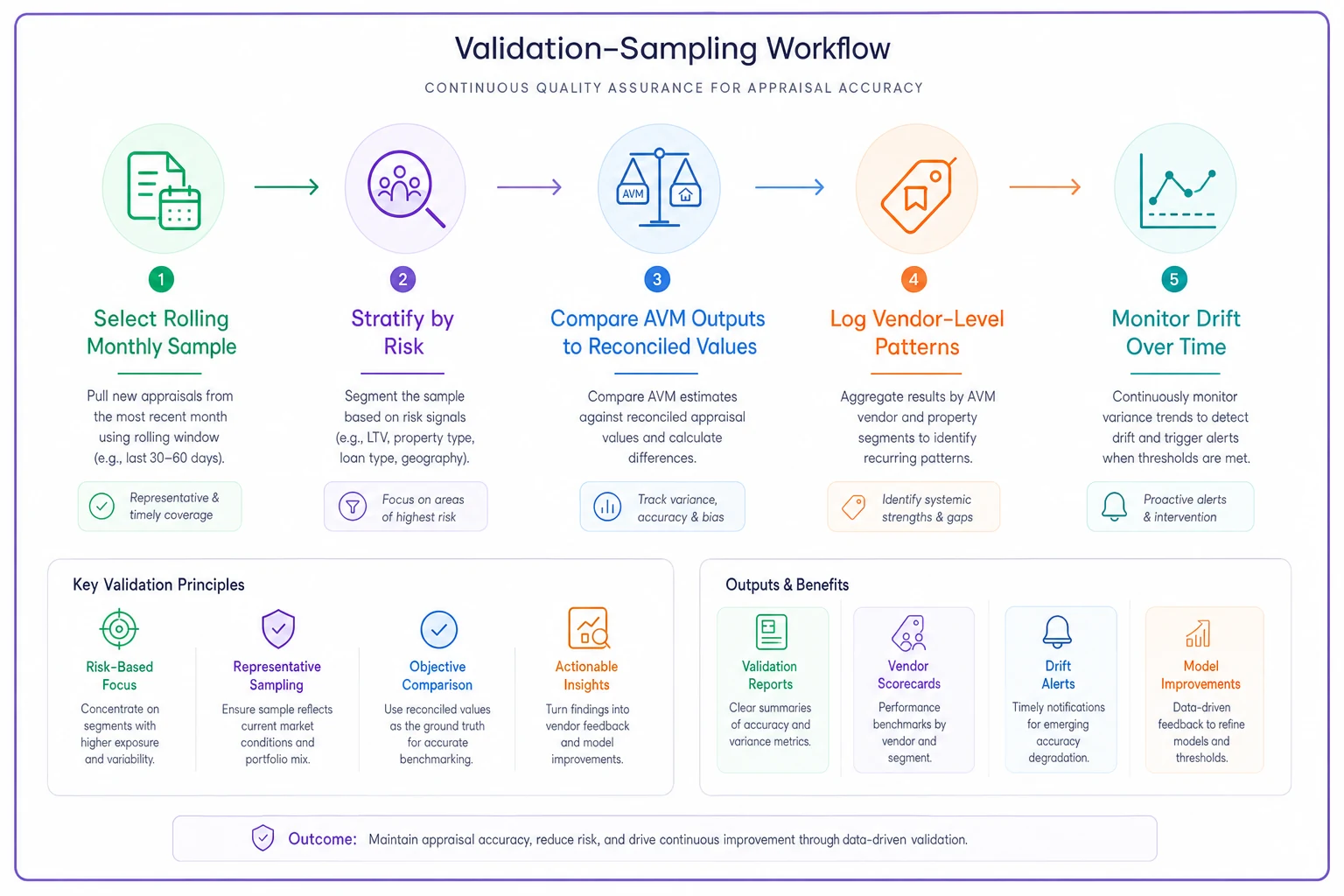
A simple flow showing selection, stratification, comparison, logging, and monitoring helps reviewers understand the process at a glance.
Logging and documentation templates
Documentation is where governance either becomes real or stays aspirational. If the log lives in someone's head or scattered across email threads, you have nothing when a review comes.
A minimum AVM decision record, per file, should capture:
-
- Assignment ID and product type (hybrid, desktop, full, portfolio review)
-
- AVM vendor and model version (versions matter — a model update can shift outputs)
-
- AVM value and disclosed confidence/FSD
-
- Assigned threshold tier (high/medium/low/undisclosed)
-
- Permitted use for that tier
-
- Independent appraised value
-
- Gap percentage
-
- Reconciliation note (required if gap exceeds your band)
-
- Override reason (if applicable)
-
- Reviewer initials and date (if sampled)
Ten fields. It fits on a single screen or one row of a spreadsheet. The discipline is filling it every time, not building something elaborate.
For firms sending files into automated underwriting or GSE review pipelines, this log also needs to survive machine parsing — consistent field names, no free-text where a code will do, dates in one format. The same rigor that helps you cut machine-review exceptions with a pre-send file-structure and metadata checklist applies directly to how you store AVM decision records. Sloppy metadata here shows up as exceptions later.
A quick note on where this often goes wrong: firms create a solid template and then let appraisers fill it in at the end of the file. At the end, memory has faded and the log becomes reverse-engineered fiction. The record has to be captured at the moment of the decision, ideally baked into the workflow so a file can't advance without it. This is one place where operational software earns its keep — not by making the valuation, but by refusing to let a file close with an empty AVM decision field and timestamping the entry so the record reflects what actually happened when it happened.
Acceptable-use clauses: writing the rules down where they count
Thresholds and logs handle your internal behavior. Acceptable-use language handles the relationship — with clients, with the AVM vendor, and inside your own engagement scope.
-
- Scope of reliance. State plainly that AVM outputs are used as a screening or corroborating data source and do not, on their own, constitute the firm's opinion of value. This protects you when a client later implies the appraiser "just used the AVM."
-
- Client-provided AVM handling. When a lender hands you their AVM as a reference, spell out that you evaluate it against your independent development and are not bound to reconcile toward it. Firms that skip this end up in a tug-of-war where every gap becomes an argument.
-
- Vendor version and licensing. Note which AVM products you're licensed to use and for what purposes. Using a consumer-grade AVM for a lending decision it wasn't licensed for is an easily avoided own-goal.
-
- Prohibited uses. Explicitly bar using AVMs to support values in the low-confidence tier, and bar using an AVM to backfill a value when comp support is genuinely absent. Naming the prohibited moves is what makes them enforceable internally.
Acceptable-use clauses aren't lawyer decoration. They're the thing that turns "our appraiser exercised judgment" into "our firm has a policy and this file followed it." Reviewers and courts treat those two statements very differently.
A defensibility checklist with worked examples
Here's the checklist your reviewers can run against any AVM-referenced file. Every box checked means the file defends itself.
-
[ ] AVM vendor and model version recorded
-
[ ] Disclosed confidence/FSD captured
-
[ ] Correct threshold tier assigned per policy
-
[ ] Use of the AVM matched what the tier permits
-
[ ] Independent value developed without anchoring to the AVM
-
[ ] Gap percentage calculated
-
[ ] Reconciliation note present if gap exceeded the band
-
[ ] Override documented with a substantive reason if applicable
-
[ ] Prohibited uses avoided (no low-confidence reliance, no backfilling)
-
[ ] Record entered at time of decision, not reconstructed later
Worked example 1: the clean case
Suburban tract home, active market, seven sales within a mile in the last four months. AVM value $412,000, tight confidence band. Independent conclusion $405,000. Gap is under 2%. Tier: high confidence, usable as corroboration. The log notes agreement, no reconciliation needed. This file takes maybe two extra minutes to document and is bulletproof.
Worked example 2: the disagreement that gets defended
Older home in a transitioning neighborhood. AVM value $328,000, medium confidence. On inspection the appraiser finds an unpermitted addition and deferred maintenance the model couldn't see. Independent conclusion $291,000 — roughly a 13% gap, outside the band. Tier permits screening use only, and the reconciliation note reads: "AVM does not reflect observed condition (deferred maintenance, unpermitted addition per inspection). Independent value supported by three condition-comparable sales." The override is logged. When this file gets pushed back — and files like this often do — the answer is already written.
Worked example 3: the file that should never have leaned on the AVM
Rural property, five acres, nearest comparable sale nine miles out. AVM returns a number with a wide FSD. Tier: low confidence — not usable beyond flagging complexity. The right move is to route this to full development and note the assignment as complex. The mistake to avoid: quoting the AVM in the report as if it were supporting evidence. Under this policy, that's a prohibited use, and the checklist catches it before the file leaves.
When this level of governance makes sense — and when it's overkill
When it's clearly worth it: any firm doing hybrid or desktop volume where AVMs are baked into the product, any shop with more than a handful of appraisers, and anyone doing portfolio or review work at scale. Once multiple people are touching AVM decisions, inconsistency is guaranteed without written thresholds.
When it's lighter than you think: a solo appraiser who only occasionally references an AVM doesn't need a sampling program. They need the decision record and the acceptable-use language, and that's about it. Don't build a validation department for twelve files a year.
Who should not bolt this on carelessly: firms that haven't first cleaned up their underlying data. If your comp records and file structures are a mess, your AVM validation will produce noise, because you can't tell whether a gap reflects the model or your own bad inputs. Fix the data foundation first, then layer governance on top.
A short real scenario
A mid-sized shop running hybrid products across three counties kept getting review pushback on files where the appraised value diverged from the lender's reference AVM. No policy existed — each appraiser reconciled differently, and roughly a quarter of divergent files came back with questions, each eating an hour or two of rework and straining the client relationship.
They introduced three things: a tiered threshold table, a mandatory one-row decision log per file, and a 10% gap band triggering a written reconciliation. Nothing fancy — the log lived in their existing workflow so files couldn't close without it. Within a couple of months, pushback on divergent files dropped noticeably, and the ones that still came back were resolved in minutes because the reasoning was already in the file. The firm didn't change a single valuation. They just made every valuation explainable.
The takeaway
An AVM is a tool, and like any tool the risk lives in how it's handled, not in the tool itself. The firms that get surprised are the ones treating automated valuations as either infallible or worthless, with no rules and no record in between. The firms that stay defensible do something unglamorous: they decide in advance when a model output is usable, they check their own behavior around it on a regular sample, and they write down the decision while they're making it.
Do that, and the audit question that used to cause panic — "how did you validate this?" — becomes a file you can just hand over.
Ready to elevate your appraisal operations?
Join 500+ appraisal firms using Rateoly to enhance accuracy, save time, and improve client satisfaction.