

Most fee schedules inside appraisal shops are basically flat. A number for a 1004, a number for a 1073, maybe a rush add-on, maybe a mileage line if the office remembers to bill it. Then a log cabin on 40 acres with a spring-fed well and no permits on file comes in at the same fee as a 12-year-old colonial in a cookie-cutter subdivision.
That's the leak. The colonial takes four hours end to end. The cabin eats a day and a half, two calls to the county, and a narrative you rewrite twice because there's nothing comparable within eight miles. Same fee. And nobody flagged it because there was no structured way to say this one is harder, here's how much harder, and here's how we tell the client.
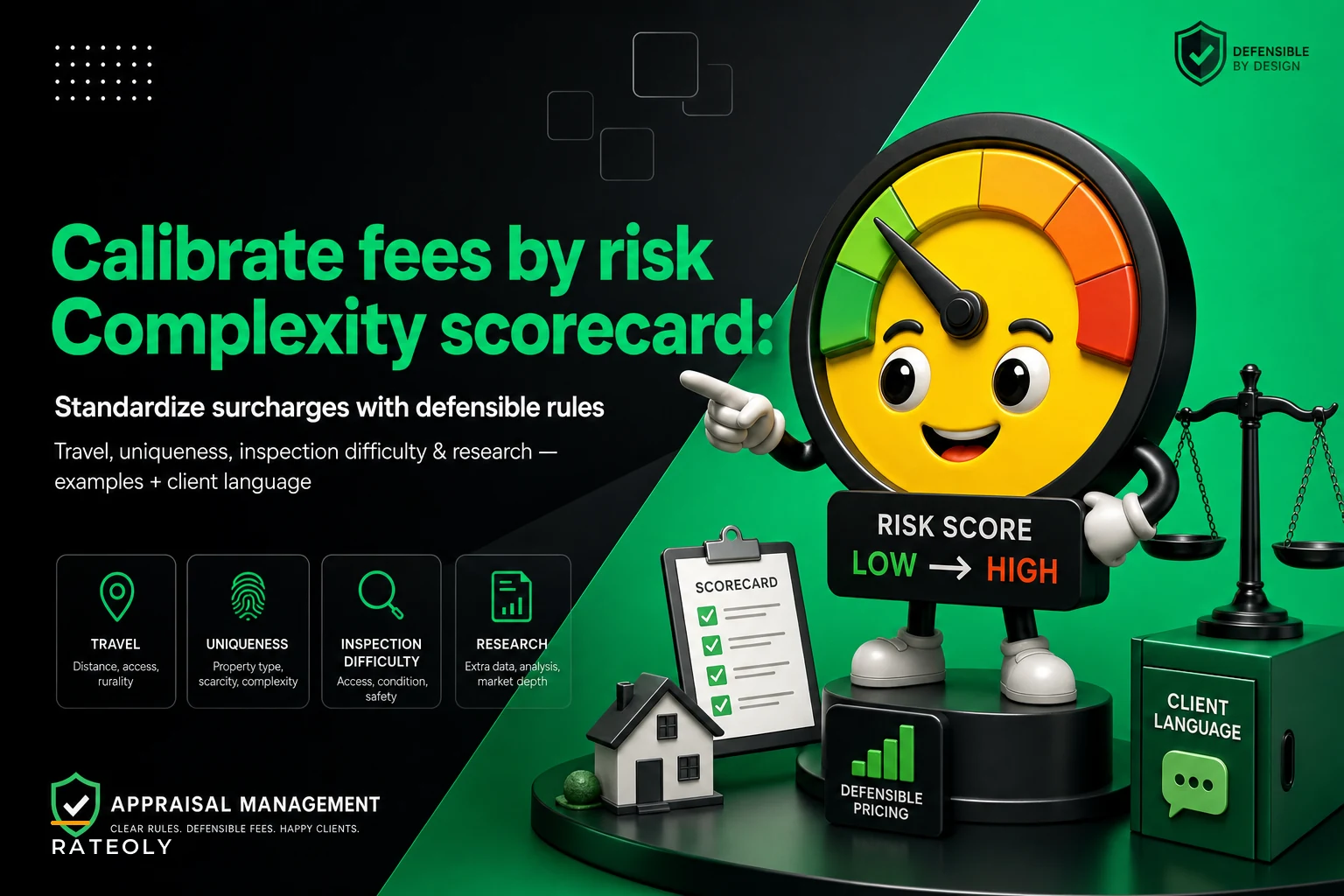
An appraisal fee complexity scorecard fixes that. It turns "this feels hard" into a repeatable number with surcharge categories you can defend line by line. Below is the actual scoring model, the surcharge math, worked examples, and client-facing language you can lift almost word for word.
Why flat fees quietly bleed margin on the hard files
The problem isn't that firms underprice everything. It's that they average. The easy files subsidize the hard ones, and the appraiser who keeps drawing the hard ones burns out while the P&L looks "fine."
-
Travel gets swallowed. A 55-minute drive each way is two hours of unbilled time. Do that three times a week and you've donated an appraiser-day back to your lender clients every single month.
-
Uniqueness eats research time nobody tracks. No good comps means bracketing from adjacent markets, extra photos, extra explanation. Real hours, invisible on a flat fee.
-
Inspection difficulty gets discovered on-site. Locked outbuildings, a mother-in-law unit that wasn't disclosed, a partial crawlspace you have to document — you find out at the door, not at intake.
-
Research time is treated as free. Pulling permits, chasing zoning, verifying a private road easement. It's billable-quality work billed at zero.
The core issue is there's no trigger at intake that says "this one scores high, add the surcharge and set expectations." Scope creep gets discovered mid-assignment, when it's too late to reprice and too awkward to ask.
The complexity scorecard: four dimensions, plain scoring
Score every assignment on four dimensions at intake. Each gets 0–3 points. Total runs 0–12. The score maps to a surcharge tier — not a vibe.
Manage every appraisal with confidence and clarity.
Rateoly helps you coordinate inspections, generate reports, and communicate seamlessly with clients.
- Comprehensive appraisal tracking
- Automated client notifications
- Integrated scheduling & report management
No credit card required
| Dimension | 0 points | 1 point | 2 points | 3 points |
|---|---|---|---|---|
| Travel | Under 20 min one way | 20–40 min | 40–60 min | 60+ min or ferry/seasonal road |
| Uniqueness | Standard tract/condo, 3+ recent comps <1 mi | Minor atypical feature, comps <2 mi | Rural/mixed-use, comps 2–5 mi, some bracketing | No true comps <5 mi, special-use, acreage |
| Inspection difficulty | Single unit, full access | Minor access notes (locked gate, tenant coordination) | Multi-structure, ADU, partial access | Hazard/condition issues, multiple buildings, measure-heavy |
| Research time | Public data clean and complete | One data gap (missing permit) | Zoning/easement/private road verification | Legal description issues, unpermitted additions, chain-of-title questions |
Tier mapping:
-
0–3 (Standard) Base fee. No surcharge.
-
4–6 (Elevated) Base + 15–25%.
-
7–9 (Complex) Base + 30–50%.
-
10–12 (Highly complex) Base + 60–100%, or custom quote.
The point of the 0–3 scale per dimension is that anyone at the front desk can score it. You don't need a senior appraiser to eyeball every order. Intake staff can read a scope note, check the address on a map, and get a defensible number.
How to actually assign surcharges (not just multiply the total)
The mistake firms make when they first build one of these: they take the total score and slap one percentage on it. That's cleaner to explain but it hides why. Lenders and AMCs push back harder on a blob than on itemized lines.
-
Set your base fee for the product type as usual (say $500 for a 1004 in your primary market).
-
Travel surcharge $0 at score 0–1, +$40 at score 2, +$85 at score 3. Tie it loosely to round-trip mileage plus time, not just IRS mileage — you're billing the appraiser's hour, not the gas.
-
Uniqueness surcharge +$60 at score 2, +$150 at score 3. This is buying research and narrative time.
-
Inspection difficulty surcharge +$50 at score 2, +$120 at score 3. Extra structures and measuring are the biggest hidden time sinks.
-
Research surcharge +$45 at score 2, +$140 at score 3. Permit chasing and title questions can double your desk time.
A simple workflow showing intake scoring to itemized surcharges.
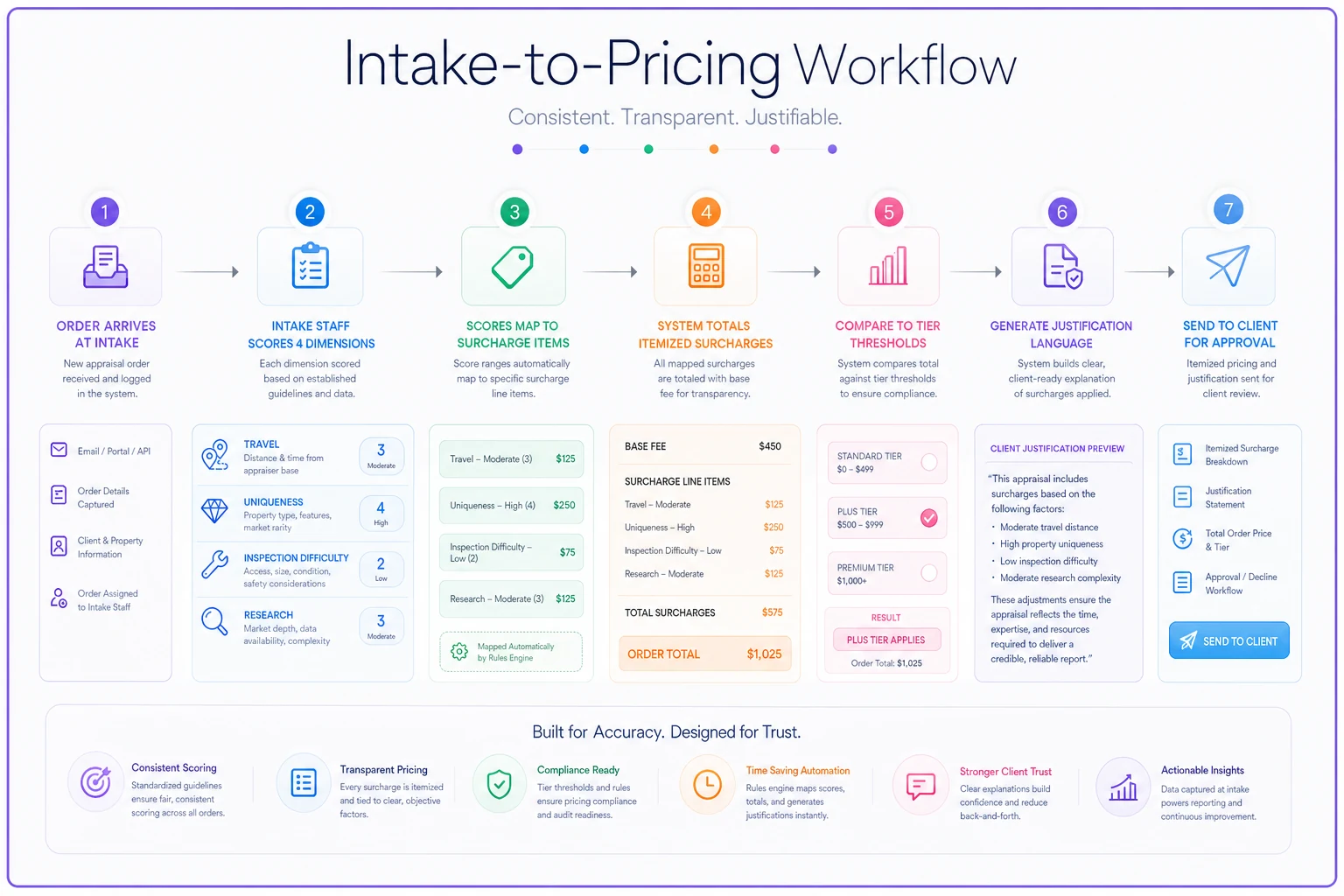
The itemized version also gives you a paper trail. When an AMC asks "why is this $685 instead of $500," you don't say "it's complex." You say "travel tier 3, private-road easement verification, one unpermitted addition" — three concrete facts.
Worked example 1: the rural acreage assignment
Order: SFR on 22 acres, 48 minutes out, private gravel road, a detached shop and a small barn, one addition with no permit on file.
-
Travel
48 min → 2
-
Uniqueness
22 acres, nearest true comps ~4 miles → 3
-
Inspection
three structures, addition to measure → 2
-
Research
private road easement + unpermitted addition → 3
Total: 10 → Highly complex.
Base 1004 fee: $500. Surcharges: travel +$40, uniqueness +$150, inspection +$50, research +$140 = +$380. Quoted fee: $880.
Compare that to the flat-fee reality. At $500 flat, that assignment probably ran the appraiser 9–10 hours with the drive and the county calls. That's roughly $50/hour before overhead on a file that should be clearing well north of that. The scorecard didn't invent the cost — it just made it visible before the work started.
Worked example 2: the "looks easy, isn't" condo
Order: Condo, 15 minutes away, in a small non-warrantable project with only two sales in the last 14 months, both slightly dated.
-
Travel
15 min → 0
-
Uniqueness
thin comp set, dated sales, project-level analysis → 2
-
Inspection
single unit, full access → 0
-
Research
HOA docs, project questionnaire review → 2
Total: 4 → Elevated.
Base 1073 fee: $450. Surcharges: uniqueness +$60, research +$45 = +$105. Quoted fee: $555.
This is the one people miss constantly. Short drive, easy inspection, so it feels like a base-fee file. But the comp thinness and project research quietly add two to three hours. A flat schedule never catches it because two of the four dimensions look clean. The scorecard catches it because it scores all four independently.
Client-facing justification language you can reuse
Surcharges fall apart at the point of the awkward email. So write the language once, and reuse it. Keep it factual, tied to scope, never apologetic.
For a rural/travel surcharge:
"This assignment is located approximately 48 minutes from our coverage center and involves a private-access road. The quoted fee reflects additional field time and access coordination required to complete the inspection."
For a uniqueness/comp surcharge:
"The subject is a [acreage/non-warrantable/mixed-use] property with limited comparable sales within the immediate market area. The fee accounts for the extended comparable research and additional narrative support required to produce a credible, well-supported opinion of value."
For an inspection-difficulty surcharge:
"The property includes multiple structures and an addition requiring measurement and separate condition analysis. The fee reflects the additional inspection scope."
For a research surcharge:
"Public records indicate an addition without corresponding permits on file and a private-road easement requiring verification. The fee reflects the additional due diligence needed to address these items in the report."
Notice what's missing: no "sorry for the extra cost," no hedging. You're describing scope, and scope justifies fee. AMCs approve these far more often than a bare number because the reasoning is right there.
When this makes sense — and when it doesn't
When the scorecard earns its keep:
-
You cover a wide geographic area with real drive-time variance.
-
Your work mix includes rural, acreage, unique, or non-warrantable properties.
-
You've got more than one or two appraisers and want consistent pricing across all of them.
-
You're doing a meaningful share of private/attorney/estate work where you set the fee directly.
When it's overkill:
-
You're a solo appraiser working a tight suburban footprint where 90% of files genuinely are the same product. A two-tier fee (standard / rush) covers you fine.
-
Your volume is 100% AMC panel work with fixed, non-negotiable fees — the scorecard still helps you decline underpriced complex orders, but you can't reprice them.
One thing worth saying directly: don't bolt this on if nobody at your firm will actually score at intake. A scorecard that gets skipped when the phone's ringing is worse than no scorecard, because now you think you're pricing risk and you're not. If intake can't or won't run four quick scores per order, fix the intake habit before you fix the fee schedule.
A real scenario: three-appraiser shop, mixed metro-and-rural coverage
A small firm covering a metro plus about 40 miles of surrounding rural county was running a flat schedule with an occasional ad-hoc "complex" bump that one senior appraiser decided by feel. The other two never added it because they didn't want the client fight.
They built a four-dimension scorecard, trained the office coordinator to score at intake, and standardized the client language above. Nothing fancy — a shared sheet and a tier table.
Over the next several months, roughly 1 in 5 orders scored into Elevated or higher. Average realized fee on those complex files moved up by something like $90–$160 each. The quieter change was actually more significant: the two junior appraisers stopped eating unbilled travel and research because the surcharge was now a form field, not a confrontation. Complex-file turn times also settled down, because expectations were set at the order instead of discovered mid-report. Net revenue lift was modest in raw dollars, but the margin repair on the hard files was the real win — those assignments went from break-even to actually profitable.
Making the scoring stick without adding admin drag
The failure mode is obvious: scoring becomes one more step people skip. Two things keep it alive.
First, embed the scorecard in the intake step you already do, not as a separate task. When an order lands, whoever logs it scores it in the same screen. If you're already thinking about how to trim manual steps, the same logic in this automation inventory for cutting manual appraiser chores applies here — the goal is to make the score a byproduct of intake, not extra homework.
Second, connect it to your fee schedule so the tier auto-suggests a number. This is where a workflow platform with rules helps: address maps to a drive-time band, product type sets the base, and the four scores drive the surcharge lines automatically. You still eyeball the total, but the math and the client language populate themselves. If you've already thought about how tiered pricing structures fit your service model, this pairs naturally with the ideas in the pricing and service-tier playbook for appraisal businesses — the scorecard is basically the risk layer that sits underneath your published tiers.
Embed the scorecard in the intake screen so scoring is completed as part of order logging, not a separate task.
The tooling isn't the point, though. A shared spreadsheet with the tier table and copy-paste client language gets you 80% of the value on day one. What matters is that every order gets scored, every complex file gets its surcharge, and nobody has to invent justification language on the fly.
The one thing to walk away with
Flat fee schedules don't fail because the base number is wrong. They fail because the number never changes when the work does. A complexity scorecard gives you a repeatable way to see travel, uniqueness, inspection difficulty, and research time before you commit — and turn each of those into a surcharge you can actually defend.
Start with the four-dimension table, score your next twenty orders, and check what percentage lands above Standard. If it's more than one in ten, you've been giving that work away. The scorecard just stops you from doing it again.
Ready to elevate your appraisal operations?
Join 500+ appraisal firms using Rateoly to enhance accuracy, save time, and improve client satisfaction.