

Most appraisal firms don't think about integration governance until something goes wrong. An AMC pushes a new order format, your intake tool silently drops half the fields, and nobody notices until three reports come back with the wrong loan numbers. Or an MLS provider changes how they report living area, and your comp pipeline starts pulling square footage that's off by enough to make your adjustments look completely wrong.
The frustrating part is that none of these failures announce themselves. Integrations don't crash loudly. They degrade. They start returning slightly wrong data, or stop returning some data entirely, and the damage shows up downstream — in rework, in lender exceptions, in an appraiser wondering why the GLA doesn't match the sketch.
"Governance" sounds like something a 200-person shop needs. It isn't. For a small firm running two or three integrations, governance just means a handful of written rules about what you accept, what you check, and what you do when something drifts. That's what this is about — building that lightweight structure, the kind you can actually maintain, so your appraisal integration governance doesn't collapse the first time a partner changes their API without telling you.
Why integrations break in ways you don't expect
The mental model most firms have is wrong. They picture an integration as a pipe: data goes in one end, comes out the other, and either works or it doesn't. In reality, an MLS or AMC connection is a running agreement between two systems that both change over time, usually without coordinating with each other.
-
Silent field changes. An AMC renames
borrower_nametoborrowerName, or splits a single address field into three. Your intake still "works" — it just stops capturing the field. Nobody sees an error. You see a report three days later missing the co-borrower. -
Type drift. A field that used to come in as a number now arrives as a string with a dollar sign. Your adjustment math either errors out or, worse, treats
"$1,200"as zero. -
Volume changes. During a refi wave, an AMC that sent you 20 orders a day starts sending 60. Your polling job, tuned for light traffic, starts missing orders because it hits a rate limit it never touched before.
-
Partial outages. The connection is up, but one endpoint — say, the status callback — is down. Orders come in fine, but the AMC never receives your "inspection scheduled" update, so their system flags you as late on assignments you're actively working.
The common thread: the failure isn't binary. It's a slow drift that produces plausible-looking wrong data, which is far more dangerous than an obvious outage. An outage you notice within an hour. Bad data you might ship to a lender.
This is the same reasoning behind treating your comp inputs as a governed system rather than a series of one-off fixes — something covered in depth in why lightweight data governance beats one-off fixes for reliable comps. Integration governance is that same discipline pointed at the connection layer instead of the data layer.
The API contract checklist: what you actually agree to
Before you rely on any MLS or AMC feed, you need a written record of what that connection is supposed to deliver. Not a legal contract — an operational one. A one-page description of the shape of the data so that when it changes, you can prove it changed.
Manage every appraisal with confidence and clarity.
Rateoly helps you coordinate inspections, generate reports, and communicate seamlessly with clients.
- Comprehensive appraisal tracking
- Automated client notifications
- Integrated scheduling & report management
No credit card required
-
Required fields — the exact list of fields you cannot process an order without (order ID, property address, product type, due date, loan number)
-
Field types and formats — is the due date
2026-03-14or03/14/2026? Is GLA an integer or a decimal? Is price a number or a formatted string? -
Identifiers — what's the unique key for an order, and is it guaranteed stable? (You'd be surprised how many AMCs reuse order IDs across cancellations.)
-
Cardinality — can one order have multiple properties? Multiple borrowers? How is that represented?
-
Nullable vs. never-null — which fields are always present, and which can legitimately be blank?
-
Status vocabulary — the exact set of status values the AMC uses ("assigned," "accepted," "scheduled," "completed") and what each one actually means on their side
-
Callback expectations — what status updates do they expect from you, in what format, and how quickly?
-
Rate limits and polling rules — how often can you call, how many orders per page, what happens when you exceed it?
The thing most firms miss: the contract is only useful if it's machine-checkable. A field list sitting in a Word doc nobody opens does nothing. The same list encoded as a validation rule — one that flags any order missing a required field, or any due date in the wrong format — catches the drift the day it happens instead of the week the exception lands.
A typical small-firm version of this is just a table you keep per partner:
| Field | Type | Required | Notes |
|---|---|---|---|
order_id | string | yes | stable, unique; do not reuse |
property_address | string | yes | single line; parse to components internally |
gla | integer | no | square feet; reject if > 15,000 or < 200 |
due_date | date (YYYY-MM-DD) | yes | reject non-ISO formats |
loan_number | string | yes | must match callback payload |
product_type | enum | yes | one of your known SKU list |
When an AMC sends gla: "1,850" instead of 1850, that row is what tells you the contract was violated — not an appraiser noticing three days later.
Schema and version policy: how you handle change on purpose
Every integration will change. The question is whether you find out on your terms or theirs.
The core rule worth adopting: treat any change to required fields, field types, or the identifier as a breaking change, and everything else as non-breaking. That single distinction tells you how to react.
-
A non-breaking change (a new optional field, a longer allowed value) — log it, note it in your contract table, move on.
-
A breaking change (a required field renamed, a type changed, an ID scheme altered) — stop auto-processing affected orders and route them to a human until you've updated your mapping.
Version pinning matters here too. If an AMC offers a versioned API (v2, v3), don't auto-upgrade just because a new version is available. Pin to the version you've tested and migrate deliberately. The firms that get burned are the ones on "always latest," where a partner's Tuesday deploy silently changes behavior with no warning.
Keep a short changelog per integration. It doesn't need to be fancy — a running note with a date, what changed, and how you responded:
-
2026-01-08 — Regional MLS split
full_addressintostreet/city/zip. Updated parser. Non-breaking, backward field retained for 60 days. -
2026-02-19 — AMC #2 changed status "inprogress" → "inreview". Breaking (our automation keyed on the old string). Paused auto-status sync ~3 hrs while we remapped.
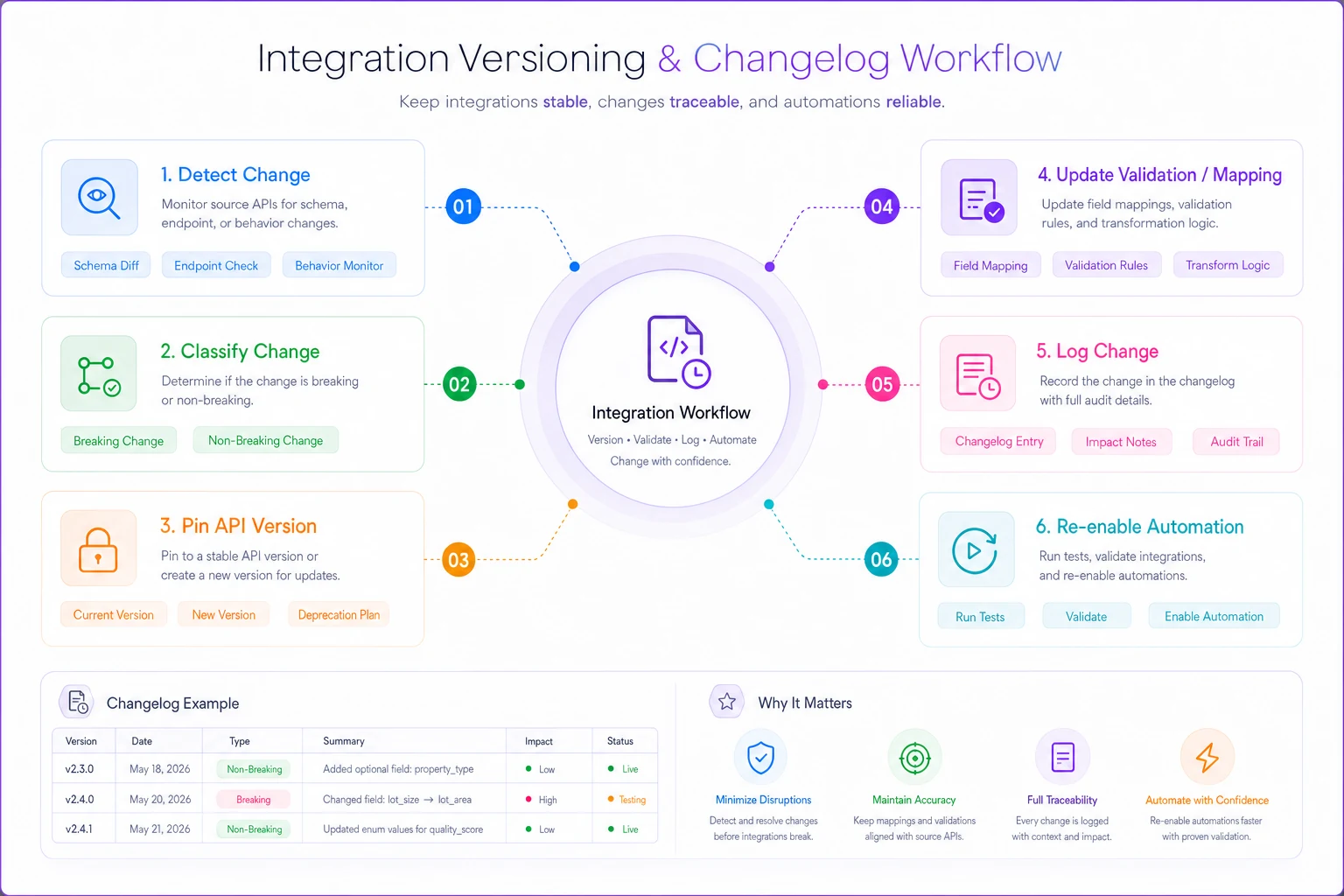
That log becomes surprisingly valuable during a dispute. When an AMC claims you were late updating statuses, you can point to the exact day their vocabulary changed and show that your updates resumed within hours.
Reconciliation windows: catching what slips through
Even with solid validation, some things only show up when you compare two systems against each other. Reconciliation is the scheduled habit of asking: does what I think I have match what the partner thinks I have?
-
Order-level reconciliation. At the end of each day, compare the list of open orders in your system against the AMC's active order list. Mismatches mean either an order came in that you never captured, or you're working an order they cancelled. Both are common. Both are expensive if caught late.
-
Status reconciliation. Compare the status the AMC shows for each order against the status you've reported. This catches failed callbacks — the "we scheduled it but they think we're silent" problem — before it becomes a delinquency flag.
-
Financial reconciliation. Match completed orders against invoiced orders against paid orders. This is where quiet revenue leakage lives: a completed appraisal that never got invoiced because the "completed" callback failed.
How wide should the window be? A practical pattern:
-
Real-time / same-day for order intake — you want to know within hours if an order dropped.
-
Daily for status sync — end-of-day comparison of your statuses vs. theirs.
-
Weekly for financial reconciliation — enough cadence to catch missed invoices before they age out.
Automate the daily order-level reconciliation if you can; it catches intake drops before they become a stack of late orders.
Running reconciliation too rarely is the real mistake. A monthly reconciliation on a firm doing 300+ orders means you might discover a broken callback that's been failing for four weeks across 40 orders. By then the AMC has already scored you on turn-time metrics you didn't actually miss.
Alert thresholds: knowing when drift becomes a problem
Not every anomaly deserves a 2 a.m. alert. The skill in lightweight governance is setting thresholds that fire on real problems and stay quiet on noise.
Think in terms of rate of change, not just absolute counts. A single malformed order might be a fluke. Ten in an hour is a schema change. Setting alerts on ratios and windows keeps you from either drowning in noise or missing a genuine break.
Some threshold examples that hold up in practice:
| Signal | Warning threshold | Critical threshold |
|---|---|---|
| Orders failing validation | > 5% in a 1-hour window | > 20% in a 1-hour window |
| Missing required field (same field) | 3 occurrences in a day | 10 in an hour (schema change) |
| Status callback failures | any 2 in a row | > 5% of daily callbacks |
| Intake volume vs. 7-day average | +50% or −50% | +100% or a full stop |
| Reconciliation mismatches | 1–2 per day | > 5 per day |
| API error rate (4xx/5xx) | > 2% of calls | > 10% of calls |
Worth internalizing: a spike in "missing required field" for the same field is almost always a schema change, not bad luck. Random data-entry errors scatter across fields. When one specific field starts failing repeatedly, a partner changed something. That distinction — is the failure clustered or scattered — tells you whether to fix data or fix your mapping.
One more thing that catches firms off guard: a drop in volume is just as important as a spike. If an AMC that normally sends 25 orders a day suddenly sends zero for six hours, that's not a slow day — that's a broken feed. Alert on silence, not just noise.
Rollback decision matrices: what to do when it breaks
When an integration misbehaves, the worst response is improvising under pressure. That's when someone disables the wrong sync, or keeps auto-processing bad orders because turning it off feels too drastic. A decision matrix removes the judgment call from the moment of stress.
The framework is simple: for each failure type, decide in advance whether you keep running, degrade to manual, or fully roll back.
| Failure | Impact | Default action | Rollback to |
|---|---|---|---|
| New optional field appears | Cosmetic | Continue, log it | — |
| Required field type changed | Math/parse errors | Degrade: route affected orders to manual | Manual intake for that partner |
| Order IDs no longer unique | Duplicate/lost orders | Full stop on auto-intake | Manual intake + reconcile |
| Status callback endpoint down | Late flags on their side | Continue intake, queue callbacks | Retry queue; manual status email |
| Intake feed silent > 2 hrs | Missing orders | Alert + switch to portal polling | Manual portal check every hour |
| Auth/token failure | Total outage | Full stop, escalate to partner | Manual portal until restored |
The principle behind the matrix: degrade gracefully before you roll back completely. Most failures don't require shutting everything down. If only the callback is broken, keep taking orders and queue the status updates to retry — don't halt intake. If the identifier scheme breaks, you do stop, because duplicate or lost orders are far more expensive than a few hours of manual entry.
Write down who makes the call and who executes it. On a small team that's often the same person, but the matrix means they're not inventing a response mid-crisis — they're following a decision that was already made calmly.
A short rollback runbook that pairs with the matrix:
-
Detect — alert fires or reconciliation flags a mismatch.
-
Classify — match the failure to a row in the matrix.
-
Act — continue, degrade, or roll back per the default.
-
Contain — quarantine affected orders so bad data doesn't ship downstream.
-
Notify — tell the affected appraisers and, if needed, the partner.
-
Log — record it in the integration changelog.
-
Restore — re-enable automation only after re-validating against the contract.
Having that runbook written down matters more than it sounds. When a feed breaks at 4 p.m. on a Friday, the last thing you want is someone guessing at step three.
A real scenario: the callback that failed quietly
A three-appraiser firm running connections to two AMCs and one regional MLS was getting dinged on turn-time scorecards for one AMC — enough that the AMC started routing fewer orders their way. The appraisers knew they were completing on time. They were right.
The actual problem: that AMC had changed one status string in their expected callback vocabulary. The firm's sync was still sending the old value, which the AMC's system rejected. So every "inspection completed" update failed silently. Orders looked stalled on the AMC's side even though the work was done. No error surfaced on the firm's end because the callback returned a 200 with a rejection buried in the response body.
They were losing somewhere around 8–12 orders a month in reduced allocation — somewhere in the range of $3k–$5k in monthly revenue slipping away over something completely invisible.
Once they added two things — a daily status reconciliation comparing their statuses against the AMC's, and an alert on consecutive callback failures — the mismatch surfaced within a day instead of accumulating for weeks. The remap took under an hour. Allocation recovered over the following month. Nothing about the fix was sophisticated. What changed was that the drift became visible the day it started, not weeks later after the damage was done.
When lightweight governance is enough — and when it isn't
This approach makes sense when you're running a handful of integrations, you have one or two people who touch the technical side, and your volume sits somewhere in the range where a broken feed for a day is painful but not catastrophic. For most small and mid-size firms, the contract table, a changelog, scheduled reconciliation, sensible alerts, and a rollback matrix cover the vast majority of what actually goes wrong.
It starts to strain when you cross into higher volumes or more partners. At six or eight integrations, per-partner spreadsheets and manual daily reconciliation stop scaling — you'll want validation and reconciliation running automatically, with alerts routed somewhere your team actually watches. The principles don't change; the tooling does.
Who should not over-invest here: a firm with a single AMC relationship and low volume doesn't need a formal matrix and threshold table. A written required-field list and a weekly glance at completed-vs-invoiced is probably enough. Building elaborate governance around one stable connection is effort spent where it won't pay back.
Where a workflow platform earns its place is in removing the manual steps — automatically validating incoming orders against your contract, running reconciliation on a schedule, and firing alerts when thresholds trip — so a two-person team isn't eyeballing spreadsheets every evening. But the tooling only helps if the underlying rules exist first. Software enforces a policy; it doesn't invent one. That's also why the connection between governance and how you choose tools matters — the same evaluation discipline in our vendor-evaluation and TCO framework for appraisal software applies to any integration platform you're weighing.
Pulling it together
Integration governance for a small appraisal firm isn't a compliance project. It's a set of habits that make invisible failures visible before they reach a lender. A written contract per partner so you know what you agreed to. A version policy so change happens on your terms. Reconciliation windows so two systems can't quietly disagree for weeks. Alert thresholds that fire on real drift and stay quiet otherwise. A rollback matrix so nobody improvises during a break.
The firms that struggle aren't the ones with the most complex integrations — they're the ones treating every break as a surprise. The ones that stay steady have decided, in advance, what normal looks like and what they'll do when a connection stops matching it. That decision, written down and lightly automated, is the whole game. Everything else is just maintaining the habit.
Ready to elevate your appraisal operations?
Join 500+ appraisal firms using Rateoly to enhance accuracy, save time, and improve client satisfaction.