



Most appraisal firms track revenue by client. Almost none track profit by channel. That gap is where margin quietly disappears. An AMC order and a direct-lender order might both show $450 on the invoice, but by the time you factor in the fee split, revision cycles, portal uploads, net-45 payment terms, and appraiser hours burned, one of those is a solid job and the other is a slow bleed.
The problem is the bleed never shows up as a single line item. It hides inside aggregate numbers that look fine on the surface. Your firm did $1.2M last year, margins seemed okay, everyone stayed busy. But busy and profitable aren't the same thing — and when you finally break the numbers apart by channel, the picture usually looks nothing like what you assumed.
This is a systems problem, not a pricing problem. You can't fix channel mix by nudging fees up here and there. You need a cost-to-serve model running underneath every assignment, acceptance thresholds your intake team actually uses, and some way to flag marginal work before it fills a slot a better job could have taken.
The reason channel profitability stays invisible
The mechanical reason most firms never see this clearly: appraisal costs are lumpy and shared. One appraiser handles jobs from three AMCs, two lenders, and a handful of attorney and estate clients in the same week. The office manager chases payment across all of them. QC touches every file regardless of source. So when you look at expenses, everything pools together. Nothing is tagged to a channel.
What's common across a lot of small shops is that owners feel which clients are painful but can't actually quantify it. They'll say "that AMC is a headache" without being able to say it costs them around $90 per order in extra coordination. And because it's a feeling rather than a number, nobody ever makes the hard call to fire the client or push for better terms.
-
Appraiser production time (varies wildly by property type and channel expectations)
-
Revision and rework cycles (one channel might average 1.1 revision rounds, another 2.4)
-
Admin overhead per order (portal logins, status updates, document formatting)
-
Payment lag and collection effort (net-30 vs net-60, dispute frequency)
-
QC intensity (some channels trigger far more exceptions than others)
Until you assign dollar figures to each of those, every channel looks roughly equal. They almost never are.
Building a channel-specific P&L
The fix starts with separating your P&L by channel instead of running one blended statement. You're not inventing new accounting — you're re-cutting the same data along a dimension you've been ignoring.
Manage every appraisal with confidence and clarity.
Rateoly helps you coordinate inspections, generate reports, and communicate seamlessly with clients.
- Comprehensive appraisal tracking
- Automated client notifications
- Integrated scheduling & report management
No credit card required
A workable channel P&L has these rows for each channel (AMC, direct lender, agent/private, attorney/estate, etc.):
| Line item | AMC Channel | Direct Lender | Agent/Private |
|---|---|---|---|
| Gross fee per order | $385 | $525 | $600 |
| Revenue after split/referral | $385 | $525 | $540 |
| Appraiser production cost | $210 | $230 | $245 |
| Admin/coordination cost | $62 | $34 | $28 |
| Revision/rework cost | $48 | $22 | $31 |
| QC/exception handling | $18 | $14 | $12 |
| Collection/payment carry cost | $15 | $9 | $21 |
| Contribution per order | $32 | $216 | $203 |
These numbers are illustrative, but the shape is what matters — and it holds up in real shops more often than you'd expect. The AMC order with the lowest gross fee gets hit again on coordination and rework, and contribution collapses. The direct lender and agent work, despite higher production cost, clears far more per order.
That's the trap. If your capacity is 80% full of AMC work at $32 contribution, you're running flat out for very little. Shift even 20% of that volume toward direct or private work and your contribution per slot can roughly double without adding a single appraiser.
A couple of notes on building this honestly:
-
Production cost should be loaded, not just hourly. Include a share of licensing, E&O, software, and vehicle/field cost. If you only count wage time, every channel looks more profitable than it actually is.
-
Coordination cost is where most firms undercount. Time your intake and admin team for two weeks, tag the time by channel, and you'll get a real per-order number. It's usually higher than anyone guesses — portal-heavy AMC work especially.
A couple of notes on building this honestly:
Cost-to-serve: the model that drives everything else
A channel P&L is the output. The cost-to-serve model is the engine. The distinction matters: the P&L tells you what happened last quarter; the cost-to-serve model lets you price and triage the next order before you accept it.
A practical cost-to-serve model estimates the fully loaded cost of an assignment from inputs you already know at intake:
-
Property/complexity tier — drives expected production hours. This should connect directly to how you score assignment difficulty. If you haven't built that yet, the approach in calibrating appraiser fees by assignment risk gives you the complexity scorecard that feeds straight into this model.
-
Channel overhead multiplier — the admin, portal, and payment carry cost specific to that client type.
-
Expected revision rounds — pulled from that channel's historical average, not optimistic assumptions.
-
Turn-time pressure — rush expectations that force overtime, weekend field work, or bumped scheduling.
Multiply those out and you get expected cost-to-serve. Subtract from the offered fee and you've got projected contribution before you say yes. That one number changes how a firm operates, because now acceptance is a decision with math behind it instead of a reflex.
A quick worked example. An AMC sends a complex rural order:
-
Offered fee
$475
-
Complexity tier 4 → ~7.5 production hours at loaded $34/hr = $255
-
AMC overhead multiplier adds $58
-
Channel averages 2.3 revision rounds → $44 expected rework
-
Rush turn → $35 overtime loading
Expected cost-to-serve: roughly $392. Projected contribution: about $83. That's thin for a complex rural job that ties up most of a day. Compare it to a direct-lender tier-2 suburban order at $525 with a cost-to-serve near $300 — about $225 contribution in less time. Same week, same appraiser, wildly different value per slot.
Acceptance thresholds that actually get used
A cost-to-serve number is useless if intake ignores it. So you need acceptance thresholds — simple rules that convert the math into a yes, no, or escalate.
What works in practice is a three-band threshold tied to contribution per production hour, not per order. Per-order margin lies when jobs take wildly different amounts of time. Per-hour is honest.
-
Green (auto-accept) contribution above ~$30/production hour. Take it, schedule it, move on.
-
Yellow (accept with condition) contribution between ~$12 and $30/hour. Accept only if it fills an otherwise idle slot, or request a fee bump before confirming.
-
Red (decline or renegotiate) contribution under ~$12/hour. Push back on fee, extend turn time, or pass.
Set the exact cutoffs to your own cost structure. The point is they exist, they're written down, and intake applies them consistently. The most common failure isn't bad thresholds — it's thresholds that live only in the owner's head and get overridden every time the pipeline looks thin. Panic-accepting red work to "stay busy" is how firms end the year exhausted and under-margin.
One important nuance: thresholds should flex with capacity. At 60% utilization, a yellow job that keeps an appraiser productive is fine. At 95% utilization, that same yellow job is actively displacing green work and should be declined. Without a capacity input, your acceptance rules will either leave appraisers idle or crowd out your best clients during peak demand.
Automated flags for marginal work
Running cost-to-serve math by hand on every order falls apart fast. At 20 orders a week it's tedious; at 200 it's impossible — and that's exactly when channel discipline matters most. This is where lightweight automation earns its place, not as a gimmick, but as the thing that keeps the model running when everyone is slammed.
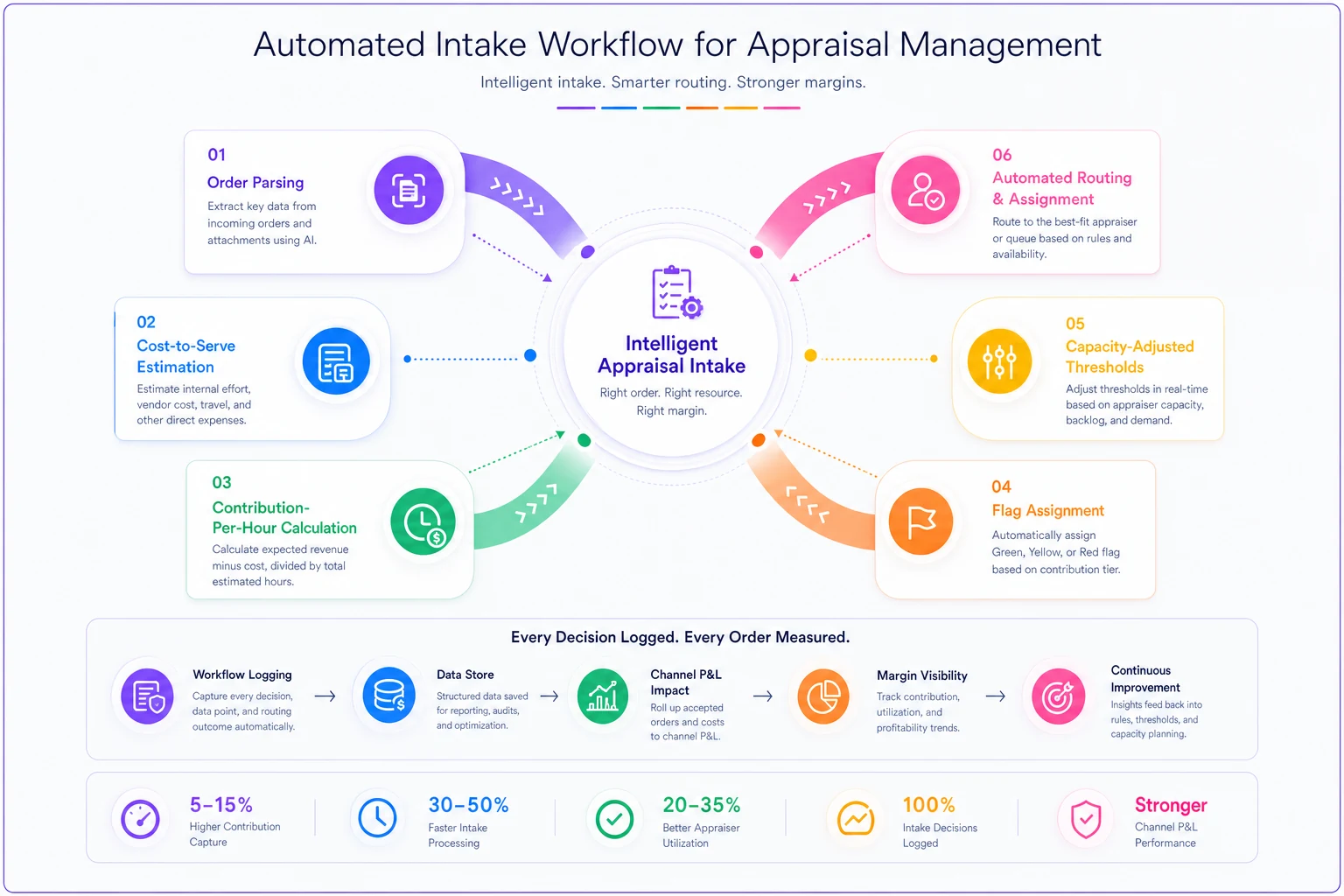
The practical setup: your intake or workflow system scores each incoming order against the cost-to-serve model automatically and attaches a flag. Green flows through. Yellow routes to a manager with the contribution math already attached so the decision takes seconds. Red gets held for review or triggers an automatic fee-counter template. AI-assisted intake can also pull each channel's historical revision average and payment lag so the estimate uses real numbers instead of defaults — the flag gets more accurate as more orders run through it.
-
Order arrives via portal or email → system parses fee, property, channel, turn time.
-
Cost-to-serve model estimates loaded cost using channel history and complexity tier.
-
Contribution-per-hour calculated → flag assigned (green/yellow/red).
-
Capacity level checked → threshold adjusts for current utilization.
-
Routing happens automatically
accept, escalate, or counter.
-
Outcome logged back to the channel P&L, improving next month's estimates.
That last step is the one firms skip and it's the most valuable. The system should learn from actuals. If a channel's real revision rounds keep beating the estimate, the model updates and the flags get sharper over time.
When this makes sense — and when it doesn't
This whole apparatus is worth building when you're running enough volume that mix actually moves the P&L, and when more than one real channel is competing for the same capacity. If you're doing 15 orders a month from two local lenders you trust, a full cost-to-serve model is overkill — you can manage mix in your head just fine.
It makes sense when:
-
You run 60+ orders a month across three or more channels.
-
Appraiser capacity is the binding constraint, so every slot has an opportunity cost.
-
You suspect a high-volume client is low-margin but can't actually prove it.
It's a bad idea when:
-
You're so under capacity that any paying work beats idle time. Fix demand first.
-
Your fee data is too inconsistent to model honestly — garbage in, garbage out.
-
You'd use the model to justify firing clients without a plan to replace the volume.
And to be direct about who shouldn't start here: a brand-new firm still building relationships shouldn't be declining yellow work on principle. You need the volume and referral momentum more than you need per-hour margin optimization. Channel discipline is a scaling tool, not a startup tool.
A real scenario
A two-appraiser shop in a mid-size metro was doing somewhere around $540k–$580k a year, mostly AMC work with a thin slice of direct-lender and agent orders. The owner felt busy but couldn't figure out why the bank balance never seemed to grow. Classic symptom.
When they cut the P&L by channel, the AMC work — about 70% of volume — was clearing something like $25–$40 contribution per order after rework and payment lag. The direct and agent work, maybe 30% of volume, was carrying almost the entire actual profit of the firm.
They didn't blow up the business. They set acceptance thresholds, declined the bottom-tier AMC orders — the complex rural ones and heavy-revision files — and used the freed capacity to pursue two more direct-lender relationships and a couple of estate attorneys. Over about five months, AMC volume dropped maybe 15%, total order count was slightly lower, and contribution went up somewhere in the range of $3k–$4k a month. Same two appraisers. Less total work. Noticeably more money. The shift came entirely from mix, not from grinding harder.
Tying it back to pricing and tiers
Channel profitability and pricing structure are two halves of the same system. Once you know your per-channel contribution and your acceptance thresholds, your pricing and service tiers should reflect it — faster turn times and premium handling priced for the channels that can bear it, and firm fee floors on the channels that keep sliding toward red. If you're setting up that structure, the worked examples in designing SLA-linked pricing and service tiers pair directly with the cost-to-serve model here: the P&L tells you what to charge, the tier matrix tells you how to package it.
The firms that get this right stop thinking of every order as revenue and start thinking of every slot as a scarce asset with an opportunity cost. That shift — from "did we get paid?" to "was this the best use of that day?" — is what separates a shop that's merely busy from one that's actually building margin as it grows. Channel mix is one of the few levers you can pull without hiring, without raising rates across the board, and without putting in more hours. It just requires seeing the numbers that were always there, broken apart the right way.
The firms that get this right stop thinking of every order as revenue and start thinking of every slot as a scarce asset with an opportunity cost. That shift — from "did we get paid?" to "was this the best use of that day?" — is what separates a shop that's merely busy from one that's actually building margin as it grows. Channel mix is one of the few levers you can pull without hiring, without raising rates across the board, and without putting in more hours. It just requires seeing the numbers that were always there, broken apart the right way.
Ready to elevate your appraisal operations?
Join 500+ appraisal firms using Rateoly to enhance accuracy, save time, and improve client satisfaction.