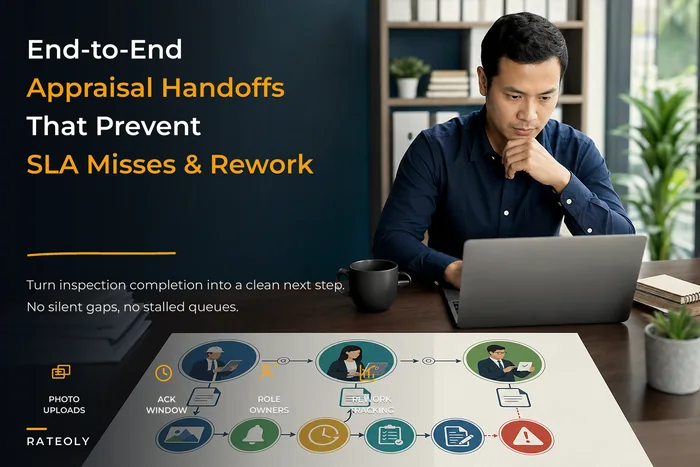


Most appraisal shops don't have a workflow problem. They have a coordination problem disguised as one. The steps are usually fine — intake collects the order, someone schedules the inspection, an appraiser writes it up, QC reviews it. What breaks is the space between those steps: a file sitting in someone's inbox for two days because nobody knew it was their turn, or a reinspection request that got verbally mentioned and then evaporated.
That gap between steps is where turn times quietly bleed out. And a checklist won't fix it, because a checklist assumes someone is reading it at the right moment. What you actually need is a system where the file itself announces where it is, what's owed, and who's late — without a human having to chase it.
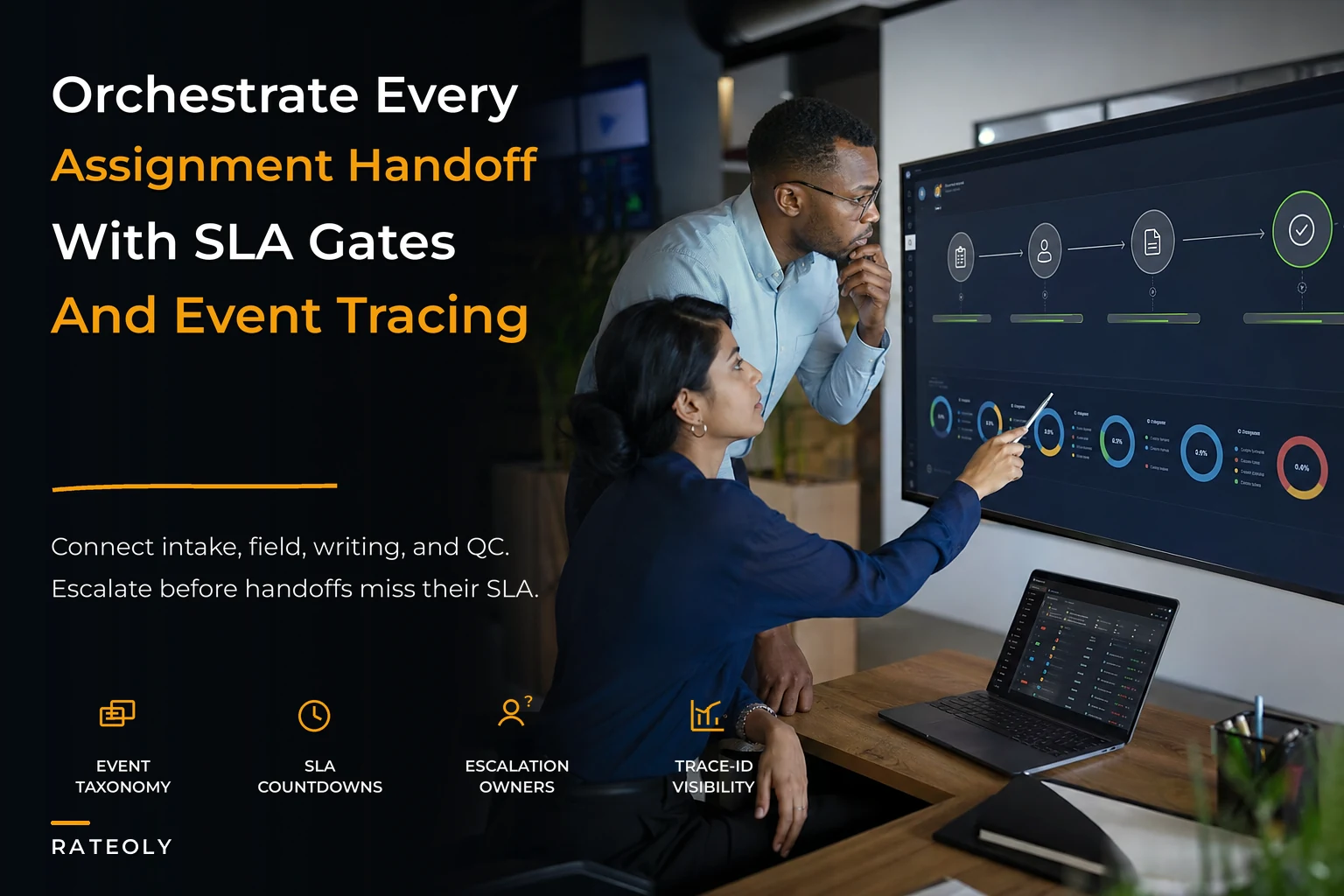
This is what appraisal assignment orchestration is really about: treating the assignment lifecycle as a sequence of events, each with a clear owner, a clear deadline, and a clear rule for what happens when the deadline slips. Not a folder that moves around. A stream of events you can trace end to end.
Why "we have a process" isn't the same as orchestration
You see this pattern constantly in firms doing 150–400 orders a month. They've documented the process. There's a shared drive, maybe a status field in their AMC portal, and everyone knows the sequence. And yet turn times still swing wildly — one file closes in five days, an identical one takes eleven.
A documented process describes the happy path. It says nothing about what happens at the seams. When a field appraiser finishes an inspection at 4pm on a Friday, what fires? In most shops: nothing automatic. The photos land somewhere, and it's on the appraiser to remember to flag the writer, or on the writer to notice the folder changed. Coordination depends on memory and vigilance — the two things that collapse first under volume.
If you've read our breakdown on standardizing an end-to-end appraisal workflow with role-based handoffs, think of this as the layer underneath it. Role clarity tells you who owns each phase. Event-driven orchestration tells you how the baton actually moves — and what the system does when it drops.
The distinction matters because manual handoffs don't just add delay. They hide it. When a file stalls between field and writing, nobody logs "waiting 36 hours for writer pickup." It just shows up later as a missed SLA that everyone's surprised by.
The building block: an event taxonomy
Before you can automate escalation or measure a gate, you have to agree on what an "event" is. This sounds academic until you try to build reporting and realize half your team means different things by "in progress."
Manage every appraisal with confidence and clarity.
Rateoly helps you coordinate inspections, generate reports, and communicate seamlessly with clients.
- Comprehensive appraisal tracking
- Automated client notifications
- Integrated scheduling & report management
No credit card required
An event is a discrete, timestamped thing that happens to an assignment. Not a status ("in writing"), but a transition ("inspection completed," "file assigned to writer," "QC returned for revision"). Statuses are states; events are the moments the state changes. You want to capture the moments, because moments are what you attach deadlines and alerts to.
A workable taxonomy for a residential shop looks roughly like this:
| Event | Emitted when | Owner after event | SLA clock it starts |
|---|---|---|---|
order.received | Order lands from AMC/lender | Intake coordinator | Intake validation (4 business hrs) |
order.validated | Address, product, fee, due date confirmed | Scheduler | Schedule inspection (1 business day) |
inspection.scheduled | Appointment booked | Field appraiser | Complete inspection (by appt date) |
inspection.completed | Field data + photos submitted | Writer | Draft narrative (2 business days) |
draft.submitted | Writer sends to QC | QC reviewer | Review (1 business day) |
qc.returned | Revisions requested | Writer | Rework (1 business day) |
qc.passed | File cleared | Delivery | Deliver to client (4 business hrs) |
report.delivered | Sent to lender/AMC | — | Assignment closed |
Two things people get wrong here. First, they make events too coarse — one giant "in appraisal" event that swallows scheduling, field, and writing. You can't diagnose or escalate what you can't distinguish. Second, they emit events that don't change ownership. If an event doesn't hand the ball to someone new or start a clock, it's probably a status update, not an event, and it doesn't belong in this list.
Getting the taxonomy right matters because everything downstream — SLA gates, escalation, reporting — hangs off it. Sloppy taxonomy means sloppy everything else.
SLA gates: deadlines that actually block
An SLA gate is a checkpoint tied to an event, with a defined deadline and a defined consequence for breaching it. The word "gate" is deliberate. A soft SLA is just a number in a report nobody looks at. A gate means something concrete happens at the boundary.
-
- Soft gates trigger a notification or escalation but don't stop work. "Draft is due in 4 hours" → nudge the writer. Most of your gates should be soft.
-
- Hard gates prevent progression until a condition is met.
qc.passedshould be a hard gate — a file physically cannot be marked delivered until QC clears it. This is where you enforce non-negotiables like compliance sign-off.
Set SLA clocks against business hours, and pause them during events you don't control.
The mistake firms make is hard-gating everything, which grinds the pipeline to a halt the first time someone's out sick — or making nothing a hard gate, in which case QC gets bypassed the moment things get busy. The art is picking the two or three points where bypassing is genuinely dangerous and hard-gating only those.
One concrete thing to get right: don't set SLA clocks against calendar time. Set them against business hours, and pause them during events you don't control. If an inspection is scheduled for Thursday but the homeowner reschedules to the following Tuesday, the inspection.scheduled → inspection.completed clock should account for that — otherwise your field team eats a breach they didn't cause. Firms that skip this end up with SLA reports so noisy nobody trusts them, and untrusted reports get ignored, which defeats the entire point.
Automated escalation: rules, not heroics
In most shops, escalation is a person — usually an ops manager who lives in a spreadsheet, mentally tracking which files are getting old. That works until it doesn't, and it stops working right around the volume where you can least afford it to.
-
1. T-minus (pre-breach nudge) When a gate hits 75% of its allotted time, notify the current owner directly. Most slippage dies here — people just forgot the file existed.
-
2. At breach Notify the owner and their team lead. Log the breach against the assignment automatically. No verbal "hey did you see that."
-
3. Breach + 4 business hours Escalate to the ops manager with the full event trail attached, so they're not reconstructing history before they can act.
-
4. Repeat or critical breach For files that breach twice, or high-priority client orders, jump straight to the ops manager and flag for post-mortem.
The piece most people miss: escalation rules should be keyed to the client and product, not uniform. A rush order for your biggest AMC and a routine order for a low-volume client shouldn't escalate on the same timeline. Bake the priority into the rule so the system knows which fires actually matter. Uniform escalation trains everyone to ignore alerts, because they can't tell the urgent ones from the routine.
And a quieter point — every escalation should be logged as its own event. Over a quarter, that log tells you where your pipeline is structurally weak. If 60% of escalations cluster on the inspection.completed → draft.submitted handoff, you have a writer-capacity or field-quality problem, not a discipline problem.
Message-id tracing: how you actually debug a stalled file
This is the piece almost nobody builds, and it's the one that saves you when a client calls asking why their file is four days late and you have thirty seconds to answer.
Give every assignment a persistent trace id at order.received, and stamp that id onto every event, notification, escalation, and system message tied to it. When something goes sideways, you pull the trace and see the entire lifecycle as an ordered timeline — not a reconstruction from three people's memories and a Slack thread.
[trace: A-20419] 09:12 order.received → intake queue 11:40 order.validated → scheduler (2h28m, within SLA) next day 08:05 inspection.scheduled → field (appt +3 days) +3d 15:22 inspection.completed → writer queue +3d 15:22 gate.start: draft (due +2 biz days) +5d 09:00 escalation.t_minus → writer notified +5d 17:00 gate.breach: draft NOT submitted → team lead notified +6d 10:15 draft.submitted (breached by ~17 biz hrs)
Reading that top to bottom, you instantly know the file was fine until the writer sat on it for a full day past deadline despite a nudge. No blame guessing. The trace is the answer.
The pattern to watch for: firms that log events but don't tie them to a single traceable id end up with data that's technically complete and practically useless, because reassembling one file's history means querying five systems. The trace id is the thread that makes the whole thing legible.
A worked orchestration flow: intake → field → writing → QC
Intake. Order arrives, order.received fires, trace id assigned, intake SLA clock starts (4 business hours). The coordinator validates address, product type, fee, and complexity flags. If the order is missing something, they don't email back and wait in limbo — they fire an order.hold event that pauses the SLA clock and routes a specific query to the client. When it's clean, order.validated fires and hands off to scheduling.
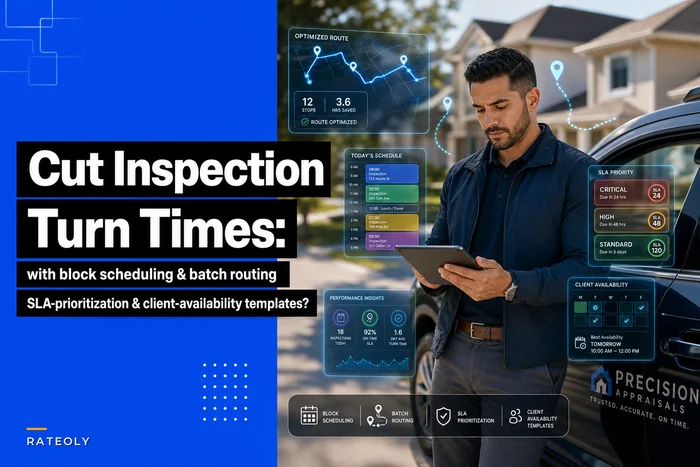
Field. Scheduler books the appointment; inspection.scheduled fires and the clock now runs to the appointment date, not a fixed window. Routing and sequencing here is its own discipline — worth reading our take on cutting inspection turn times with block scheduling and optimized routing if this is where your delays cluster. The field appraiser completes the inspection, submits photos and data, and inspection.completed fires. This is the single most important handoff in the whole pipeline, because it's where a physical activity becomes a desk activity, and it's the one most likely to stall silently.
Writing. inspection.completed automatically drops the file into the writer queue and starts a 2-day draft clock. The writer doesn't wait to be assigned; the event assigned it. At 75% of the clock, a nudge. At breach, team lead notified. Writer finishes and fires draft.submitted, which hands to QC and starts the review clock.
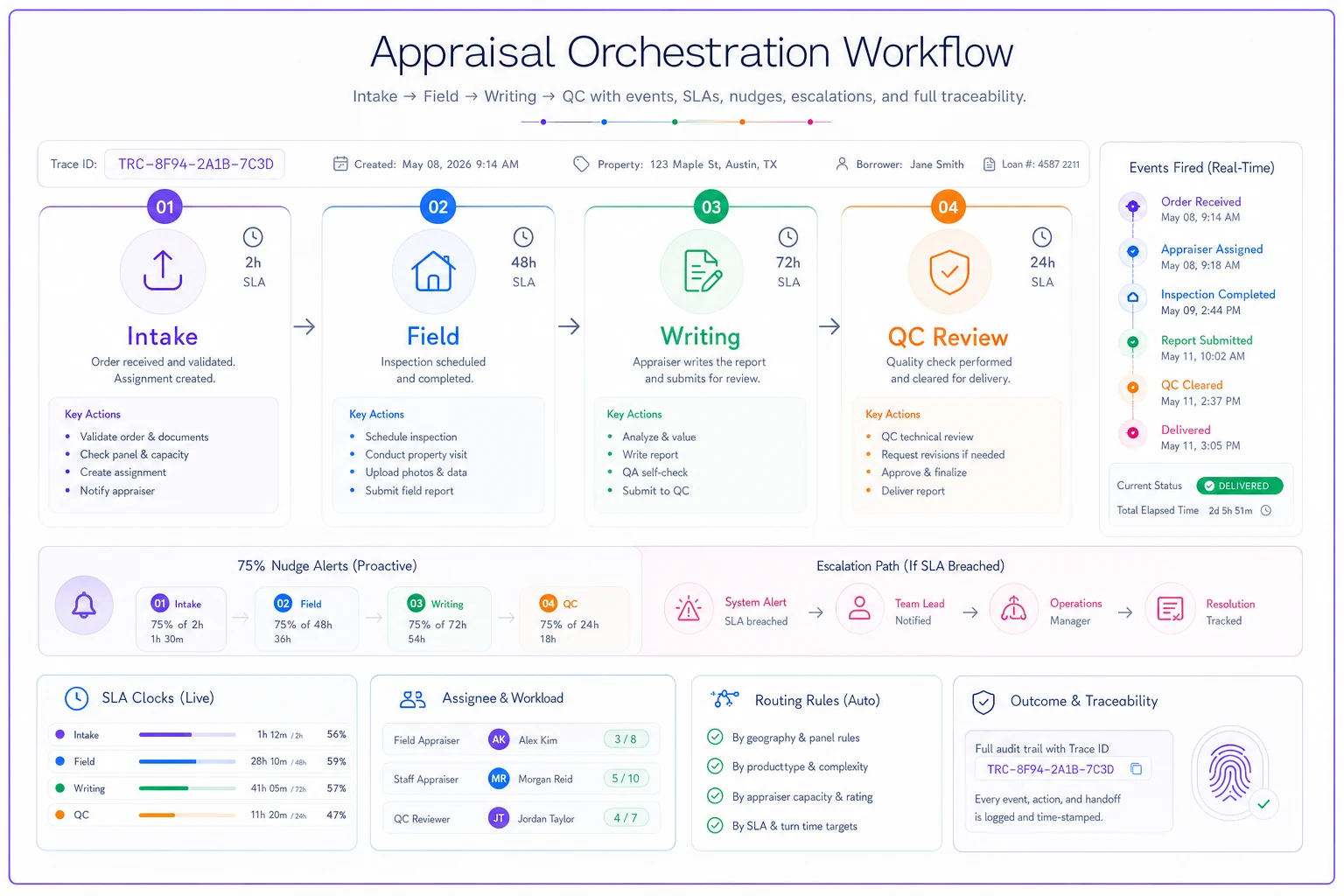
Here's a simple visual to keep the flow in your head.
QC. Reviewer works the file. Two outcomes: qc.passed (hard gate — clears the file for delivery) or qc.returned (soft gate — bounces to the writer with specific findings and starts a rework clock). The rework loop is where hidden time hides, so every qc.returned is logged with a reason code. Over time those reason codes tell you whether your QC bounces are a training problem, a template problem, or a field-data problem.
Delivery. qc.passed clears the hard gate, delivery packages the file, report.delivered fires, assignment closes, trace finalizes.
Notice what's not in that flow: anyone asking "whose turn is it?" Every transition either assigns the next owner or starts the next clock. The coordination happens by design, not by attention.
A real scenario
A three-appraiser shop doing around 180–220 orders a month was running everything through a shared status field and their ops lead's memory. Their average turn time sat around 8.5 business days — and this was the killer — it was unpredictable, swinging from 5 to 12 days on similar orders. Clients noticed. Two AMC relationships were on thin ice over inconsistency, not slowness per se.
When they mapped their events, the culprit was obvious in hindsight: the field-to-writing handoff had no owner and no clock. Completed inspections sat, on average, about a day and a half before a writer picked them up — and on bad weeks, three or four days. Nobody was tracking it because it wasn't a "step," it was a gap.
They didn't overhaul anything dramatic. They defined the eight events above, put a soft gate on the field-to-writing transition with a 75% nudge, and started logging every escalation with a trace id. Within about two months the average turn time dropped to roughly 6 days. The bigger win was the variance — the swing tightened to something like 5 to 7 days. The AMC that had been threatening to pull volume actually increased it the following quarter, specifically citing predictability.
The delay had been invisible. Making the handoff into a timestamped event with an owner was 80% of the fix.
When this level of structure makes sense — and when it doesn't
Build this when you're consistently above roughly 100 orders a month, you have more than one person in any given role, or you have clients holding you to SLAs with real consequences. The moment work is being handed between people rather than done end-to-end by one appraiser, you need something better than memory.
Skip most of it when you're a solo or two-person shop doing under around 60 orders a month. If one person carries a file from intake to delivery, a lightweight status tracker is plenty. Building an eight-event taxonomy with tiered escalation for that volume is over-engineering.
Be careful if you're tempted to hard-gate everything. Teams that do this find their pipeline freezes solid the first time someone's on vacation, and then they start building undocumented workarounds — which is worse than having no gates at all, because now the process on paper is a lie.
Where software fits — quietly
You can run a version of this on spreadsheets and calendar reminders, and plenty of firms start there. It breaks down for a predictable reason: manual event logging depends on humans remembering to log the event, which is the exact behavior you're trying to escape. The value shows up when events fire automatically off actions people already take — submitting photos, marking a draft done — and when nudges, escalations, and traces happen without anyone tending them.
That's the practical case for an operational platform built around this model. Not because software is exciting, but because event emission, SLA clocks that pause correctly, tiered escalation, and end-to-end tracing are exactly the kind of consistent, unglamorous coordination that AI-assisted automation handles well and tired humans handle badly on a Friday afternoon. The point isn't to replace judgment — it's to make sure judgment gets applied at the right moment, on the right file, by the right person, before the SLA is already blown.
The shift in thinking
The firms that get turn times under control aren't the ones with the most disciplined people. They're the ones who stopped relying on discipline to move files. When the assignment lifecycle is a stream of owned, timed, traceable events, coordination becomes a property of the system instead of a daily act of vigilance.
Start smaller than you think. Pick your single worst handoff — for most shops it's field-to-writing — turn it into a real event with an owner, a clock, and a nudge, and add a trace id so you can see what's actually happening. Once you can see the gap, closing it stops being guesswork. Everything else in this architecture is just that same move, repeated across the pipeline.
Start smaller than you think. Pick your single worst handoff — for most shops it's field-to-writing — turn it into a real event with an owner, a clock, and a nudge, and add a trace id so you can see what's actually happening. Once you can see the gap, closing it stops being guesswork. Everything else in this architecture is just that same move, repeated across the pipeline.
Ready to elevate your appraisal operations?
Join 500+ appraisal firms using Rateoly to enhance accuracy, save time, and improve client satisfaction.