


Most appraisal firms don't grow because someone planned it. They grow because a good chief appraiser lands a big lender relationship, hires two more appraisers, then opens a second market because a client asked. Six years later the owner is running three offices, twelve appraisers, four staff reviewers, and a bookkeeper who quietly became the operations manager without anyone deciding that on purpose.
That's when things start to wobble. Not because the work got worse — because the structure never caught up to the headcount. This piece is about the structure: how to design an appraisal firm organizational blueprint that actually holds together as you add locations, roles, and cost centers, and specifically how QC and intake ownership need to be mapped to real people with real authority before things break.
I'm going to skip the "what is an org chart" basics. You know that. What most owners haven't worked through is who owns which decision, where the money gets measured, and what routines keep quality consistent once the founder can't personally touch every file.
The single-office habits that quietly sabotage the second office
In a one-office firm, ownership of everything is implicit. The owner reviews the tricky files. The senior appraiser mentors the new hire by leaning over their desk. Intake is "whoever picked up the email." QC is "the owner catches it before it goes out." None of this is written down because it doesn't need to be — everyone's within earshot.
These systems don't survive distance. The second you open a location two hours away, the invisible glue disappears. The owner can't lean over the desk anymore. Intake at the new office starts making its own calls about complexity and fee. QC at the new office means "the local senior appraiser eyeballs it," which is a completely different standard than what's happening at the home office.
What tends to happen across scaling firms is that quality doesn't degrade evenly — it forks. Office A and Office B start producing subtly different reports, different comp selection habits, different exhibit formatting, different revision timelines. Six months in, a lender notices that files from one branch have three times the exception rate of the other, and now you've got a client-relationship problem sitting on top of an internal consistency problem.
The root cause is almost never talent. It's that nobody defined ownership of the two functions that determine whether a firm scales cleanly: intake and QC.
Why intake and QC are the two functions everything else hangs on
Strip an appraisal firm down to its load-bearing walls and two decisions matter more than the rest:
Manage every appraisal with confidence and clarity.
Rateoly helps you coordinate inspections, generate reports, and communicate seamlessly with clients.
- Comprehensive appraisal tracking
- Automated client notifications
- Integrated scheduling & report management
No credit card required
-
What comes in the door and how it's characterized (intake) — assignment acceptance, complexity classification, fee, due date, and routing.
-
What goes out the door and whether it holds up (QC) — review depth, defect catching, revision loops, and defensibility.
Everything else — scheduling, field work, report writing, billing — sits between those two gates. If intake mislabels a complex rural property as a standard suburban assignment, you've underpriced it, given it too little time, and possibly sent it to the wrong appraiser. That single intake error blows up in QC, where a reviewer either catches it (file is now late and over budget) or misses it (the lender catches it, and you're doing rework for free).
So when firms ask how to structure a multi-location org, the first question shouldn't be "how many appraisers do you have." It should be "who owns intake decisions and who owns QC standards, and are those roles mapped to real people with real authority?"
The firms that scale cleanly centralize the standards for both functions while distributing the execution. The ones that struggle do the opposite — they let each location invent its own standards while pretending there's one firm.
Org templates by firm size
There's no universal chart, but there are recognizable stages. Here's how the structure realistically evolves, and where each stage tends to break.
| Firm stage | Typical headcount | Who owns intake | Who owns QC | Cost-center design | Where it breaks |
|---|---|---|---|---|---|
| Solo / founder-led | 1–3 | Owner, informally | Owner, informally | None — one P&L | Owner is the bottleneck for everything |
| Small firm, one office | 4–8 | Office coordinator + owner sign-off on complex | Owner + one senior reviewer | One P&L, maybe track by client | QC depends entirely on owner availability |
| Multi-appraiser, one office | 8–15 | Dedicated intake coordinator | Dedicated QC/review lead | Cost by service line (residential vs. commercial) | Standards live in one person's head |
| Two–three locations | 15–30 | Central intake with local routing | Central QC standards, local first-pass review | Cost center per location + shared services | Standards fork between offices |
| Regional, 4+ locations | 30+ | Centralized intake team, standardized rules | QC director over location reviewers | Full cost-center accounting per branch | Coordination overhead and governance drift |
The jump that hurts most is from "one office" to "two–three locations." That's where informal systems that worked fine for years suddenly stop working, and owners usually respond by hiring more people instead of defining more structure. Adding headcount to an undefined system just gives you more people doing things inconsistently.
Role charters: define authority, not just titles
A title tells you what someone is called. A charter tells you what they're allowed to decide. This is where most firms fumble — they hire a "review appraiser" without ever specifying whether that person can reject a file, change a fee, or override a field appraiser's adjustment.
A usable role charter answers four things for each position:
-
Owns — the decisions this role makes unilaterally.
-
Consulted — the decisions this role weighs in on but doesn't own.
-
Escalates — the situations this role must push up.
-
Measured on — the two or three numbers this role is judged by.
Here's what that looks like for the four roles that matter most in a scaling firm.
Intake Coordinator
-
Owns
assignment acceptance for standard work, due-date setting, appraiser routing within a location.
-
Consulted
fee for anything flagged complex.
-
Escalates
complexity above the standard tier, unusual property types, client scope disputes.
-
Measured on
intake-to-assignment time, accuracy of complexity classification, fee-capture on complex files.
Field/Report Appraiser
-
Owns
the valuation, comp selection, adjustments, narrative.
-
Consulted
scheduling conflicts, scope questions.
-
Escalates
data conflicts, unique-property judgment calls, anything that'll blow the SLA.
-
Measured on
on-time delivery, first-pass QC rate, revision volume.
QC / Review Lead
-
Owns
pass/fail on the review checklist, revision routing, sign-off to release.
-
Consulted
fee disputes tied to complexity missed at intake.
-
Escalates
recurring defect patterns, appraiser-level quality trends.
-
Measured on
exception rate on delivered files, review turnaround, defect-catch rate.
QC Director (multi-location)
-
Owns
the review standard itself — the checklist, sampling rules, defect taxonomy across all locations.
-
Consulted
hiring of location reviewers.
-
Escalates
systemic quality drift to ownership.
-
Measured on
cross-location consistency, aggregate exception rate, remediation cycle time.
The most common mistake here: giving someone a QC title without giving them stop authority. A reviewer who can flag problems but can't hold a file from going out is just an expensive spellchecker. If the field appraiser or the owner can casually overrule the reviewer, the QC function is decorative.
Cost-center design: measure the money where the work happens
This is the part owners avoid because it feels like accounting homework, but it's the difference between knowing which office is actually profitable and guessing. On a single P&L, a struggling location can hide behind a strong one for years.
The practical move is to treat each location as its own cost center, and treat shared functions — intake, QC, IT, admin — as either their own cost centers or as costs allocated back to the locations they serve. You don't need enterprise accounting software for this. You need consistent tagging on revenue and expenses.
-
Location A / B / C — direct revenue and direct costs (appraiser comp, local rent, mileage, local licensing).
-
Shared Intake — the intake team's cost, allocated back to locations by assignment volume.
-
Shared QC — the review team's cost, allocated by file count reviewed.
-
Overhead — software, insurance, ownership, allocated by revenue share.
The insight most firms miss: when you allocate shared QC cost back to locations by file volume, you suddenly see which location is consuming the most review effort — which is usually the one with the highest revision rate. That's not a QC cost problem, it's a training or hiring problem at a specific branch. You couldn't see it before because the cost was pooled.
A typical example: a firm running three offices believed all three were roughly equal performers because total revenue was split fairly evenly. Once they allocated review hours back by location, Office C was eating close to 45% of the QC team's time while producing about a third of the volume. The files weren't unprofitable on paper — until you counted the disproportionate review labor. That reframed the whole conversation from "we need more reviewers" to "Office C has a first-pass quality problem."
Governance routines: the checks that keep standards from drifting
Structure on paper decays without routines that reinforce it. Governance isn't bureaucracy — it's the small set of recurring checks that keep a multi-location firm behaving like one firm instead of three franchises that share a logo.
The routines that actually matter:
-
Weekly intake calibration (15 min). Intake coordinators across locations review a sample of complexity classifications together. This is what keeps "complex" meaning the same thing in every office. Without it, one coordinator's "standard" is another's "complex," and pricing drifts quietly.
-
Weekly QC review-of-reviews. The QC Director samples a handful of files that already passed local review to check whether the reviewers are applying the standard consistently. You're not re-reviewing files — you're reviewing the reviewers.
-
Monthly cost-center read. Each location's numbers side by side, including allocated shared costs, so drift shows up in weeks rather than at year-end.
-
Monthly defect-pattern review. Aggregate exceptions and revisions by type and by location. Recurring patterns tell you whether you have a person problem, a training problem, or a standard that's genuinely ambiguous.
-
Quarterly charter review. Roles blur as you grow. This is where you catch the intake coordinator who's quietly been making fee decisions they were never authorized to make.
The mistake is running these as status meetings instead of calibration meetings. "How's everyone doing" is a waste of an hour. "Here are four files — do we all classify them the same way" is calibration. It actively pulls the offices back toward one standard.
If you want to go deeper on the metrics that should feed these routines, a lot of this connects to which KPIs actually move the needle for appraisal teams, because governance routines are only as good as the numbers you bring into them.
How the whole system connects: an intake-to-delivery walkthrough
Here's the workflow when the structure is working, so you can see how the roles hand off cleanly.
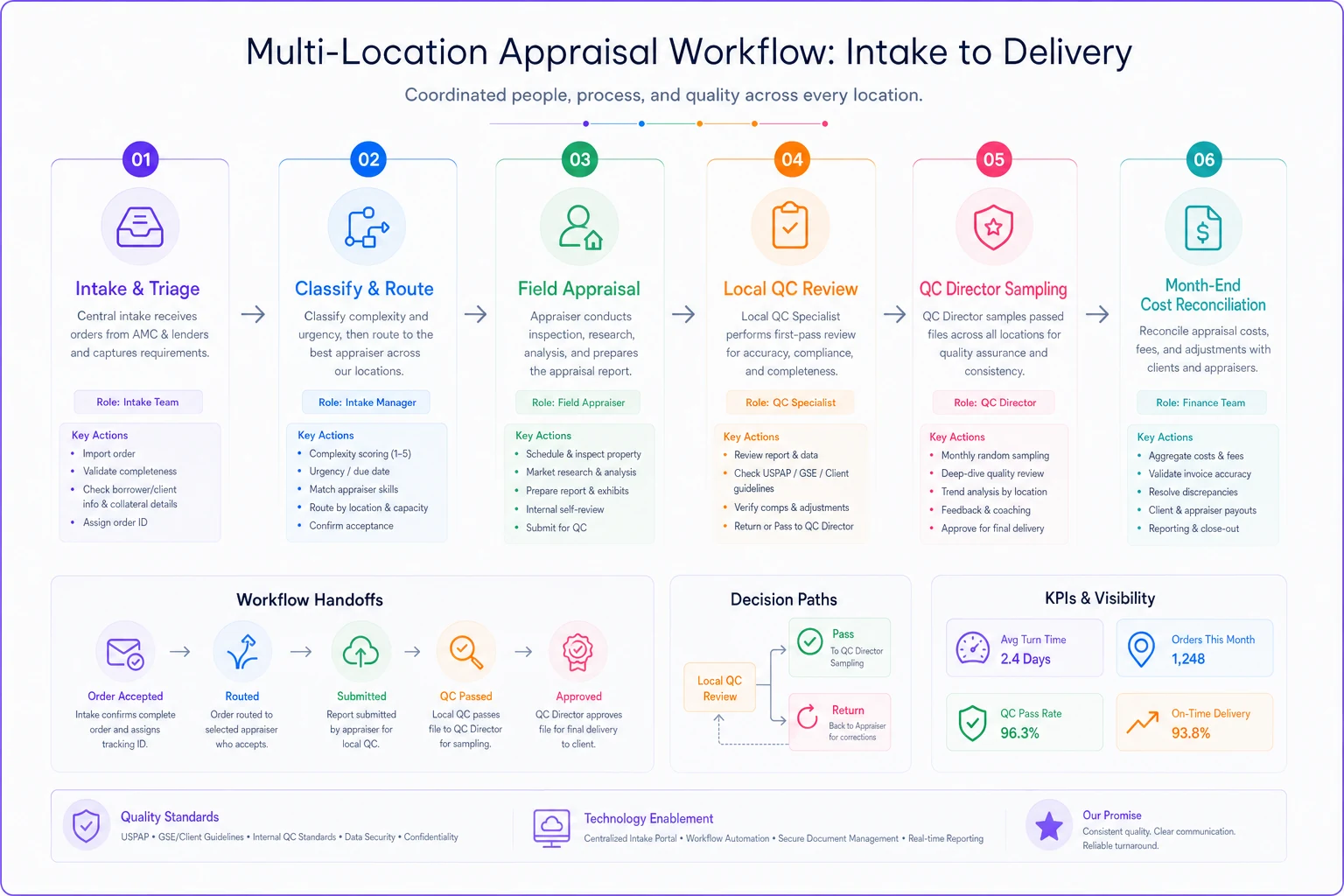
Quick visual of the handoffs above.
[Order arrives] ↓ [Central Intake: classify complexity, set fee + due date, route to location] ↓ [Field Appraiser: field work + report, complexity tier already attached] ↓ [Local QC: first-pass review against standard checklist] ↓ Pass? → [Release to client] Fail? → [Route back with specific defect notes] ↓ [QC Director: weekly sampling of passed files across all locations] ↓ [Month-end: cost tags reconciled by location, intake share, review labor]
An order arrives. Central intake classifies complexity against a shared scorecard, sets the fee and due date from that classification, and routes to the right location based on geography and appraiser fit. The field appraiser picks it up with the complexity tier already attached — they know the scope and time budget before they touch it. They do the field work and write the report.
Local QC runs the first-pass review against the standard checklist. It passes and releases, or it fails and routes back with specific defect notes — not vague "fix this." The QC Director isn't in that loop day to day. They're sampling passed files across all locations weekly to make sure "pass" means the same thing everywhere. Cost tags follow the file the whole way, so at month-end the firm knows what that assignment actually cost to produce, including its share of intake and review labor.
Every handoff has a clear owner and a clear artifact. Nothing sits in limbo waiting for someone to notice it. This is the same principle behind a documented, role-based end-to-end appraisal workflow — the org chart and the workflow are two views of the same system, and they have to agree with each other. If your workflow says QC catches problems but your org chart gives QC no authority, the workflow loses every time there's a deadline.
Where coordination gets hard at scale is keeping all of this visible without drowning people in status updates. A central operational platform helps here — not as a magic fix, but as the shared surface where intake classifications, routing decisions, QC status, and cost tags all live in one place instead of scattered across email, three spreadsheets, and each office's own habits. AI-assisted routing and complexity flagging can take some of the manual judgment load off intake — surfacing files that look like they might be misclassified based on property characteristics, for example — but the real value is that everyone's looking at the same information, so the governance routines have something real to calibrate against.
When this level of structure actually makes sense
Not every firm needs a QC Director and cost-center accounting. Over-engineering the org is its own failure mode.
This structure makes sense when:
-
You're running two or more locations, or clearly heading there within a year.
-
Exception rates differ noticeably between offices or appraisers.
-
You've already had a client raise inconsistency as a concern.
-
The owner is spending more time firefighting quality than growing the business.
It's premature when:
-
You're a solo or three-person shop where everyone's still within earshot. Formalizing charters here just adds overhead you'll ignore.
-
Your volume can't support dedicated intake and QC roles yet. Don't create a QC Director position for twelve files a week.
Firms that are growing fast but haven't stabilized their basic workflow yet should also hold off. If handoffs are still chaotic within a single office, adding a second location and a formal org structure on top of that is just multiplying the chaos. Fix the workflow first, then layer the org structure on a system that already works.
A short real scenario
A residential firm running two offices — about eighteen people total — was losing files to slow turn times and getting inconsistent exception rates between branches. One office ran around a 9% exception rate; the other was closer to 22%. The owner assumed the second office just had weaker appraisers.
When they mapped ownership, the actual problem was intake. The second office had no dedicated intake role — assignments were classified by whoever grabbed them, which meant complex files regularly got standard fees and standard timelines. The appraisers weren't weaker; they were being handed underscoped, underpriced work and then blamed for the mess in QC.
The fix wasn't hiring more reviewers. They centralized intake classification under one shared scorecard, gave the local QC lead actual stop authority, and started a fifteen-minute weekly calibration between the two offices. Over the next quarter, the gap between the two offices' exception rates narrowed to a few points, and revision-driven rework dropped enough that the second office stopped blowing SLAs on complex files. Nothing about the people changed. The ownership of two decisions did.
Bringing it together
Scaling an appraisal firm past one office isn't a hiring problem — it's a definition problem. The firms that scale cleanly figure out, before they open the second location, who owns intake decisions and who owns QC standards. They keep those standards centralized even as execution spreads out. They measure money where the work happens, so a weak location can't hide inside a strong one. And they run small, unglamorous calibration routines that keep every office pulling toward the same standard.
An appraisal firm organizational blueprint isn't a chart you draw once and frame on the wall. It's a living map of who decides what, where the quality gates are, and how you'll notice — early — when two offices start drifting apart. Get intake and QC ownership right, tie your cost centers to reality, keep the governance routines short and honest, and the structure will hold as you add the third office, the fourth, and the appraisers you haven't hired yet.
Ready to elevate your appraisal operations?
Join 500+ appraisal firms using Rateoly to enhance accuracy, save time, and improve client satisfaction.