
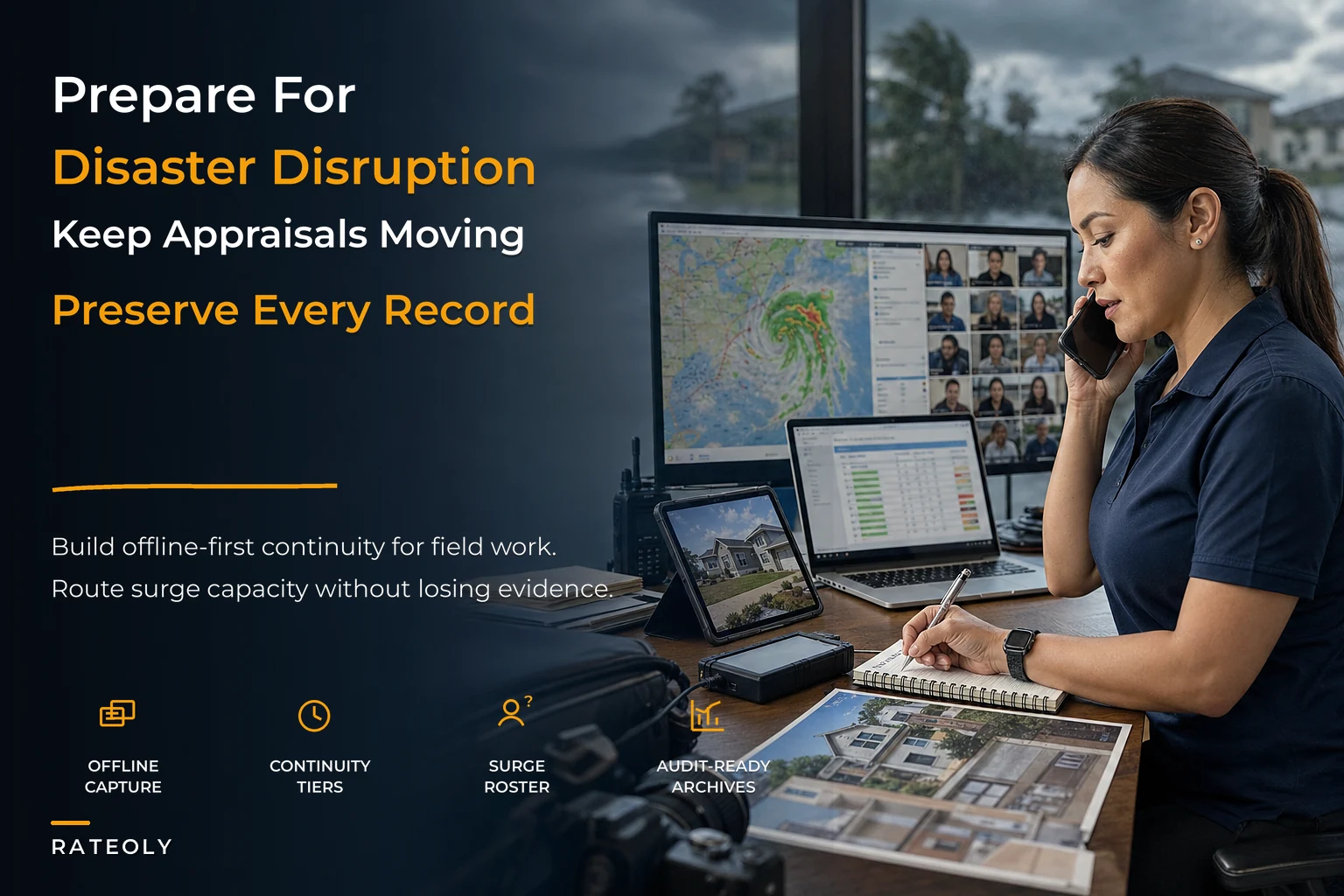

Most appraisal firms are one bad week away from a stall. Not bankruptcy — a stall. A lead appraiser gets hospitalized during a 40-order backlog. A wildfire closes two counties and reroutes a third of your field schedule. A ransomware note shows up on the shared drive at 6 a.m. and nobody can open a workfile. The firm doesn't collapse, but it limps, misses SLAs, and spends the next month explaining to AMCs why everything slipped.
What separates firms that recover cleanly from the ones that scramble isn't luck or even backups. It's whether continuity was designed as a system — tiered by how long the disruption lasts, built to keep field evidence intact even offline, and structured so temporary help can plug in without breaking your audit trail. An appraisal business continuity plan that only exists as a two-page PDF in a shared folder almost never survives contact with a real event.
This is the whole-system view: how the pieces connect, where they break as you grow, and what a defensible continuity posture actually looks like in day-to-day field operations.
Why most continuity plans fail the moment they're needed
The typical plan treats disruption as a single binary — "we're down" or "we're up." Real disruptions don't work that way. They have duration, and duration changes everything about the right response.
A two-hour MLS outage is not the same problem as a two-week key-person absence, which is not the same problem as a three-month displacement after a regional disaster. But most firms respond to all three with the same reflex: everyone works harder, the owner starts triaging by gut feel, and the written plan — if there is one — never gets opened because it doesn't say anything specific enough to act on.
The pattern is consistent across firms of every size. The continuity document was written once, usually to satisfy an AMC vendor-approval checklist or a state board requirement. It lists phone numbers, a backup vendor or two, and a sentence about "restoring operations as quickly as possible." It was never tested. Nobody knows who declares an incident, what the first 30 minutes look like, or how field evidence collected during the disruption gets preserved in a way that survives a later audit.
The gap isn't awareness. Owners know they should be prepared. The gap is that continuity gets treated as a document instead of an operating mode — a set of workflows that activate based on how bad and how long the problem is.
Tiered continuity: short, medium, long
The single most useful structural change is to stop writing one plan and start writing three. Each tier maps to a disruption duration, and each has different goals, different decision-makers, and different acceptable tradeoffs.
Manage every appraisal with confidence and clarity.
Rateoly helps you coordinate inspections, generate reports, and communicate seamlessly with clients.
- Comprehensive appraisal tracking
- Automated client notifications
- Integrated scheduling & report management
No credit card required
| Tier | Duration | Primary goal | Acceptable tradeoff | Who decides |
|---|---|---|---|---|
| Short | Hours to ~1 day | Keep field work moving, buffer the backlog | Minor delays, manual workarounds | Shift lead / senior appraiser |
| Medium | ~1 day to 2 weeks | Protect SLAs, redistribute load, bring in surge help | Reduced throughput, selective order acceptance | Operations owner |
| Long | 2+ weeks | Preserve the business, reset client expectations formally | Turning away work, temporary capacity reshaping | Principal / owner |
The point of the tiers is that they force pre-made decisions. In a short-tier event — say your valuation software is down for the afternoon — the senior appraiser already knows the rule: field inspections continue on offline tools, office work shifts to report QC and comp research that doesn't need the live system, and nothing gets declared to clients yet. No meeting required.
Medium-tier events are where firms usually get hurt, because the disruption lasts long enough to blow SLAs but feels "too small" to formally escalate. This is exactly when you need the redistribution rules written down: which order types you keep taking, which you push, and what the client notification language is. More on surge routing below.
Long-tier events are rare but existential — a regional disaster that displaces your office for a month, the sudden loss of your only certified appraiser in a specialty, a legal hold that freezes part of your operation. The long-tier plan isn't about speed. It's about controlled contraction and formal communication so you don't quietly default on obligations you can't meet.
A note on where the tiers break at scale
A solo shop and a five-office firm need different versions of this. For a solo appraiser, "medium tier" might just mean a pre-arranged reciprocal coverage agreement with two other appraisers in the area. For a multi-location firm, medium tier means cross-office load balancing, and the failure point shifts — now your bottleneck is coordination, not capacity. Firms that grow past three or four appraisers almost always discover their old continuity habits, the informal, owner-driven kind held in one person's head, simply stop scaling. The owner can't be the single point of decision for every disruption across every office.
Offline-first evidence preservation in the field
Field operations are where continuity plans quietly fall apart, because the disruption and the data collection happen at the same time and place. An appraiser is standing in a half-flooded basement documenting condition when cell service drops. Where do those photos live? What happens to the inspection notes if the tablet dies before sync? If a dispute surfaces eight months later, can you prove the capture time and that nothing was altered?
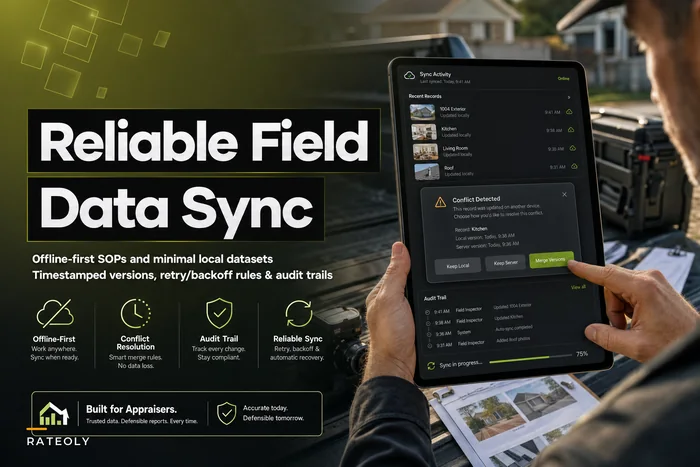
The right default is offline-first: field tools capture and store everything locally first, timestamp and geotag at the moment of capture, and sync when connectivity returns — without depending on a live connection to function. This isn't just convenience. It's an evidentiary posture. Data captured locally with reliable metadata and later synced cleanly is far more defensible than data that may or may not have made it to a server during a spotty inspection.
The hard part isn't capture — it's reconciliation. When three field tablets all sync back after a day in a dead-zone county, you can get conflicts: duplicate records, overlapping edits, out-of-order timestamps. If you haven't thought through how those conflicts resolve, you end up with quiet data corruption nobody notices until a reviewer asks why two versions of the same photo set exist. We've written separately about offline-first mobile workflows and conflict resolution patterns for appraisers, and that mechanics layer is what makes the continuity layer trustworthy.
-
Capture metadata at the source, not at upload. Timestamp, GPS, device ID, and appraiser ID should be stamped when the photo is taken, not when it reaches the office.
-
Treat local storage as evidence, not a buffer. Don't let the tablet auto-purge before a confirmed, verified sync.
-
Make sync status visible. The appraiser should be able to see, in the field, what's synced and what's still local — so nothing gets wiped by mistake.
-
Hash or seal critical artifacts. For high-stakes assignments, a content hash at capture gives you a clean integrity story later.
There's a deeper connection worth noting: offline-first field evidence is itself a continuity feature. In a short-tier outage where your central systems are down, offline-capable field tools mean inspections never stop. The field keeps producing; the office catches up on sync when systems return. Firms that rely on live, always-connected field apps lose both — they can't capture and they can't preserve.
Temporary staffing and surge routing templates
Capacity disruptions and demand surges are two sides of the same coin, and both need the same thing: a pre-built way to route work to people who weren't on the original plan.
Improvising this under pressure is where firms consistently get hurt. When your senior residential appraiser is out for three weeks and 25 orders are stacking up, "figure it out" is not a plan. By the time you've called around for coverage, negotiated terms, and figured out how to hand off files without wrecking your audit trail, you've already burned a week of SLA.
A surge routing template answers these questions before the event:
-
Trigger definition. What specifically activates surge mode? A common rule: backlog exceeds X days of normal capacity, or a key-person absence projected past Y days.
-
Who gets called first. A ranked roster of pre-vetted contract appraisers and reciprocal partners, with their coverage areas, certifications, and rate agreements already on file.
-
What they can and can't touch. Which assignment types a temp appraiser is authorized to sign, which need your review, and which are off-limits entirely.
-
How files hand off. The exact handoff pack — order details, prior comps, access notes, client requirements — standardized so onboarding a temp takes minutes, not a morning.
-
How quality stays consistent. Lightweight review gates so surge-produced reports meet the same standard as your in-house work.
-
How it's logged. Every reassignment recorded so you can reconstruct who did what, when, and under whose authority.
Step 6 is the one firms skip and later regret. Bringing in temporary staff dramatically expands who has access to active files, and that access needs to be scoped and logged — not handed out as a shared login. Surge staffing is precisely when access-control discipline matters most, because you're adding people fast under pressure. The same role-based access and lightweight logging approach that works for small firms day-to-day is what lets you add a contract appraiser for two weeks and remove them cleanly without leaving loose access or gaps in your audit trail.
Keep a single, pre-tested handoff pack so onboarding a temp truly takes minutes.
Here's a compact visual of the surge routing workflow to make the handoff steps and logging points obvious.
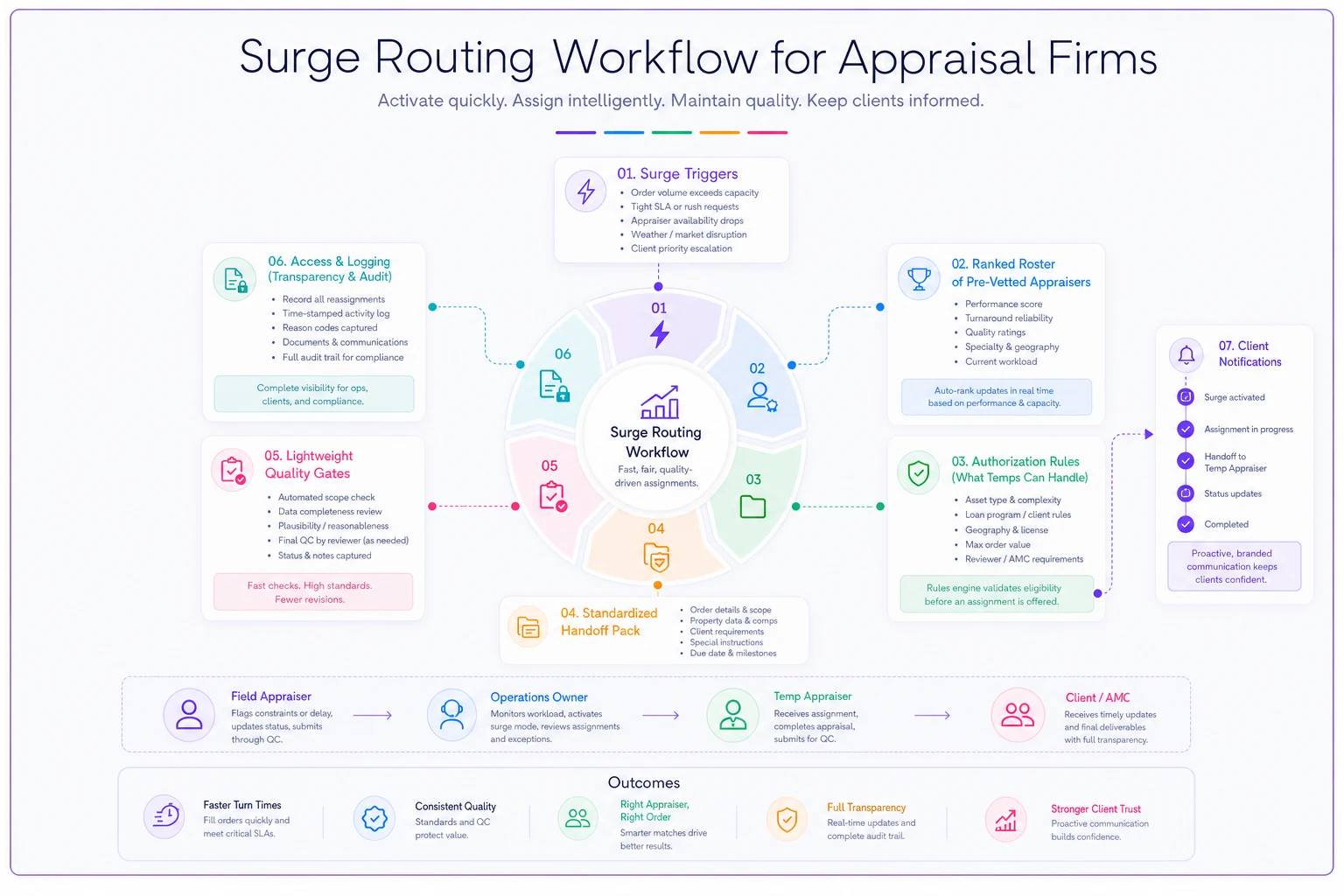
The visual emphasizes quick decision points and where logging must happen so you don't lose auditability while scaling capacity fast.
Audit-defensible evidence preservation during disruption
The evidence you collect during a disruption is exactly the evidence most likely to be challenged later. Work produced under surge conditions, by temporary staff, with systems partly down — that's the work a reviewer or opposing expert will scrutinize hardest. If your continuity plan keeps you producing but doesn't keep that production defensible, you've traded one problem for a worse one that surfaces months later.
-
Chain of custody never breaks. Every file should have a traceable history: who touched it, when, under what authority, including temporary staff. This is what falls apart in a scramble — work gets done, but the record of who did it and when gets reconstructed from memory afterward. That reconstruction is what destroys credibility in an audit.
-
Capture integrity is provable. Timestamps and location data on field evidence should be captured at the source and preserved through sync, so you can demonstrate the inspection happened when and where you say it did.
-
Decisions get logged, not just outcomes. If you reassigned an order, deferred a client, or accepted degraded conditions during an event, write down the decision and the reason at the time. A short contemporaneous note is worth far more than a polished explanation written after the fact.
-
The plan activation itself is documented. When did you declare the incident, which tier, who authorized it, what changed. This is your defense that any slippage was a managed response to a real event, not neglect.
The underlying principle: defensibility is about reconstruction. An audit, a lawsuit, or an AMC review is someone asking you to reconstruct what happened. If your continuity process generates its own record as it runs — tier declared, work rerouted, access granted and revoked, field evidence captured and sealed — reconstruction is straightforward. If it doesn't, you're defending your most-scrutinized work with the weakest possible documentation.
A real scenario
A three-appraiser firm in a fire-prone region got hit with a double disruption: their lead appraiser was out for shoulder surgery recovery, roughly three weeks, and two weeks into that, a brush fire closed access to a cluster of pending inspections. They were carrying around 30 active orders.
Before any of this, their continuity "plan" was a single document that mostly listed backup contacts. When the surgery absence hit, they improvised — the owner absorbed the lead's queue, work backed up, and by the time the fire hit they were already a week behind on SLAs. They lost a chunk of orders to AMC reassignment and spent most of a month catching up and smoothing over client relationships. The combination of lost orders, rush-fee pressure, and the owner's time ran into several thousand dollars, and it dinged their standing with two AMCs.
The rebuild was the interesting part. They didn't buy anything exotic. They wrote three tiers, pre-vetted two contract appraisers with signed rate and coverage agreements, built a standard handoff pack, and set up scoped, logged access so a temp could be added and removed cleanly. They moved field capture to an offline-first setup so inspections in low-signal areas kept producing with intact metadata.
Roughly six months later a smaller version of the same event hit — one appraiser out for about ten days during a busy stretch. This time, medium tier activated on day one, a contract appraiser picked up the routable orders by day two with a clean handoff, and the firm held its SLAs. No AMC reassignments, no scramble. The difference wasn't effort — the first time around they worked harder. The second time, the decisions were already made.
Building it without over-engineering
You don't need an enterprise continuity program. For a small or mid-size firm, the useful version is lean and testable. A starting checklist:
-
- [ ] Three written tiers (short / medium / long) with defined triggers and decision-makers
-
- [ ] A clear "who declares an incident" rule — one named role, with a backup
-
- [ ] A ranked roster of pre-vetted contract appraisers, with rates and coverage on file
-
- [ ] A standardized file handoff pack temps can onboard from in minutes
-
- [ ] Scoped, logged access that can be granted and revoked cleanly for temporary staff
-
- [ ] Offline-first field capture with source-level metadata and visible sync status
-
- [ ] Conflict-resolution rules for when multiple field devices sync back
-
- [ ] Contemporaneous logging of tier activation, reassignments, and degraded-condition decisions
-
- [ ] Pre-written client/AMC notification language for medium and long tiers
-
- [ ] A once- or twice-a-year tabletop test where you actually walk through a scenario
That last item is the one firms skip and shouldn't. A plan you've never rehearsed is a plan you'll misread under stress. A 45-minute tabletop — "the lead is out for two weeks and the MLS is down, go" — surfaces every gap fast and cheap.
Who should probably not bother with the full version
A pure solo appraiser with no staff and a steady, predictable workload doesn't need three formal tiers and a surge roster. For them, the whole continuity plan reasonably collapses into two things: offline-first field capture so inspections never stall, and a reciprocal coverage handshake with one or two trusted peers. Over-building continuity for a one-person shop is wasted effort. The tiered approach earns its keep the moment you have staff, multiple SLAs to protect, or a specialty where losing one person stalls a whole line of work.
The system view
Continuity, field evidence, surge staffing, and audit-defensibility aren't four separate concerns — they're one system under stress. The tiers decide how you respond. Offline-first capture keeps the field producing and keeps that production defensible. Surge templates let you add capacity without breaking access control or chain of custody. Contemporaneous logging ties it all together so the work you produce under pressure holds up later.
The firms that handle disruption well aren't the ones with the thickest binders. They're the ones who made the decisions in advance, scoped access so new people can plug in cleanly, kept their field evidence intact regardless of connectivity, and generated a record as the response unfolded. An appraisal business continuity plan built that way doesn't just help you survive a bad week — it means the work you did during that bad week is the work you can stand behind a year later.
Ready to elevate your appraisal operations?
Join 500+ appraisal firms using Rateoly to enhance accuracy, save time, and improve client satisfaction.