

Most appraisal firms that abandon a new platform didn't buy bad software. They bought reasonable software and rolled it out badly. The order management system, the field app, the QC workflow tool — whatever it was, it got introduced on a Monday, half the team ignored it by Wednesday, and by the end of the quarter the firm quietly reverted to email and spreadsheets while still paying the subscription.
That pattern is almost predictable. And it has almost nothing to do with the vendor. Rollout failure is an operations problem, and it shows up in the gap between "we bought it" and "everyone actually uses it the same way." Appraisal digital change management is what closes that gap — and it's the part almost everyone skips.
This isn't about pep talks or getting buy-in. It's about staging the change so the firm can absorb it without breaking turn times, without confusing lenders mid-transition, and without burning out the two or three people who actually understand the new system.
Why rollouts fail even when the software is good
Appraisal firms have a structural disadvantage when it comes to change: the work never stops. There's no slow season where you can pause and retrain. Orders keep coming, SLAs keep ticking, and lenders don't care that you're "in transition." So new tools get shoved into a live operation with no slack, and the first time someone hits friction under deadline pressure, they fall back to the old way. Once that happens twice, the rollout is effectively dead.
A few patterns come up over and over:
-
The champion bottleneck. One tech-savvy appraiser or ops person configures everything, and the whole rollout lives in their head. When they're on vacation or slammed, everyone else stalls.
-
Everyone trained the same way. A trainee, a senior appraiser, an AMC-facing coordinator, and the owner all sat through the same 90-minute demo. None of them learned their actual job in the new system.
-
No definition of "done." Nobody agreed on what successful adoption looks like, so there's no way to tell whether it's working or quietly failing.
-
Silent partial adoption. Half the team uses the new order intake fields; the other half skips them. Now your data is worse than before because it's inconsistent.
That last one is the real killer.
A tool that 60% of the team uses correctly is often worse than the old manual process, because it creates the illusion of a single source of truth while the underlying data is a mess.
The staged rollout: pilot before you scale
The single biggest mistake is switching the whole firm at once. A staged rollout — pilot, then controlled expansion, then full cutover — gives you a chance to find the breakage points while they're still small and cheap.
Manage every appraisal with confidence and clarity.
Rateoly helps you coordinate inspections, generate reports, and communicate seamlessly with clients.
- Comprehensive appraisal tracking
- Automated client notifications
- Integrated scheduling & report management
No credit card required
A realistic staging sequence for a small-to-mid appraisal shop:
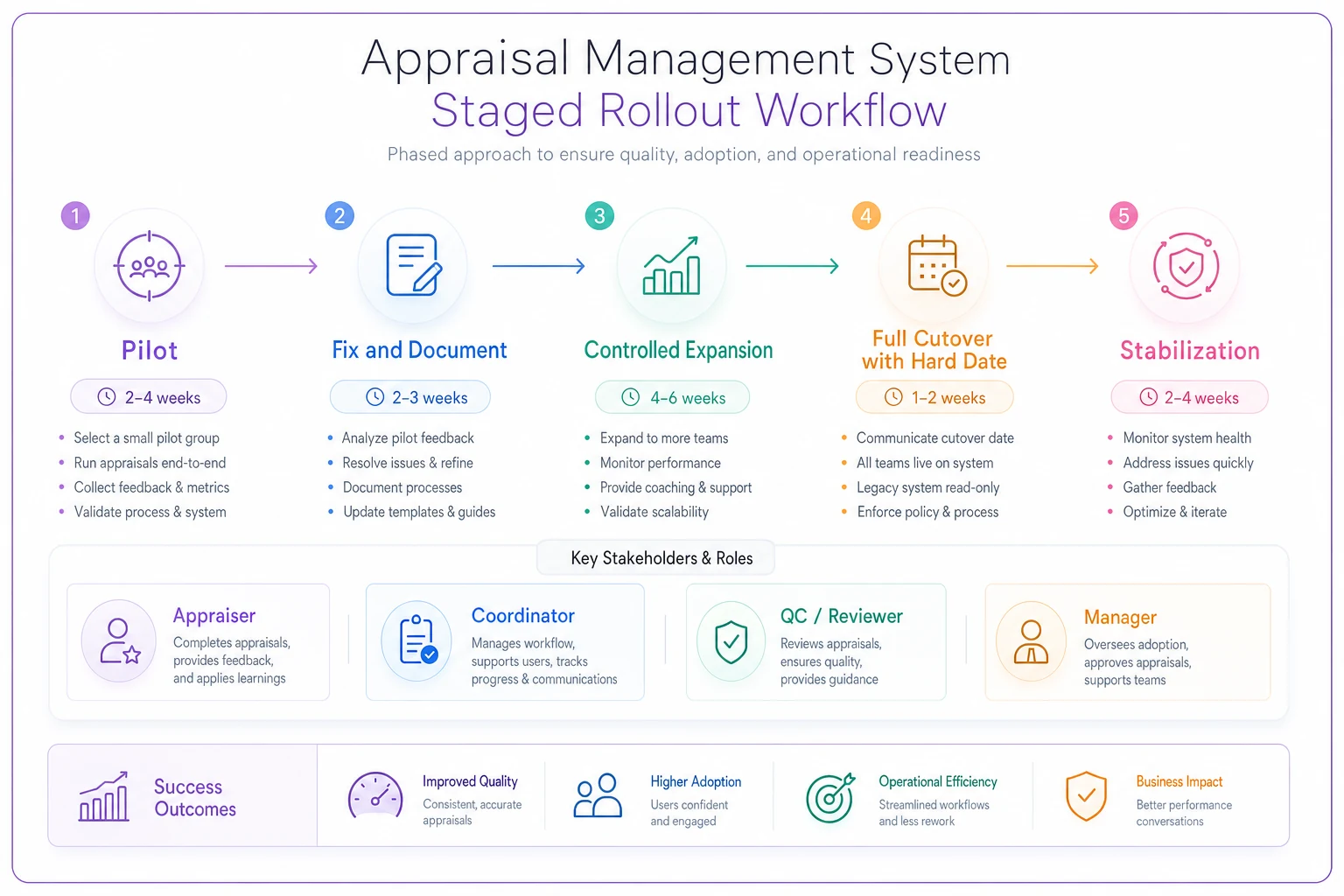
Here's a simple workflow for a staged rollout.
-
Pilot (2–3 weeks). Pick one appraiser, one coordinator, and a slice of live work — say, standard suburban 1004s from a single client. Run those files fully through the new system while everything else stays on the old process.
-
Fix and document (1 week). The pilot will surface a bunch of small problems: a field that doesn't map to what the AMC expects, a photo naming rule that fights the app, a QC step that got skipped. Fix them and write down the corrected workflow.
-
Controlled expansion (3–4 weeks). Add two or three more people and a second file type — maybe complex properties or a second lender. Watch whether the documented workflow holds up against harder assignments.
-
Full cutover (with a hard date). Once expansion is stable, set a firm switch-off date for the old process. No indefinite "use whichever you prefer." Ambiguity kills adoption.
-
Stabilization (ongoing). For the first month post-cutover, expect elevated questions and keep a fast feedback loop open.
The pilot isn't just a test — it's where you build the training material. The problems your pilot team runs into are the curriculum for everyone else.
When a full-firm rollout actually makes sense
Staging is the default, but not universal. If you're a two-person shop, a pilot is basically the whole firm anyway — just be deliberate for a week before committing. And if the new tool replaces something genuinely broken (a system that's already causing lender exceptions), the cost of staying slow can outweigh the risk of moving fast. In that case, shorten the pilot. Don't skip it.
Role-tuned training beats the group demo
Generic training is where adoption goes to die. The coordinator doesn't need to know how the appraiser handles field photos, and the appraiser doesn't need the full AMC-communication workflow. When you teach everyone everything, they remember nothing.
Break training into short, role-specific sprints tied to what each person actually does every day:
| Role | What they need to master | Sprint length | Success signal |
|---|---|---|---|
| Intake / coordinator | Order entry, validation fields, assignment routing | 2 sessions | Orders enter clean with no missing required fields |
| Field appraiser | Mobile capture, photo standards, sync/upload | 2 sessions | Files sync without manual cleanup |
| Reviewer / QC | Review queue, exception flags, sign-off | 2 sessions | QC steps logged in-system, not on paper |
| Owner / manager | Dashboards, capacity view, SLA tracking | 1 session | Uses the dashboard weekly instead of asking people |
Keep sessions short — 30 to 45 minutes — and run them against real, current orders, not a sandbox demo file. People learn the system by doing their actual job in it, not by watching someone click through a fake property.
One thing worth doing: designate a backup for every role's expertise. The champion bottleneck disappears the moment two people, not one, can answer the coordinator's questions.
Adoption KPIs: how you know it's actually working
"It seems to be going fine" is not a status. You need a small number of measurable signals that tell you whether adoption is real or cosmetic. Pick three or four — more than that and nobody tracks any of them.
Useful adoption KPIs for an appraisal rollout:
-
Feature-through rate what percentage of new files actually went fully through the new workflow versus getting handled the old way on the side.
-
Data completeness percentage of orders with required fields filled correctly at intake.
-
Rework from tool confusion files that had to be reopened because someone used the system wrong (distinct from normal QC).
-
Time-to-competence how long after training before a person stops asking basic how-to questions.
-
Turn-time delta are turn times recovering to baseline after the initial dip, or staying elevated?
Expect turn times to worsen during the pilot and early expansion — that dip is normal. The failure signal is when it doesn't recover within a few weeks of cutover. If completeness is stuck at 70% a month in, you don't have an adoption problem. You have a workflow that fights the way people actually work, and you need to change the workflow, not scold the people.
Remedial coaching without the drama
Some people will lag. Usually it's not resistance — it's that the new way genuinely slows them down at first, and under deadline pressure they revert. Treating that as an attitude problem poisons the whole rollout. Treat it as a coaching problem instead.
A lightweight remedial approach that actually works:
-
Identify by data, not gut feel. If someone's completeness or feature-through rate is low, that's the trigger — not a manager's instinct.
-
Short paired sessions. 20 minutes, one-on-one, running their own backlog through the system with someone who knows it. No group shaming.
-
Fix the workflow when it's the workflow. If three people all skip the same step, the step is the problem. Re-sequence it or automate it away.
-
Set a check-back date. "Let's look again in a week" makes it a process, not a confrontation.
Use data (completeness and feature-through rates) to identify who needs coaching rather than relying on manager intuition.
The tone matters more than the content here. The moment coaching feels like discipline, people stop reporting problems, and hidden partial adoption creeps back in.
The communications playbook
Half of rollout failure is a communication vacuum. People fill silence with worst-case assumptions — "this is going to replace me," "this is another thing that'll get abandoned in a month." A simple communications cadence prevents most of that.
Cover these before, during, and after:
-
Before why the change is happening, what problem it solves, what the timeline looks like, and — critically — that turn times may dip temporarily and that's expected.
-
During a single channel where people report friction and actually see it get fixed. Nothing builds trust faster than someone flagging a broken field on Tuesday and seeing it corrected Thursday.
-
After cutover confirm the old system is off, share the early wins (fewer missing fields, cleaner handoffs), and acknowledge what's still rough.
Don't forget outside parties either. If your intake or communication with AMCs and lenders changes format, tell them before they receive a differently-structured file and open an exception. A two-line heads-up email prevents a week of back-and-forth.
A realistic scenario
A three-appraiser firm doing roughly 90–110 orders a month bought a combined order-management and field-capture platform after years on shared spreadsheets and email. Their first attempt — everyone switched at once, one group demo — collapsed inside three weeks. Turn times spiked, two appraisers quietly went back to email, and intake data ended up split between the tool and the old spreadsheet.
The second attempt used a staged plan. They piloted with one appraiser and the coordinator on a single lender's standard files for two weeks, fixed about a dozen field-mapping and photo-naming issues, then built those fixes into short role-specific training. Full cutover came with a hard date and a shared channel for reporting problems.
Around six weeks after cutover, intake completeness had climbed from the low 70s to the low-to-mid 90s, and the turn-time dip had recovered to slightly better than their old baseline — because handoffs stopped getting lost in email threads. The difference between the two attempts wasn't the software. It was identical software both times. It was the staging.
Where tooling fits — carefully
Change management is mostly discipline, but the right platform does make some of it easier. Specifically, one that surfaces adoption signals — completeness rates, feature-through, where files are stalling — turns "I think it's going okay" into something you can actually see and act on. That visibility matters most in the weeks right after cutover, when problems are still small enough to fix without derailing the whole thing.
Worth saying: being deliberate about tool selection before you roll anything out prevents you from carefully managing the change of something you shouldn't have bought in the first place. The same rigor applies whether you're working through a proper vendor-evaluation and TCO framework or mapping out which manual steps are worth automating using an automation inventory with compliance guardrails.
The point isn't more software layered on top of a rollout. It's visibility into whether the rollout is actually taking hold, so you can intervene while problems are still small enough to matter.
Who should slow down before rolling anything out
Not every firm is in a position to run a clean rollout. A few situations where slowing down is the right call:
-
Firms in the middle of their busiest stretch with zero capacity slack — even a two-week buffer helps more than people expect.
-
Firms without a single owner accountable for the rollout. If it's "everyone's job," it's no one's.
-
Firms trying to change three systems at once. Stack changes and you can't tell which one is breaking.
-
Firms that haven't agreed on what success looks like. Define the adoption KPIs before the pilot, not after.
Recognizing when to wait isn't a failure of momentum. It's the kind of call that keeps a rollout from becoming another abandoned subscription.
Final thought
A rollout is a temporary state your firm passes through, and the whole game is getting through it fast enough that people don't lose faith and slow enough that the work doesn't break. Stage it, train by role, watch a few honest adoption numbers, coach the laggards without making it a thing, and keep people informed. Do that, and the tool you bought actually becomes the tool you use — which, in the end, is the only version of the purchase that was ever worth paying for.
Ready to elevate your appraisal operations?
Join 500+ appraisal firms using Rateoly to enhance accuracy, save time, and improve client satisfaction.