


Most small appraisal firms already have a technology roadmap. It isn't written down, and it isn't really a roadmap. It's a pile: whatever annoyed the owner most recently, whatever vendor demo landed in a slow week, and that one integration someone swears will "fix everything" once it's connected.
The pile produces a predictable year. A mobile inspection app gets bought in March. Somebody starts an MLS data connection in May. By August the firm has decided the forms software is the real problem and is looking at a switch. By October three projects are half-done, the appraisers have learned to ignore new tools because the last two didn't stick, and the office coordinator keeps her own spreadsheet on the side because she doesn't trust any of the systems.
None of those purchases were stupid on their own. The failure is in the order and the overlap. Appraisal operations are tightly coupled: intake feeds scheduling, scheduling feeds field work, field data feeds the report, the report feeds QC, and delivery triggers billing. Change one piece without thinking about the others and the problem doesn't go away. It just shows up somewhere else.
This article is about building a roadmap that respects that coupling. It's not a list of tools to buy. It covers how to score what's worth doing, why fixes usually come before integrations, how to migrate without wrecking turn times, how to talk to the people affected, and how to find automation wins that pay off fast enough to buy goodwill for the harder stuff.
The three roadmap mistakes that keep repeating
Small appraisal shops fall into three patterns over and over, and most firms are doing at least two at once.
Loudest-pain prioritization. Whatever caused the worst week gets fixed next. A lender escalation over a missing photo leads to a new photo app. A cash crunch leads to a new invoicing tool. But the loudest pain is rarely the most expensive one. Scheduling churn and re-keyed order data quietly cost more every month than the dramatic one-off failure. They just never produce a memorable phone call.
Vendor-driven sequencing. The roadmap ends up in the order the salespeople called you. Vendors are good at making their product feel like the foundation. The forms software vendor says data should start in their system, the scheduling platform says it should be the hub, and the mobile app vendor says field capture comes first. They can't all be right.
Everything-at-once. This one usually comes from a good place. The owner finally carves out budget and attention and tries to fix the whole stack in one push. A team of five to twelve people can absorb maybe one significant change at a time while still delivering 250–400 reports a month. Stack three and nobody fully adopts any of them, the workarounds start, and workarounds are where data quality goes to die.
The fix for all three is a written scoring and sequencing method. It doesn't need to be sophisticated, but it has to make you compare options side by side instead of reacting to them one at a time.
Why tech decisions in appraisal shops are so tangled
Before scoring anything, look at the operation as one connected flow. Take a typical order in a small residential firm and trace it end to end, counting how many places a single decision touches.
Manage every appraisal with confidence and clarity.
Rateoly helps you coordinate inspections, generate reports, and communicate seamlessly with clients.
- Comprehensive appraisal tracking
- Automated client notifications
- Integrated scheduling & report management
No credit card required
An order lands from an AMC portal or a lender email. Someone on the admin side reads it and retypes the address, borrower, contact, due date, fee and product type into the scheduling tool, then copies some of the same fields into the forms software to start the file. The scheduler calls or texts the homeowner, books a slot, updates the status. The appraiser pulls public record and MLS data, sometimes before the inspection and sometimes after. The inspection happens. Photos and sketch data make their way back to the office by whatever route that appraiser prefers, which is often email to themselves, a shared drive, or a mobile app sync. The report gets written, then reviewed if the appraiser is a trainee or the assignment is complex. It goes out through the portal. Later, sometimes days later, an invoice goes out for direct-lender work, and AMC payments get reconciled against what was expected.
Now count the handoffs where the same data gets entered or interpreted again. In most shops it's four to six. Every one is a spot where a typo, a wrong product code or a stale due date can get in and travel downstream.
So "should we integrate MLS data into our forms software?" isn't really a standalone question. If intake data is inconsistent (say the property address is formatted three different ways depending on who typed it), an MLS integration will match the wrong records or fail silently. The project looks like it failed. Really the intake process failed, and the integration just made it visible.
What changes as the firm grows
The coupling gets worse with size, and not in a straight line.
A solo appraiser with a part-time assistant can tolerate a lot of mess because one person holds the context. They know the address in the scheduler is wrong because they remember the phone call.
At six to ten appraisers with one or two admins, context stops living in anyone's head. That's usually when re-keyed data starts generating revisions, and "where's my report" calls start eating the coordinator's morning.
With two locations, or once there's a dedicated reviewer, a new problem shows up. Different people have different habits for the same step, and every tool decision has to work for both offices. A mobile app one office loves and the other ignores gives you two data formats landing in the same QC queue.
A roadmap that made sense at five people is often wrong at twelve, which is a good reason to revisit it quarterly instead of setting it once.
Value/effort scoring that doesn't lie to you
Most value/effort grids fail because the effort side only counts money. A tool that costs $150 a month looks cheap. Then it takes three weeks of the owner's attention, a template rebuild, retraining for every appraiser, and a parallel run where turn times slip. The license ends up being the smallest cost.
For appraisal teams, a more honest version scores both sides on several dimensions. Start with value, scoring each one from 0 to 5:
-
Capacity recovered. Hours of appraiser or admin time freed per month. Weight appraiser hours higher than admin hours, but only if you'll actually fill those hours with more assignments (more on that below).
-
Quality and rework. Does it reduce revision requests, QC kickbacks, or reschedules?
-
Cash timing. Does it shorten delivery-to-invoice or invoice-to-payment?
-
Risk reduction. Compliance exposure, data loss, audit defensibility.
Effort gets the same 0 to 5 treatment, across five dimensions:
-
Money. Licenses, setup fees, any outside help.
-
Internal hours. Who has to spend time on it, and is it the owner? Owner hours are the scarcest resource in most firms.
-
Disruption window. How long does normal production slow down?
-
Dependency count. How many other things have to be fixed or decided first?
-
Reversibility. If it doesn't work, how hard is it to back out? A swapped forms platform is nearly irreversible within a year. A notification rule can be turned off in a minute.
Then add a confidence multiplier: 1.0 if you've measured the problem, 0.7 if you have a decent estimate, 0.4 if it's a hunch. This matters more than people expect, because teams consistently overrate the value of fixing problems they've never counted. "Revisions are killing us" often turns out to be something like a 9% revision rate concentrated in two appraisers and one AMC. That's a training and client-specific problem, not a software one.
The priority score is simple: (Value total × confidence) ÷ Effort total. It isn't precise and isn't supposed to be. Its only job is to force the comparison.
Below is a scored backlog for a roughly eight-person residential shop. It's simplified, but these items show up on almost every list:
| Initiative | Value (0–20) | Confidence | Effort (0–25) | Key dependencies | Reversible? | Decision |
|---|---|---|---|---|---|---|
| Standardize intake fields + order validation checklist | 13 | 1.0 | 4 | None | Yes | Do now |
| Auto-capture AMC order emails into scheduling | 12 | 0.7 | 7 | Intake fields standardized | Yes | Next |
| Milestone-based client status notifications | 9 | 0.7 | 6 | Status definitions agreed | Yes | Next |
| Invoice generated automatically at delivery | 11 | 1.0 | 6 | Fee schedule cleaned up | Yes | Next |
| Mobile inspection app (pilot, 2 appraisers) | 10 | 0.4 | 10 | Photo/naming standards | Mostly | Pilot after standards |
| Two-way MLS/public record integration | 13 | 0.7 | 15 | Clean address data, vendor API access | Partially | Later (Q3+) |
| Owner KPI dashboard | 7 | 0.4 | 9 | Reliable status data | Yes | After data fixes |
| Switch report-writing/forms platform | 12 | 0.4 | 22 | Templates, archive access, training, AMC compatibility | No | Park, re-evaluate in slow season |
The forms platform switch was the item the owner was most excited about, and it scored lowest once effort and confidence were honest. That doesn't mean it never happens. It means it doesn't happen first, and it doesn't happen in spring.
There's one more scoring trap. Capacity recovered only counts as revenue if there's demand to fill it. If your appraisers are already turning down orders, freeing ten hours of their week means more fees, and the value score should be high. In a soft market where they're already waiting on work, those hours mostly translate into less overtime or a deferred hire. That's still real money, just less of it. Score for the market you're in now, not the one you had last year.
Fixes before integrations (most of the time)
The default sequencing rule: fix the definitions before you connect the systems.
An integration moves data faster, and that's all it does. If the data is inconsistent, you get inconsistent data delivered faster and to more places, and it's harder to catch because no human looks at it on the way through.
In appraisal shops, the fixes are unglamorous:
-
One agreed list of product types and how they map across AMC portals, your scheduler and your forms software
-
A single address format that everyone uses at intake
-
Clear status definitions. What does "inspected" mean? Photos uploaded, or the appraiser said they went?
-
A clean fee schedule, so billing automation doesn't invoice the wrong amount
-
Agreed due-date logic. Client due date and internal target date are different fields, and a lot of firms store only one.
None of this costs software money. It costs a few meetings and some discipline. It's also the step most firms skip, because it doesn't feel like progress.
When integration should come first
There's a real exception. If the error is caused by manual re-entry, then removing the re-entry is the fix.
Say an admin retypes AMC order details into scheduling and gets the borrower name or unit number wrong on 3–5% of orders. You can write a better checklist, but you're still asking a tired person to copy text accurately at 4:45 on a Friday. Capturing the order data automatically from the source email or portal export removes the step where the error happens. In that case the integration is the fix.
So the question isn't "fix or integrate?" It's whether the error comes from a bad definition or from a manual copy step. Bad definitions get fixed first. Manual copy steps are integration candidates, as long as the definitions on both ends are already clean.
A rough sequencing ladder
-
Tier 0 – Definitions and standards. Intake fields, statuses, naming, fee schedules. Weeks, not months, and almost no cost.
-
Tier 1 – Quick-win automations. Small, reversible, single-system or two-system rules that remove a manual step. Notifications, invoice triggers, order capture, task assignment.
-
Tier 2 – Integrations. Data flowing between systems in both directions: MLS, public records, accounting, AMC portals. These depend on Tier 0 being solid.
-
Tier 3 – Migrations. Replacing a core system. Highest risk, least reversible. Schedule these deliberately, ideally after Tiers 0–2 have made the data clean enough to move.
Firms that start at Tier 3 almost always end up redoing Tier 0 in the middle of the migration, which is the worst possible time to argue about what "inspected" means.
Quick-win automation, and how to tie it to ROI honestly
Quick wins matter beyond their own ROI because they buy credibility with your team. Appraisers who have watched two tools fail are skeptical, and reasonably so. A small automation that visibly removes an annoying task by week three makes the bigger changes in month four a lot easier to land.
There's a fuller automation inventory with compliance guardrails that catalogs individual chores. This section is narrower: which automations go on the roadmap first, and how to justify them with numbers that survive scrutiny.
Order capture. If an admin spends six to eight minutes retyping each AMC order and you process around 280 a month, that's 30-plus hours a month of pure copying, before you count the revisions triggered by typos. An AI-assisted operational platform can read the incoming order email or portal notification, pull out the structured fields, and stage them for a human to confirm. The confirm step matters. You don't want blind auto-entry, you want a check that takes 30 seconds instead of seven minutes. Realistically that recovers 20–25 hours a month, not all 30, because some orders are messy and need a person.
Status notifications. "Where's my report" calls and emails are a quiet tax. A six-appraiser shop can easily field 25–40 of them a week across lenders, AMCs, agents and borrowers, at a few minutes each. An automatic update at each milestone (scheduled, inspected, in review, delivered) won't eliminate them but usually cuts the volume noticeably. The dollar savings look modest, maybe a few thousand a year in admin time. The bigger gain is that the coordinator stops getting interrupted during the hours she's supposed to be confirming inspections. Put that in the ROI case, because it's what the team will actually feel.
Invoice at delivery. Firms that batch-invoice direct-lender work weekly or at month-end often carry 8–12 days between delivery and invoice. Triggering the invoice at delivery pulls that cash forward. Be careful how you describe it, though. On roughly $40k a month of direct-billed work, moving invoicing up ten days is a one-time cash-flow improvement plus faster collection going forward. It isn't new revenue. Owners who pitch it as revenue to a partner or spouse lose credibility when the P&L doesn't change.
Revision request routing. When a revision request arrives, automatically matching it to the original appraiser and file and opening a task with a due date cuts a surprising amount of "who's handling this?" back-and-forth. The ROI is mostly in revision turn time, which feeds AMC scorecards. It's harder to price, but very real for firms whose order volume depends on those scorecards.
A good quick win usually has four traits: it touches one or two systems, it can be turned off without consequences, it removes a step people already dislike, and its effect shows up within a couple of weeks. If a proposed "quick win" needs a vendor API you haven't confirmed or a data cleanup you haven't done, it's a Tier 2 project wearing a disguise.
The migration risk checklist
Migrations hurt small firms the most, mostly because the old system holds more hidden behavior than anyone realizes. Report templates with years of tweaked language. Comp notes in fields nobody documented. Workfiles that reference the old system's file paths. The AMC portal connection that "just worked" and that nobody remembers setting up.
Before evaluating any replacement, run it through a structured vendor evaluation and TCO framework. That covers whether to buy. The checklist below covers how to move once you've decided.
-
Timing. Is the cutover scheduled in your historically slowest four to six weeks, and not near quarter-end, a known rate move, or a staff vacation?
-
Parallel run. Will both systems run side by side for at least two to three weeks, with a defined end date?
-
Archive access. Can you open, read and reproduce every historical report and workfile for your full retention period without the old system's license? If not, what's the plan and what does it cost?
-
Templates and addenda. Have your standard narratives, addenda and certification language been rebuilt and reviewed by someone who signs reports, not just set up by the vendor?
-
Comp and research data. Is stored comp data, adjustment support and market notes moving over intact, including notes fields?
-
Client delivery paths. Have you tested delivery to every AMC and lender portal you actually use, with a real test file, before cutover?
-
Users and permissions. Are trainee/supervisor relationships, review permissions and signing authority configured correctly from day one?
-
Integrations. Have you listed every connection the old system has, including informal ones like email rules and shared folders, and decided what happens to each?
-
Rollback plan. If the first two weeks go badly, what exactly do you revert to, and who decides?
-
Billing continuity. Will invoices, fees and payment reconciliation keep working through the cutover week?
-
Owner availability. Is the person with final decision authority actually around, and not booked solid with field work during cutover?
-
A named owner for the migration. One person. Not "the team."
Archive access is the one firms skip most. It doesn't hurt until a review request or legal inquiry shows up 14 months later for a report done on the old platform and nobody can open it cleanly.
Stakeholder comms: who needs to hear what
Small firms usually communicate about technology one of two ways. Either they say nothing and people find out when the tool shows up, or they announce the entire roadmap at a big all-hands and quietly drop half of it. The second is worse. Every dropped item teaches the team that announcements don't mean anything.
It's better to treat each group differently, since they care about different things.
Appraisers want to know two things: will this cost me time while I learn it, and will it actually save me time afterward? Tell them what changes in their day, when, and what the old way looks like during the transition. Skip the vision talk and be specific. "Starting the 14th, photos come in through the app instead of email. For two weeks both are fine." If you can, get one respected appraiser to pilot first. Peer adoption beats an owner mandate.
Trainees and supervisors need extra clarity, because a tool change can quietly alter supervision and review steps. If the new system routes trainee reports differently, the supervisor has to know before the first file goes through.
Admin and coordination staff usually carry the most change and get the least warning, and they're the ones who know where the hidden workarounds live. Bring them in before scoring, not after. They'll tell you which "small" change is going to wreck their week.
AMC and lender clients only need to hear about things that change their experience: a new delivery format, new status notifications, a different point of contact, a short window of slower turnaround during a migration. Don't send clients your roadmap. Do send a short heads-up a week or two before anything they'll notice, and warn your highest-volume clients directly if a migration might affect turn time.
Whoever does your books needs to know about anything touching invoicing or payment reconciliation, ideally before go-live, so month-end doesn't turn into a forensic exercise.
A short internal note once a month is plenty for most firms: what shipped, what's next, and what got deprioritized and why. People skip that last part, and it's what keeps the roadmap credible.
Building the roadmap: a working process
This tends to hold up for teams of roughly four to fifteen people. Setup takes a couple of half-days, and maintenance is about an hour a month. Once the backlog is collected, the sequence looks like this:
-
Collect the backlog from everyone, not just the owner. Ask each appraiser and admin for their top three time-wasters and top three "this keeps going wrong" items. You'll get duplicates, which is useful signal.
-
Trace one real order end to end. Walk an actual recent file from intake to payment and write down every handoff and re-entry point. Most backlog items will map onto one of those points, and anything that doesn't is worth questioning.
-
Measure the top five problems, roughly. Two weeks of tallies is enough: revision counts, status calls, time spent re-keying orders, days from delivery to invoice. Then you can stop guessing at the confidence multiplier.
-
Score everything using value, effort, dependencies, reversibility and confidence. Do it with at least one other person in the room so the owner's favorite project gets challenged.
-
Assign each item a tier (0–3) and check that nothing in Tier 2 or 3 depends on an unfinished Tier 0 item.
-
Pick one significant change per quarter, plus a few quick wins. One. If the firm is under six people, maybe one every four or five months.
-
Book migrations against your seasonality. Look at the last two years of order volume, find the dip, and put any Tier 3 work there.
-
Set a review date. Rescore the backlog quarterly. Markets shift, staff changes, and things you scored low may have grown.
The roadmap itself can live in a shared spreadsheet and doesn't need its own software. What does help is having the data that feeds the scoring (status timestamps, revision counts, order volumes) in one place instead of scattered across five tools. A centralized workflow platform with AI automation can surface those numbers without someone pulling them by hand, which turns the quarterly rescoring into an hour instead of a weekend.
Here's a simple workflow visualization you can use when explaining the process to stakeholders.
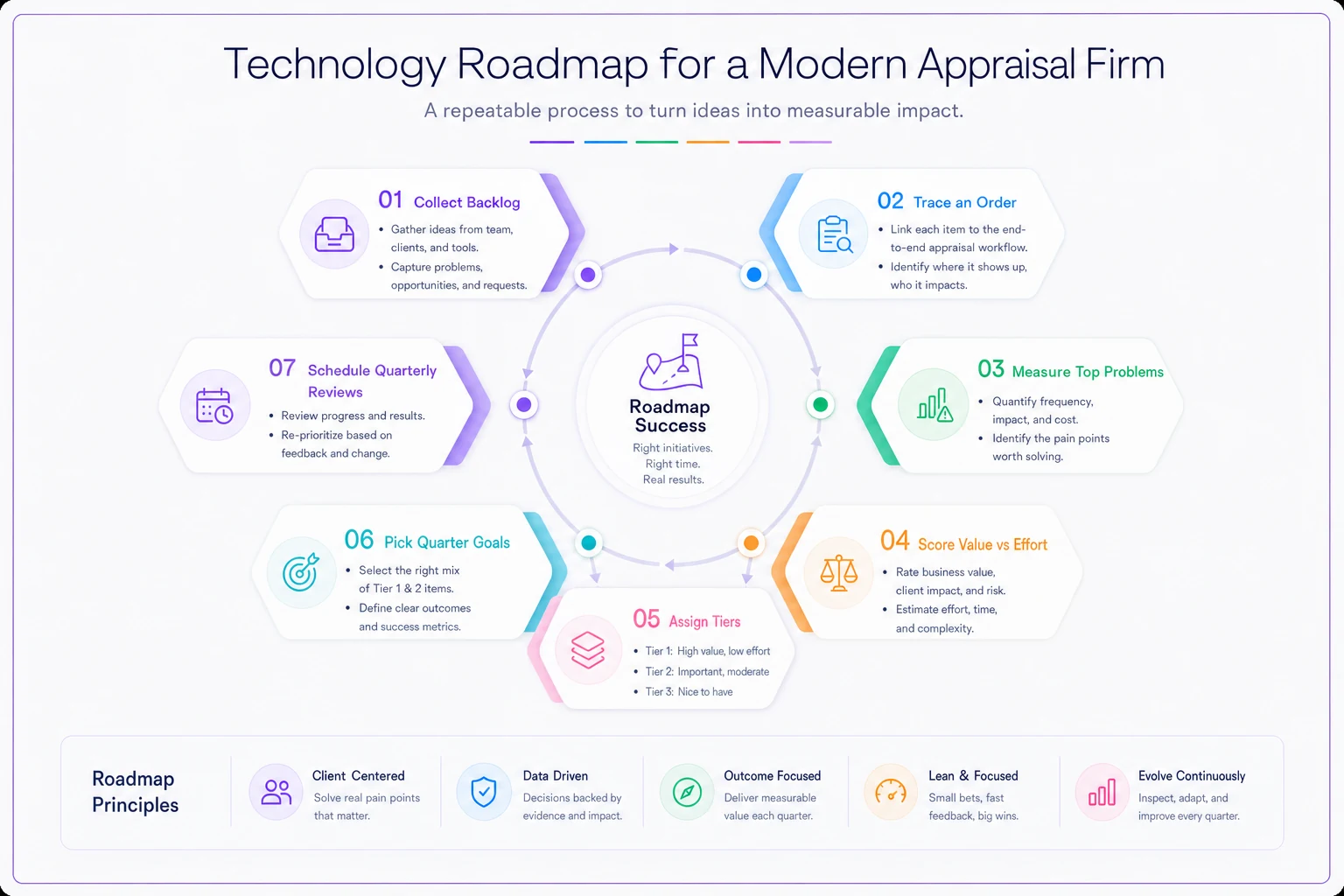
Use this to show how the steps connect and why one change depends on another.
Real scenario: a residential shop that almost did it backwards
Business type: Residential appraisal firm with nine appraisers (six certified, three trainees), two admin staff, roughly 330–370 orders a month, mostly through AMCs with some direct lender work.
The problem: In late winter the owner had already signed for a mobile inspection app. He also planned to switch report-writing software that spring and wanted an MLS data integration started at the same time. Meanwhile the revision rate sat somewhere around 17–19%, average turn time was about seven and a half days, and both admins were retyping every order from AMC emails into scheduling and then again into the forms software.
When they traced orders and tallied for two weeks, a large share of revisions came back to intake: wrong unit numbers, mismatched borrower names, wrong product type. A smaller share came from two trainees' photo and sketch habits. The forms software was clunky, but very little of the revision problem came from it.
They changed the order of things:
-
Paused the forms software switch and moved it to January, their slowest month
-
Spent about three weeks on intake standards
one field list, one address format, agreed product mapping, separate client due date and internal target date
-
Added order email capture with a human confirm step, milestone status notifications, and invoice-at-delivery for direct-lender work
-
Piloted the mobile app with two experienced appraisers and one trainee after setting photo naming standards, then rolled it out to the rest over about six weeks
-
Pushed the MLS integration to Q3, once address data was consistently clean
After roughly five months, the numbers looked like this:
-
Revision rate dropped to around 12%, with most of the remaining revisions tied to judgment calls rather than data
-
Average turn time came down to roughly five and a half to six days
-
Admins got back somewhere in the range of 20–25 hours a month, mostly spent on scheduling and client follow-up
-
Delivery-to-invoice on direct work went from about ten days to same-day or next-day
The forms migration happened the following January with a three-week parallel run. It was still painful, as migrations are, but it didn't collide with spring volume and the data moving over was far cleaner than it would have been a year earlier. The owner's own read afterward was that doing it in the original order would likely have cost them at least one AMC panel spot over turn times.
When this actually makes sense
A structured roadmap pays off when:
-
You have more than one or two technology changes on the table at once
-
More than one person touches each order between intake and delivery
-
You're feeling growing pains
a second location, a first dedicated reviewer, a trainee program
-
A tool rollout has failed or only partially stuck in the last couple of years
-
Revisions, reschedules or "where's my report" calls feel high but nobody can say exactly how high
It's especially useful right before a growth push. Hiring three more appraisers into a messy intake process just multiplies the mess.
When this is a bad idea
If you're in the middle of a real crisis, like losing a major client, a key appraiser leaving, or a compliance issue, deal with that first. Scoring a backlog while the building is on fire is avoidance dressed up as planning.
It's also a bad idea if the roadmap becomes a reason never to act. Some firms score and rescore for months because the process feels productive. If a quick win is obvious, cheap and reversible, just do it.
And if one system is truly failing, say your platform is being sunset or has a security problem, the migration jumps the queue no matter how it scores.
Who should NOT do this
Solo appraisers and two-person shops generally don't need a scored, tiered roadmap. One person holds all the context, decisions happen in a day, and the overhead isn't worth it. A short "fix this next" list is enough.
Firms whose real problem is pricing, client mix or capacity shouldn't expect a technology roadmap to solve it. If you're losing money on most AMC orders, faster intake just loses money more efficiently.
And if the owner isn't willing to let anyone else challenge their priorities, skip the scoring exercise. It only works when someone can say "your favorite project scores low" without it becoming a problem.
Pulling it together
The firms that get the most out of their technology spend usually don't buy better tools, they buy in a better order. They clean up definitions before connecting systems, start with automations small enough to turn off, schedule migrations around seasonality instead of a vendor's sales quarter, and tell their people what's changing before it changes.
None of that requires a big budget. It requires writing the options down, scoring them honestly (effort and reversibility especially), and accepting that the exciting project might need to wait a season. The usual result is fewer half-finished tools and a team that stops rolling its eyes when you announce the next change. That second outcome is hard to measure, but it often decides whether the next change works at all.
Start with one traced order and two weeks of tallies. The roadmap tends to get obvious after that.
Ready to elevate your appraisal operations?
Join 500+ appraisal firms using Rateoly to enhance accuracy, save time, and improve client satisfaction.