
The uncomfortable truth about most appraisal shops is that "quality" lives in a few people's heads. The senior appraiser knows what a defensible adjustment looks like. The review desk knows which files to trust and which to flag. Everyone else is guessing, learning through correction, and slowly absorbing standards by osmosis.
That works fine at four appraisers. It falls apart at twelve, and by twenty-five across three markets it's a liability.
The problem isn't talent. Valuation judgment just doesn't transfer cleanly between people. Two competent appraisers can look at the same suburban comp set and land $18k apart on adjustments — both defensible, both "right" by their own logic. Multiply that spread across hundreds of files a month and you get inconsistent product, uneven exception rates, and lenders who quietly start routing the tricky work elsewhere.
An appraiser calibration framework is how you fix that at the system level. Not more training PDFs. Not another compliance memo. An actual structure that defines competency, measures it against real files, and ties advancement to demonstrated consistency. Here's how the whole thing fits together — and where firms usually break it.
Why valuation drift happens across almost every firm
Drift isn't a personal failing. It's structural, and it shows up in predictable places.
New hires get trained by whoever has time that week. Two appraisers who started three months apart may have learned adjustment logic from two different mentors with two different habits. Nobody wrote down the house standard, so there isn't one — there are five, quietly competing.
Then the market shifts. Time adjustments that made sense last quarter are now stale, but there's no mechanism to re-align everyone at once. Some appraisers update fast, others lag, and the spread widens again. The review desk becomes the only place inconsistency gets caught, which means quality becomes a bottleneck instead of a built-in property of the work.
The pattern worth naming: most firms measure output, not calibration. Turn times, exception counts, revenue per appraiser — those get tracked. What doesn't get measured is whether two appraisers, given the identical assignment, would produce comparable conclusions and comparable support. Until you measure that, you can't manage it, and you definitely can't scale it.
The three layers a calibration framework has to cover
A framework that actually holds up has three connected parts. Miss any one and the whole thing degrades back into tribal knowledge.
Manage every appraisal with confidence and clarity.
Rateoly helps you coordinate inspections, generate reports, and communicate seamlessly with clients.
- Comprehensive appraisal tracking
- Automated client notifications
- Integrated scheduling & report management
No credit card required
Competency definition — what "good" looks like at each level, in concrete terms.
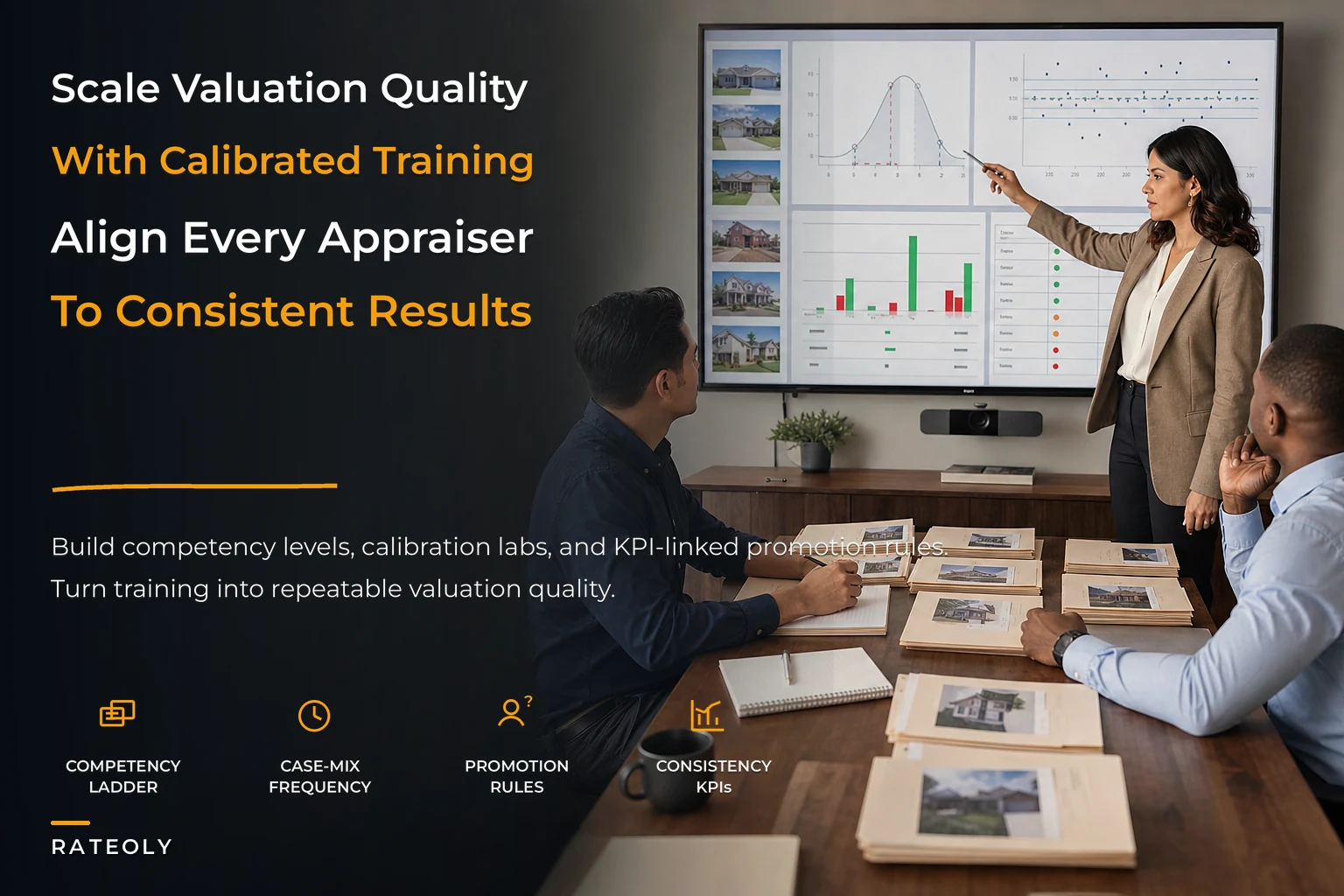
Calibration labs — repeatable exercises on real case mixes that measure how tightly people cluster.
Advancement rules — the link between measured consistency and what someone is allowed to work on, get paid, or sign off.
The mistake is treating these as separate initiatives. A firm builds a nice competency matrix, hangs it on the wall, and never connects it to actual file review or promotion decisions. Six months later nobody remembers it exists. The three layers only work when they reinforce each other — the definition tells you what to test, the labs generate the evidence, and the advancement rules give people a reason to care.
Layer one: define competency levels that mean something
Vague competency levels are worse than none. "Junior, mid, senior" tells you nothing about what someone can actually be trusted with. You want levels defined by the complexity of work they can handle unsupervised and the consistency they demonstrate on that work.
Here's a workable structure for a mid-sized residential shop:
| Level | Handles unsupervised | Adjustment spread vs. benchmark | Review touch |
|---|---|---|---|
| L1 – Developing | Conforming SFR, standard suburban tracts | Within ~15% on major adjustments | Full review, every file |
| L2 – Core | Most SFR, minor complexity, light non-conforming | Within ~10% | Sampled review, ~1 in 4 |
| L3 – Complex | Rural, unique properties, complex financing | Within ~8% | Sampled review, ~1 in 8 |
| L4 – Reviewer/Mentor | All above + signs off on others | Sets the benchmark | Audits others |
The numbers matter less than the principle: competency is defined by what work is safe to route without heavy oversight. That's the operational payoff. When your intake and assignment logic knows each appraiser's level, you stop hand-assigning every file and stop over-reviewing people who've already proven consistency.
One thing worth flagging — don't let level assignments become permanent titles. Market conditions change, people get rusty on property types they haven't touched in a year. Levels should be reviewed on a cycle, which is exactly what calibration labs are for.
Layer two: modular calibration labs with real case mixes
This is the engine of the whole framework, and it's where most firms either skip the work or make it too academic.
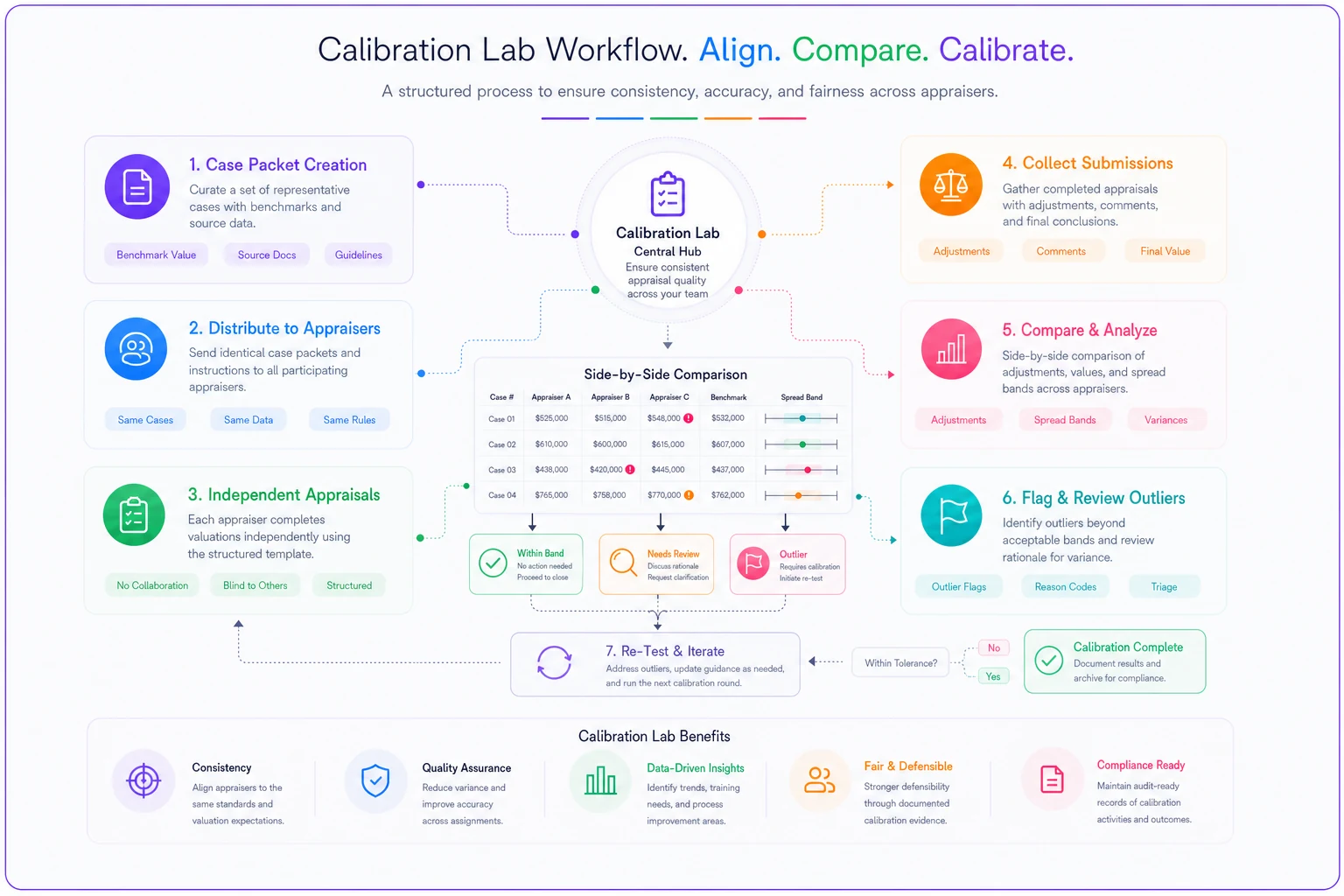
A calibration lab is a controlled exercise where multiple appraisers work the same assignment — same subject, same available comps, same market data — independently, then you compare results. The point isn't to find one correct answer. It's to measure the spread. Tight clustering means your team is calibrated. Wide spread means you've found drift, and now you can fix it with a specific conversation instead of a general memo.
Modular is the key word. You don't run one giant annual test. You build a library of small exercises by case type:
-
Standard suburban SFR with a clean comp set
-
A property with a functional obsolescence issue
-
Rural with limited comps and a wide search radius
-
A recent-renovation flip with condition ambiguity
-
A declining-market subject needing time adjustments
-
A complex-financing or concessions scenario
Each module runs on a frequency that matches its risk and how fast conditions shift. Standard SFR calibration maybe twice a year. Time-adjustment and declining-market modules quarterly, because that's where the market moves fastest and where drift does the most damage. Rural and unique-property modules can run less often but should always run before you promote someone to a level that handles them.
Run time-adjustment and declining-market modules quarterly because those conditions shift fastest and cause the most drift.
Here's a compact workflow of how a modular calibration lab runs.
A worked calibration exercise
Here's what one module actually looks like in practice.
You pull a completed, closed assignment from six months back — a suburban SFR, 1,850 sq ft, comp set of six candidates. Strip the original conclusions. Hand every participating appraiser the same subject data, the same six candidates, and the same MLS/public-record extracts.
Each appraiser independently:
-
Selects their comps from the six candidates (you record which they picked)
-
Applies adjustments for GLA, condition, garage, lot, and time
-
Reconciles to a value
Then you lay the results side by side. On a run like this you might see:
-
GLA adjustment
five appraisers within a $4/sq ft band, one at nearly double — that's your outlier
-
Time adjustment
three at ~0.4%/month, two at 0.6%, one at 0% — a real spread on a high-impact line
-
Final value
roughly a $22k range across six appraisers on a ~$480k property
The time-adjustment spread is the finding. That's not a training-video problem — it's a specific gap where three people are reading the same market data differently. You run a focused session on how the firm reads time trends, re-run the module a month later, and check whether the band tightened.
That loop — test, measure spread, target the gap, re-test — is the entire value. It converts "our quality feels inconsistent" into "our time adjustments varied by 0.6 points and here's the fix."
Layer three: tie labs to onboarding and promotion
Calibration data is worthless if it doesn't change anything. The third layer connects lab performance to real decisions.
Onboarding. New appraisers don't get routed to L2 work because they've been around 90 days. They get there by clearing the L1 calibration modules within the target spread on real case types. This flips onboarding from time-based to evidence-based. Someone might hit L2 consistency in six weeks; someone else takes four months. Both are fine — you're promoting on demonstrated calibration, not tenure.
Promotion. Moving up a level requires clearing the calibration modules for that level's case mix, within band, across at least a couple of runs so it's not a one-time fluke. A single good file isn't proof; consistency across a case mix is.
Guardrails. Levels can move down, too. If someone's sampled review exceptions climb or they miss the band on a re-calibration run, they get more review coverage and targeted labs until they're back in range. Not punitive — just the same logic that keeps the system honest.
This is also where your KPI structure has to line up. If your promotion rules reward turn-time speed but your calibration labs reward consistency, appraisers will optimize for whichever one actually affects their paycheck. Getting these to point the same direction is the hard part — worth reviewing which KPIs actually move the needle for appraisal teams so the metrics you promote on reinforce calibration instead of working against it.
How this connects to the rest of your operation
A calibration framework doesn't sit in a corner labeled "training." It plugs into how work flows through the whole firm.
Assignment routing gets smarter because the system knows each appraiser's proven case-mix competency. Complex rural work stops landing on someone who's only calibrated on suburban tracts.
Review load drops because you can safely reduce coverage on appraisers with demonstrated tight spreads and concentrate reviewer attention where the data says risk actually lives. The review desk stops being a universal bottleneck.
Exception patterns get cleaner. When calibration is tight, the exceptions you do get are genuine edge cases, not the same avoidable adjustment disputes repeating. That connects directly to defect tracking — calibration labs and your quality management system's defect taxonomy should share a vocabulary, so a recurring defect category tells you exactly which calibration module to run next.
Calibration isn't a standalone program. It's the feedback loop that keeps routing, review, and quality management pointing the same direction as you grow.
Where automation actually helps
Running calibration by hand is doable but it decays fast. The friction is in the mechanics: distributing identical case packets, collecting independent submissions without cross-contamination, calculating spreads across appraisers and adjustment lines, tracking who's cleared which modules over time.
This is where operational software earns its place — not by making valuation judgments, but by handling the coordination. AI-assisted platforms can distribute calibration packets, capture structured submissions, compute spread bands automatically, flag outliers, and keep each appraiser's competency record current so routing and review rules can actually use it. When the busywork of running labs disappears, firms run them on schedule instead of "when we get around to it." The judgment stays with your appraisers; the tracking and math stop being the reason the program quietly dies.
When this framework makes sense — and when it doesn't
When it makes sense: You're past roughly six to eight appraisers, work across more than one property type or market, and you're feeling review-desk strain or inconsistent lender feedback. If quality currently depends on one or two people catching problems, you're already carrying the risk this framework removes.
When it's overkill: A three-person shop where everyone reviews everyone and standards are genuinely shared doesn't need formal calibration labs yet. Building the whole apparatus at that size adds overhead without solving a real problem. Keep it lightweight until the pain shows up.
Who should be careful: Firms in the middle of rapid hiring. Calibration works best when it's built before a growth spurt, not bolted on during one. If you're onboarding five people this quarter with no framework in place, stabilize onboarding first, then formalize calibration — otherwise you're measuring people against a standard you haven't fully defined yet.
A real scenario
A residential firm running about eight appraisers across two suburban markets kept getting inconsistent lender feedback — some files sailed through, others drew adjustment challenges on similar properties. Turn times were fine. The problem was product consistency.
They built a small calibration program: four modules to start — standard SFR, condition-ambiguity, time-adjustment, and a light non-conforming case — run on a rolling schedule. The first run surfaced a real spread on time adjustments and condition ratings, roughly a $20k value range on comparable subjects.
Nothing dramatic followed. Two targeted sessions on the two problem areas, a re-run of the modules a month later, and the bands tightened considerably. Over the next couple quarters, adjustment-related exceptions dropped noticeably and the review desk moved a few of the proven appraisers to sampled review — which freed up reviewer hours for the genuinely complex work.
Nothing flashy. The win was that "quality" stopped being a personality trait and became something the firm could measure, target, and defend.
The takeaway
Valuation consistency isn't something you can hire or hope your way into once you're past a handful of appraisers. It has to be engineered — defined competency levels, real calibration exercises on the case mixes you actually work, and advancement rules that reward demonstrated consistency instead of tenure.
The firms that scale quality well aren't the ones with the best individual appraisers. They're the ones whose appraisers cluster — where any two of them, handed the same file, land close enough that lenders stop noticing who did the work. That clustering doesn't happen by accident. It's the product of running the loop: define, calibrate, measure the spread, close the gap, and do it again on a schedule. Build that loop once and it keeps your quality steady no matter how many people you add.
Ready to elevate your appraisal operations?
Join 500+ appraisal firms using Rateoly to enhance accuracy, save time, and improve client satisfaction.