


Most small appraisal shops don't have a collections problem. They have a timing problem that looks like a collections problem.
The report gets delivered Tuesday. The invoice goes out whenever someone gets to it — sometimes Friday, sometimes the following Monday when the appraiser finally clears their desk. By the time an AMC or lender receives the bill, three or four business days have already evaporated, and that's before their own 30- or 45-day clock even starts ticking.
Multiply that lag across 40, 60, 90 reports a month and you get a firm that's technically profitable but perpetually cash-strapped. The money exists. It's just trapped between "work done" and "invoice sent."
This post is narrowly about fixing that gap. Not pricing, not service tiers, not KPIs — just the invoicing and AR mechanics that decide how fast a finished appraisal becomes deposited cash. We'll cover batching rules built specifically for appraisal work, how to tie payment terms to your SLAs, reminder cadences that actually get responses, and what a useful AR dashboard looks like for a shop your size.
The core problem: appraisal invoicing is event-driven but gets treated as an afterthought
What makes appraisal invoicing different from, say, a plumber's: a plumber invoices at the point of service. You finish a report, but the billing trigger is report delivery — an event that already involves uploading to a portal, notifying the client, updating your log. Billing should ride along with that event. Instead it usually detaches and floats off to be handled "later."
This happens because the person who delivers the report (the appraiser or a coordinator) isn't the person who handles billing. Delivery happens immediately, billing waits for a handoff, and the handoff has no deadline. Anything without a deadline in a busy appraisal shop loses to the thing that does — the next inspection, the next revision, the next lender call.
A typical example: a two-appraiser firm delivering around 55 reports a month had an average invoice-out delay of about 3.5 days after delivery. Their AMC clients paid net-30 from invoice receipt. So the real cash cycle wasn't 30 days — it was closer to 34-35 days from when the work was actually done, assuming nobody paid late. When they tightened the invoice-out delay to same-day, they pulled roughly $12k-$15k of receivables forward permanently. Same volume, same clients, same pricing. Just closing the gap.
Appraisal-specific batching rules
Batching invoices sounds like it would slow things down — you're grouping instead of sending immediately. The trick is matching your batch cadence to how your clients actually process payments, not to your own convenience.
Manage every appraisal with confidence and clarity.
Rateoly helps you coordinate inspections, generate reports, and communicate seamlessly with clients.
- Comprehensive appraisal tracking
- Automated client notifications
- Integrated scheduling & report management
No credit card required
-
Batch by client payment behavior, not by day of week. AMCs that run payment cycles on the 1st and 15th don't care that you sent on the 3rd — you missed the cycle either way. Learn each major client's payment run dates and time your batch to land 2-3 days before, not after.
-
Never batch single-appraiser private/attorney/estate work. These clients pay faster when billed immediately and personally. Batching them just adds delay.
-
Batch AMC and lender portal work daily, not weekly. Daily micro-batches — everything delivered that day, invoiced end of day — capture the delivery event while it's fresh and still let you group by client for portal uploads.
-
Separate rush/expedite invoices out of any batch. If a client paid a surcharge for speed, the invoice should be equally fast. Bundling it into a Friday batch quietly undercuts the premium they paid for.
-
Hold nothing for "review" longer than one business day. The most common silent killer is invoices parked in a review queue waiting on a manager who's in the field. If review takes more than a day, your review process is the bottleneck, not billing.
Track each major client's payment-run dates in your CRM so your daily micro-batch consistently lands before their cycle.
The pattern worth internalizing: batching should reduce your clicks without adding client delay. The moment a batch cadence pushes an invoice past a client's payment run, batching has cost you a full cycle.
SLA-linked payment terms
If you already sell tiered service levels, your payment terms should mirror them — but most firms write one blanket "net-30" into every engagement and never revisit it.
The logic is simple: the faster and more premium the service, the tighter the terms should be. You're carrying more risk and cost on those jobs. A same-day rush appraisal on net-45 terms is just lending money to your clients at your own expense.
Here's a workable structure:
| Service tier | Turn time SLA | Payment terms | Rush/expedite fee | Late-pay trigger |
|---|---|---|---|---|
| Standard | 5-7 business days | Net-30 | — | Day 31 |
| Priority | 3-4 business days | Net-15 | +15-20% | Day 16 |
| Rush | 24-48 hours | Net-7 or due on delivery | +30-50% | Day 8 |
| Complex / unique property | Quoted per job | 50% deposit, balance net-15 | Quoted | Balance day 16 |
Two things that make this actually stick.
The deposit line on complex work matters more than most people act on. Unique-property and litigation assignments are exactly where scope creep and payment disputes cluster. Collecting half up front means the worst-case outcome is breaking even on effort, not eating the whole file. If you're uncomfortable asking for a deposit, at minimum bill a non-refundable engagement fee.
Tie the late-pay trigger to a specific day number, not a vague "past due." When your terms and your reminder system both reference "day 31," follow-up becomes mechanical instead of a judgment call someone keeps postponing.
Reminder cadences that get responses
The default at most shops: send invoice, then remember to chase it around day 40 when the bank balance looks thin. That's not a cadence — that's a reaction.
A structured cadence does two things. It makes follow-up automatic so nobody has to feel awkward about it, and it starts before the due date so the invoice never gets buried in the client's queue.
-
Day 0 — Invoice sent. Clean PDF plus portal upload if required. Reference the order number, property address, and delivery date in the subject line. Portal-based clients often lose invoices that don't match their internal reference exactly.
-
Day 3 — Delivery confirmation, not a demand. A short "confirming you received report + invoice for [address]" note. This catches lost-in-portal invoices early, which is where a huge share of late payments actually start.
-
Day 21 — Friendly pre-due reminder. "Invoice #### for [address] is due [date]." Gives an overworked AP department a chance to slot you into the upcoming payment run.
-
Day 31 — Past-due notice. Firm, factual, references the exact terms. Attach the invoice again — don't make them dig for it.
-
Day 38 — Second past-due + escalation flag. Copy a second contact if you have one. Note that continued work may pause.
-
Day 45+ — Direct human follow-up. A call, not an email. By now the pattern tells you whether this is an oversight or a genuine problem client.
The biggest miss is skipping steps 2 and 3. Firms assume reminders only matter after the due date. Most "late" payments aren't refusals — they're invoices that never got entered because they landed wrong in a portal or inbox. Catching that on day 3 instead of day 35 shaves weeks off your cycle without a single tense conversation.
Most firms that fix their DSO don't do it by getting tougher. They do it by catching the administrative fumbles earlier.
What an AR dashboard actually needs to show
You don't need aged-receivables software built for a mid-market accounting department. You need four or five numbers visible in one place, updated weekly.
-
DSO (days sales outstanding) — how many days on average it takes to get paid. Watch the trend, not just the absolute number.
-
Aging buckets — current, 1-30, 31-60, 61-90, 90+. The 61+ column is your early-warning light.
-
Invoice-out lag — average days between report delivery and invoice sent. This is the metric most firms never measure, and the one they most directly control.
-
AR by client — which clients hold the most outstanding, and which are consistently slow. One slow AMC can distort your entire cash picture.
-
% invoiced same-day — a simple discipline metric. If this drops, cash slows a few weeks later with surprising consistency.
A realistic snapshot for a firm doing around 60 reports a month might look like: DSO near 38 days, roughly 12% of AR sitting in the 61+ buckets, invoice-out lag of 2 days, same-day invoicing around 70%. None of those are disasters individually, but each one points at where a week or two of cash is quietly sitting.
The dashboard's real job isn't reporting — it's making the invisible visible. Nobody chases invoice-out lag because nobody sees it. Put it on a screen and it tends to fix itself, because people don't like watching their own number look bad.
A quick illustration of how these metrics connect:
Report Delivered │ ▼ [Invoice-Out Lag] ──► Invoice Sent │ ▼ [Reminder Cadence Fires] │ ┌──────────┴──────────┐ ▼ ▼ Paid on time Enters Aging Bucket │ │ ▼ ▼ DSO improves Escalation triggers
Here's a simple workflow showing how invoice-out lag and reminder cadence affect DSO.
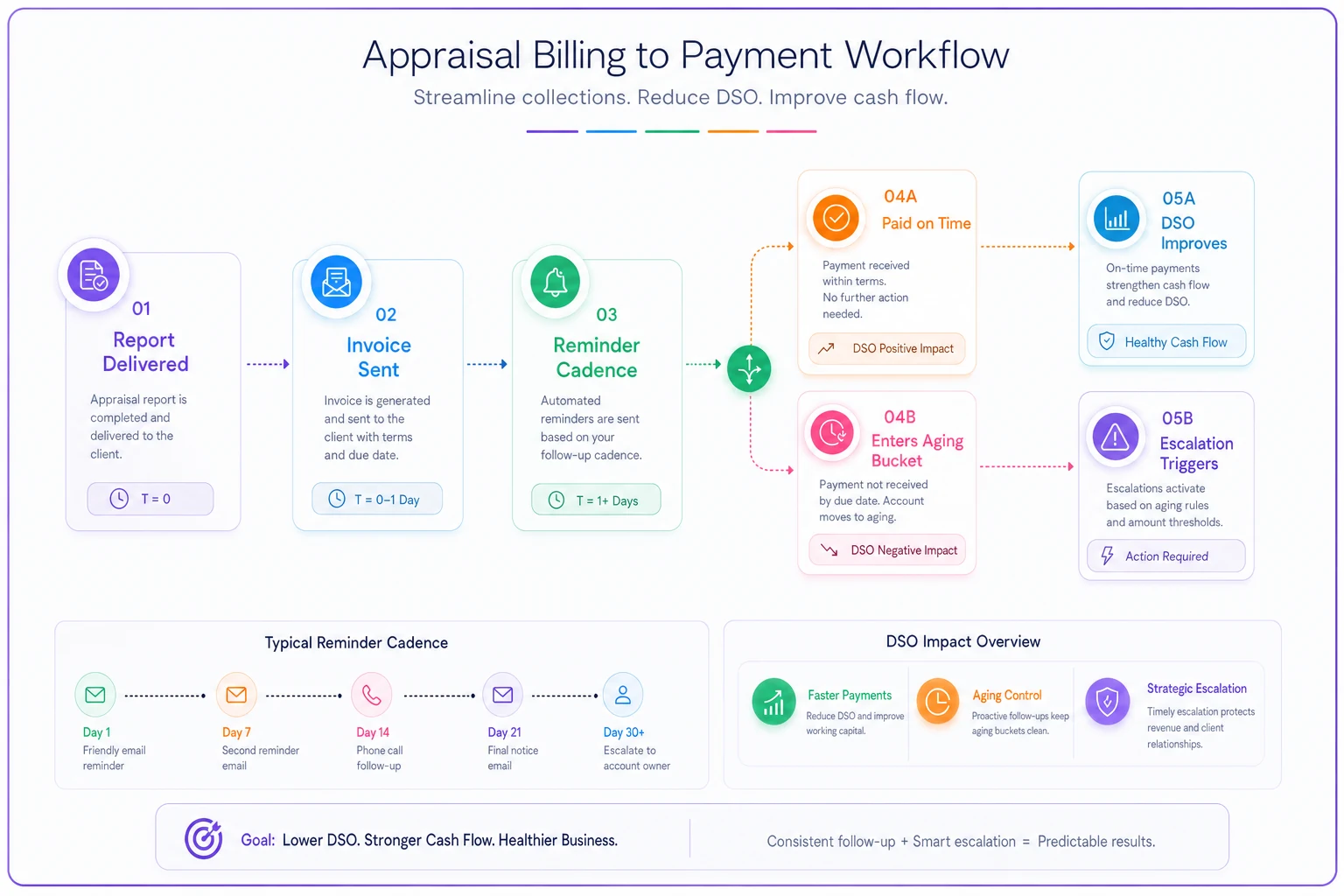
Tightening invoice-out lag and running a consistent reminder cadence are the two levers that move DSO most directly. Everything else is downstream.
Where automation actually helps (and where it doesn't)
The manual version of everything above is doable, but it competes for attention with field work and revisions — which is exactly why it slips. This is the kind of repetitive, rules-based work that's worth pulling off human plates. Same logic behind building a proper automation inventory for the low-value manual tasks eating appraiser time.
An AI-assisted operational platform can watch for the report-delivered event and generate the invoice automatically against the right service tier and terms — so invoice-out lag drops to near zero without anyone having to remember. It can run the reminder cadence on schedule, escalating on the exact day numbers you set, and surface the AR dashboard without anyone rebuilding a spreadsheet every Friday.
Where automation doesn't help: the day-45 conversation with a client disputing scope, and deciding whether to keep working for a chronically slow payer. Those stay human. Tie your billing triggers to a clean, well-defined delivery handoff — the kind you get from a standardized end-to-end workflow with role-based handoffs — and automation has a reliable event to fire on. Bolt it onto a messy process and it just automates the mess faster.
When this makes sense — and when it doesn't
When tightening AR is clearly worth it: you're delivering 40+ reports a month, carrying receivables across multiple AMCs, and you've caught yourself watching the bank balance to decide whether to make a hire or buy equipment. If cash timing is driving business decisions, this pays for itself quickly.
When it's overkill: a solo appraiser doing 10-15 mostly private-client jobs a month who gets paid on delivery or within a week anyway. Building batch rules and multi-step cadences for that volume is effort chasing a problem you don't really have. Just invoice same-day and move on.
Who should be careful: firms whose slow-pay problem is really a client-mix problem. If one AMC pays net-60 and represents 40% of your volume, no reminder cadence fixes that — that's a pricing and relationship decision, not a workflow one. Tighten the mechanics, but don't expect them to solve a structural terms mismatch.
A quick real scenario
A three-person residential firm in a mid-size metro was doing roughly 65-70 reports a month, mostly AMC work on net-30. Invoice-out lag averaged about 4 days, same-day invoicing sat below 50%, and DSO was hovering near 44 days. They weren't losing money to non-payment — they were just chronically 6-7 weeks behind their own work in cash terms, which meant carrying a line of credit they didn't really want.
They did three things: moved to daily micro-batches tied to report delivery, added the day-3 confirmation and day-21 pre-due steps to their reminder flow, and put invoice-out lag and aging on a dashboard the owner checked every Monday.
Nothing dramatic happened in week one. Over about two months, invoice-out lag fell to under a day, same-day invoicing climbed past 85%, and DSO settled around 34-35 days. That pulled roughly $18k-$22k of cash forward and got them off the credit line for normal operations. Same clients, same pricing, same volume — they just stopped leaving money parked between "done" and "billed."
Cash collection in an appraisal firm rarely gets fixed by getting tougher on clients. It gets fixed by removing the delay and guesswork from your own side of the process — invoicing on the delivery event, matching terms to the service level, running a cadence that starts before the due date, and keeping the two or three numbers that actually matter in plain sight.
The money is already yours. The whole game is shortening the distance between finishing the report and having the deposit clear.
Ready to elevate your appraisal operations?
Join 500+ appraisal firms using Rateoly to enhance accuracy, save time, and improve client satisfaction.