

Most appraisal firms lose margin long before they ever write a report. It happens at contract signing — in the fine print of an AMC engagement agreement or a lender master services agreement that someone skimmed, initialed, and filed. Two years later, when a payment dispute or an indemnity claim surfaces, the terms that seemed harmless turn out to be the whole ballgame.
The frustrating part is that appraisers are trained to be meticulous about valuation and sloppy about the documents that govern whether they get paid, how fast, and who eats the cost when something goes sideways. A firm will spend forty minutes reconciling a $15 comp adjustment and sign a 14-page AMC agreement in under five.
This piece is about treating your contracts the way you treat your files: as a system with standards, versions, and defensible positions. Not a one-off negotiation each time, but a reusable appraisal contract clauses library you pull from, red-line consistently, and improve over the years. The goal isn't to win every point. It's to stop giving away margin and data rights by default.
Why contract terms quietly erode margin across the whole operation
The reason this breaks for most firms is structural, not legal. Contracts arrive from the counterparty — the AMC, the lender, the national management company — and they're drafted to protect their interests. That's not villainy; it's just what in-house counsel is paid to do. The problem is that the appraisal firm on the other side usually has no equivalent document and no standard response.
So every engagement becomes a fresh negotiation, except most of the time there's no negotiation at all. The firm accepts the paper as-is because pushing back feels risky when you need the volume. That accumulates. A single unfavorable payment term across 300 assignments a year isn't a nuisance — it's a working-capital problem.
-
Payment and fee terms — net-60 or net-90 schedules, fee holdbacks pending "lender acceptance," unilateral fee reductions, and the right to offset against future invoices.
-
Service levels (SLAs) — turn-time penalties with no reciprocal obligations, penalties that apply even when the delay is the client's, and "time is of the essence" language with teeth.
-
Indemnification — broad, one-sided indemnities that make you responsible for the AMC's own negligence or the lender's downstream decisions.
-
Data use and ownership — clauses that grant the counterparty perpetual rights to your comps, your photos, your adjustments, and sometimes your workfile.
Each one looks reasonable in isolation. Stacked together, they transfer risk and cost onto the smallest party in the chain — usually you.
What breaks as you scale
A solo appraiser doing 8–10 orders a month can survive bad contract terms through sheer attention. They know every open invoice, chase every late payment personally, and remember which AMC always disputes fees. That memory is the system.
Manage every appraisal with confidence and clarity.
Rateoly helps you coordinate inspections, generate reports, and communicate seamlessly with clients.
- Comprehensive appraisal tracking
- Automated client notifications
- Integrated scheduling & report management
No credit card required
The moment you add appraisers, a review team, and a couple hundred monthly assignments, memory stops working. Now you've got a dozen different AMC agreements with a dozen different payment schedules, SLA definitions, and indemnity scopes — and nobody has them in one place. The staff accepting new client relationships isn't the staff managing AR. The person who signs the AMC agreement isn't the one who later discovers the data-use clause let the AMC feed your comps into their AVM.
-
Days-sales-outstanding creeps from 35 to 55+ because three of your biggest clients quietly run net-75.
-
Fee realization — what you actually collect versus what you quoted — drops a few points because of holdbacks and post-hoc reductions you agreed to in writing.
-
A quality complaint turns into a demand letter, and your indemnity clause means you're covering legal costs you never priced into the assignment.
None of this feels like a contract problem in the moment. It feels like an AR problem, a pricing problem, a staffing problem. The root cause is that your agreements are inconsistent and tilted, and there's no standard to pull them back toward.
This is the same discipline we talk about with SLA-linked pricing and service tiers — your contract terms and your pricing model have to speak to each other, or you end up selling a premium service on bargain-basement terms.
The clause bank: four categories worth standardizing
The practical fix is a clause bank — a living document where you keep your preferred language, your acceptable fallback language, and your walk-away positions for each major term. When a new agreement lands, you compare it against your bank and red-line consistently instead of reinventing your position every time.
| Clause area | Counterparty's typical ask | Your preferred position | Acceptable fallback |
|---|---|---|---|
| Payment timing | Net-60 or net-90 from "report acceptance" | Net-30 from delivery | Net-45 from delivery, interest after 45 |
| Fee holdbacks | Hold 10–20% pending lender review | No holdback | Holdback released within 15 days of delivery regardless of lender action |
| Unilateral fee changes | AMC may adjust fee at discretion | Fees fixed at engagement | Changes only by mutual written agreement before work begins |
| SLA penalties | Penalty for late delivery, one-sided | Penalties only after mutual SLA; clock pauses on client-caused delay | Capped penalty, excludes delays outside your control |
| Indemnification | You indemnify for broad claims incl. their negligence | Mutual indemnity, each party for its own acts | You indemnify only for your proven negligence or USPAP breach |
| Data use / ownership | Perpetual license to all data incl. comps & workfile | You retain workfile ownership; license limited to the specific transaction | Non-exclusive license for the transaction only; no AVM/model training use |
| Limitation of liability | No cap, or cap in their favor only | Liability capped at fees paid for the assignment | Cap at 1–2x assignment fee |
The point of the fallback column is that negotiation is rarely all-or-nothing. If you walk in knowing your acceptable fallback, you stop making concessions in the heat of a phone call that you'd never make on paper.
Payment and fee terms
The margin killer here isn't just slow payment — it's the combination of slow payment plus holdbacks plus the right to offset. An AMC that pays net-75, holds 15% pending lender acceptance, and reserves the right to deduct a disputed fee from your next invoice has essentially turned you into their lender. Your preferred red-line: payment due net-30 from delivery, not from "acceptance" (acceptance is a term they control). Strike holdback language entirely; if you can't, pin it to a hard calendar deadline so it can't float indefinitely. Kill unilateral offset — require any dispute to be resolved separately, not self-executed against money you've already earned.
SLA clauses
Turn-time penalties are fair in principle. The problem is asymmetry. The counterparty wants a penalty when you're late but accepts no obligation when they deliver the order late, send bad property data, or sit on a revision request for a week. The red-line that matters most: the SLA clock pauses whenever you're waiting on the client — access delays, missing documents, unanswered questions. Without that pause clause, you get penalized for delays you didn't cause. Second, cap the penalty. An uncapped penalty on a $500 assignment is how a profitable order becomes a loss.
Indemnification
This is the clause that keeps firm owners up at night once they actually read it. Broad indemnity language can make you responsible for defending and paying claims that stem from the AMC's or lender's own conduct. If a borrower sues the lender over a loan decision and the lender's cost allocation flows downhill, a one-sided indemnity can drag you in. Hold the line on mutual indemnification — each party responsible for its own negligent acts — and tie your exposure to proven USPAP or standard-of-care breaches, not to any claim "arising from" the appraisal, which is broad enough to swallow everything.
Data use and ownership
This is the quietest and, long-term, the most valuable fight. Your comps, adjustment logic, condition ratings, and photos are a data asset. AMCs increasingly want perpetual, broad licenses to that data — including the right to use it in automated valuation models and analytics products you're essentially building for free. Your preferred position: you retain ownership of the workfile, and any license you grant is limited to the specific transaction. Explicitly exclude use for AVM training, data resale, or model development. This single exclusion is becoming one of the most important appraisal contract clauses to standardize, because the downstream value of appraisal data is only going up.
A negotiation playbook that actually fits an appraisal firm
Having good language is half of it. The other half is a repeatable process so that red-lining doesn't depend on whichever manager happens to open the email.
-
Intake and triage. When a new agreement arrives, classify it
high-volume relationship worth negotiating, or one-off you'll accept as-is. Don't spend an hour red-lining a client who'll send you two orders a year.
-
Run it against the clause bank. Compare term-by-term to your preferred/fallback/walk-away positions. Mark each clause green (acceptable), yellow (negotiate), or red (deal-breaker).
-
Red-line only the reds and yellows. Send a clean, numbered markup. Counterparties respond far better to five targeted edits than to a shredded document.
-
Lead with the mutual framing. "We're happy to indemnify for our own work — we just need the same protection for yours." Reciprocity is hard to argue against and signals you're not being difficult.
-
Trade, don't surrender. If they won't move on net-45, ask for the holdback to disappear. If they insist on the SLA penalty, get the pause clause. Every concession earns one.
-
Log the outcome. Record which positions held and which didn't, per counterparty. Over a year this tells you exactly who's worth the fight and who isn't.
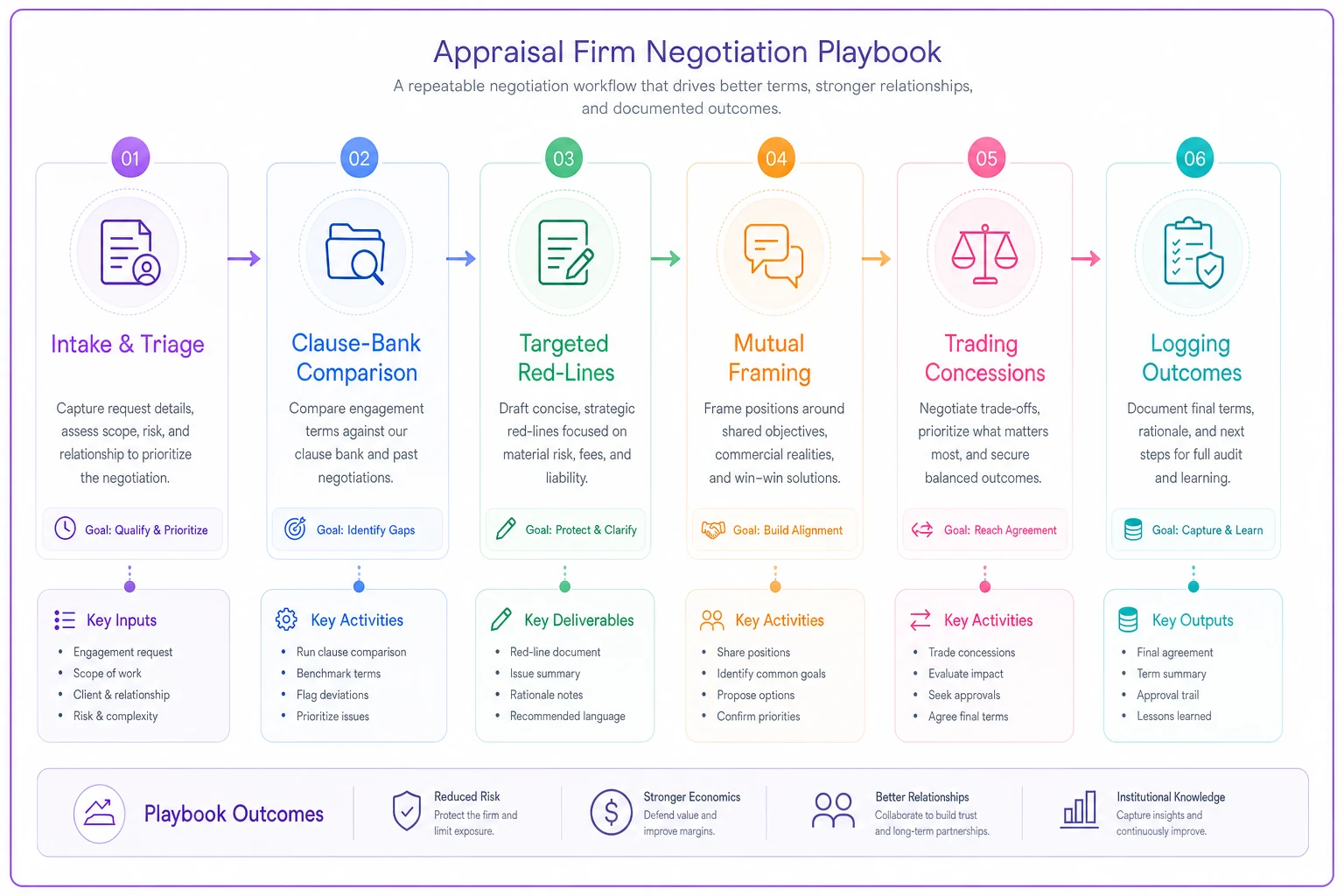
A quick visual of the negotiation playbook workflow.
Firms that do this consistently notice something within a few quarters: their red-lines get accepted more often, because they're asking for the same reasonable things every time and counterparties stop treating it as a fight.
A real scenario
A mid-size firm — three staff appraisers, roughly 260 orders a month, split across five AMCs and two direct lenders — pulled their top three agreements into a side-by-side review after their bookkeeper flagged that cash was always tight despite steady volume.
What they found: two of the three biggest clients ran effective net-70+ once you accounted for "acceptance" language, and one held 15% on every order pending lender review, releasing it inconsistently. DSO was sitting around 58 days. Quoted fees looked healthy, but realized collection was running several points under quote because of holdbacks that never fully released.
They didn't fire anyone or renegotiate everything overnight. They built a short clause bank, picked their two highest-volume AMCs, and sent targeted red-lines: net-45 from delivery, holdback released within 15 days regardless of lender action, and a data-use exclusion for AVM training. One AMC accepted most of it. The other split the difference on payment but gave up the holdback entirely.
Six months later DSO had come down to roughly 42 days, and the holdback leakage — which had been quietly costing them something in the low thousands per month — mostly disappeared. No new clients, no higher fees. Just terms that stopped bleeding margin.
When this makes sense — and when it doesn't
Standardizing contract terms isn't free. It takes time to build the clause bank, and negotiation friction can cost you a relationship if you misjudge your leverage.
When this clearly makes sense:
-
You're past the solo stage and running multiple recurring client relationships.
-
A handful of clients make up most of your volume (they almost always do).
-
Your DSO is climbing or your realized fees lag your quoted fees.
-
You're starting to think about the value of your historical data.
When it's a bad idea to push hard:
-
You're brand new and need volume more than you need perfect terms. Accept reasonable paper, note what you'd change later, and revisit once you have leverage.
-
The relationship is genuinely one-off and low-value — don't burn goodwill red-lining a client who sends you a handful of orders a year.
-
You haven't yet figured out which clients actually drive profit. Negotiating terms with an unprofitable client you should be shedding anyway is wasted effort.
A quick readiness checklist before you start:
-
[ ] You've pulled your 3–5 highest-volume agreements into one place
-
[ ] You know your current DSO and realized-vs-quoted fee gap
-
[ ] You've identified which clients are worth negotiating with
-
[ ] You have a draft clause bank with preferred/fallback/walk-away positions
-
[ ] Someone owns the red-line process so it's consistent, not ad hoc
Standardizing contract terms isn't free. It takes time to build the clause bank, and negotiation friction can cost you a relationship if you misjudge your leverage.
Keeping the system coherent as you grow
Contracts don't live in a vacuum. Your payment terms feed your AR process. Your SLA definitions feed your scheduling and turn-time commitments. Your data-use clauses feed your archiving and retention practices. When these are inconsistent across clients, every downstream process inherits the inconsistency.
Firms that handle this well keep a single source of truth — one place where every active agreement's key terms are summarized so AR knows the real payment date, operations knows the real SLA, and leadership knows where the indemnity and data exposure sits. Whether that lives in a shared workbook or inside a workflow platform matters less than the discipline of maintaining it. The same evaluation rigor you'd apply when choosing operational software applies here: the tool should reduce the number of places your contract terms are hiding, not add another.
Keep a single source of truth for active agreements so AR, operations, and leadership reference the same terms.
Firms that standardize their appraisal contract clauses — building a real clause bank, red-lining consistently, and protecting their payment and data rights the same way every time — stop leaking margin through terms they never meant to accept.
Good contract hygiene doesn't replace good appraising. But it decides whether good appraising actually pays.
That's not a legal exercise. It's an operational one, and it compounds quietly in your favor every quarter you keep at it.
Ready to elevate your appraisal operations?
Join 500+ appraisal firms using Rateoly to enhance accuracy, save time, and improve client satisfaction.