

Most firms treat corrective action like a to-do list. Something breaks, someone writes up what happened, a fix gets implemented, and everyone moves on. Six weeks later the same exception shows up from the same lender, and the cycle repeats. The fix wasn't wrong — it just never got tested, measured, or verified. It was a guess wearing the costume of a solution.
That gap is where most quality programs quietly stall. You can have a solid root-cause process and a working quality management system and still not improve, because neither one closes the loop. RCA tells you why something broke. QMS tells you how often it breaks and who owns it. But neither forces you to prove that your fix actually moved the number. The missing piece is an engine that turns every fix into a small experiment — one with a hypothesis, a measurement window, and a pass/fail gate.
This article is about building that engine. The part that sits on top of RCA and QMS and makes continuous improvement an actual loop instead of a filing cabinet.
Why Fixes Don't Stick in Most Appraisal Shops
Walk through the typical sequence after a lender exception comes back. The reviewer flags a comp-adjustment issue. Someone traces it to an appraiser who wasn't using the updated location-adjustment protocol. The fix is "remind everyone to use the new protocol." Done. Logged. Closed.
The problem: that fix has no hypothesis, no sample, and no measurement. Nobody asked how much the exception rate should drop, over what period, or how you'd know it worked versus you just got lucky with an easier batch of orders. So three months later when exceptions tick back up, there's no way to tell whether the fix failed, was never adopted, or is being swamped by a different root cause entirely.
In a lot of small operations, "remind everyone" and "add a step to the checklist" are the two most common corrective actions — and also the two least likely to be verified. They feel like progress because something happened. But a fix you can't measure is indistinguishable from doing nothing, except it costs meeting time.
The deeper issue is that RCA and QMS tend to live in different mental buckets. RCA feels like detective work — you do it when something goes wrong. QMS feels like compliance — you do it because an AMC or auditor expects it. Neither is framed as learning. And learning is what converts a fix into something durable. If your RCA playbook for recurring exceptions and your defect-taxonomy-driven QMS aren't feeding a shared experiment pipeline, you're running two systems that never compare notes.
What an Experimentation Engine Actually Is
Strip away the jargon and a continuous-improvement engine is just a disciplined way of asking: we think this change will improve this metric by this much — did it?
Manage every appraisal with confidence and clarity.
Rateoly helps you coordinate inspections, generate reports, and communicate seamlessly with clients.
- Comprehensive appraisal tracking
- Automated client notifications
- Integrated scheduling & report management
No credit card required
Every fix becomes a candidate experiment. It gets an intake form, a hypothesis, a defined sample, a KPI it's supposed to move, and a review date where leadership looks at the result and decides: adopt, kill, or run again. That's the whole loop. The discipline is in refusing to close anything as "done" until the number confirms it.
The Core Components
-
Experiment intake — a single front door where any fix, idea, or recurring defect enters the pipeline. No experiment starts life as a hallway conversation.
-
Hypothesis templates — a forced structure that makes vague fixes specific before they're allowed to proceed.
-
Sampling rules — how many files, over what window, before a result counts.
-
KPI gating — the pre-agreed threshold a change must hit to be adopted.
-
RCA integration — every experiment traces back to a confirmed root cause, not a symptom.
-
Leadership review cadence — a standing rhythm where results get judged and resources get reallocated.
Miss any one of these and the loop leaks. Skip sampling rules and you'll adopt changes based on three lucky files. Skip the review cadence and good experiments die from neglect because nobody ever looked at the result.
This matters more as you scale because of coordination. A solo appraiser can keep the whole feedback loop in their head — they notice their own patterns. But the moment you've got four or five appraisers, two reviewers, and multiple lender relationships, the signal gets diluted. One appraiser's fix never reaches another's workflow. A root cause identified in the Denver office never informs the Phoenix office. The engine makes learning portable across people and locations instead of trapped in individual memory.
Experiment Intake: One Front Door
The intake step sounds trivial and is usually the first thing firms skip. But a scattered intake is why most improvement ideas evaporate. Someone has a good idea in a Friday huddle, nobody writes it down anywhere structured, and it's gone by Monday.
Intake should capture a minimum set of fields the moment a candidate experiment exists:
-
Source — lender exception, internal QC catch, appraiser suggestion, audit finding, client complaint
-
Linked root cause — which confirmed RCA this traces to (or "unknown, needs RCA")
-
Target metric — the single KPI this is meant to move
-
Owner — one named person, not a department
-
Priority estimate — rough sense of frequency × cost
One rule worth enforcing hard: don't let anything enter the experiment pipeline without a linked root cause. If the root cause is unknown, the item routes to RCA first. This one rule prevents the most common waste in improvement work — running experiments on symptoms. You can spend a quarter "fixing" late deliveries that are actually a scheduling intake problem, a staffing problem, and a lender-responsiveness problem braided together. Requiring a root cause forces that untangling up front.
Hypothesis Templates: Making Fixes Specific Enough to Test
This step does the heavy lifting, because it converts opinions into testable claims.
A fix stated as "improve the comp selection review" is untestable. The same fix as a hypothesis: "If reviewers apply the two-tier comp scorecard before sign-off, then comp-related lender exceptions on suburban SFR files will drop from roughly 9% to under 5% within 60 days." Now it has a mechanism, a population, a direction, a magnitude, and a window. You can actually fail or pass it.
A simple template that works: > If [specific change to the workflow], then [specific KPI] for [specific file type / segment] will move from [baseline] to [target] within [time window], because [root cause mechanism].
The "because" clause is the part people want to drop, and it's the most important. It ties the experiment back to the RCA. If you can't articulate why the change should work, you're usually fixing a symptom. A hypothesis without a mechanism is a wish.
One thing worth flagging: teams tend to set targets that are either absurdly ambitious ("eliminate all exceptions") or so soft they can't fail ("some improvement"). Neither teaches you anything. A target that's meaningful but plausible — cutting a defect rate roughly in half, trimming turn time by a few days — is where real learning lives, because when it misses, the miss is actually informative.
Sampling Rules: Knowing When a Result Is Real
Small firms get burned here constantly. You run a change across eight files, see no exceptions, and declare victory. But if your baseline exception rate was around 8%, eight clean files tells you almost nothing — you'd expect most of them to be clean anyway.
Sampling rules set the floor for when a result counts. They don't need to be a statistics seminar. A practical set of rules for a small shop:
| Metric type | Minimum sample before judging | Typical window |
|---|---|---|
| High-frequency defects (comp issues, photo exceptions) | 30–50 affected files | 30–60 days |
| Turn-time / cycle metrics | 40+ completed assignments | 1 full month minimum |
| Low-frequency / high-severity (revisions, re-inspections) | 15–25 events or a full quarter | 60–90 days |
| Client/lender satisfaction signals | 20+ responses or interactions | rolling 90 days |
The exact numbers matter less than the principle: agree on the sample before you start, and don't let an early good week end the experiment. Stopping the clock the moment the data looks favorable is the most common form of self-deception in improvement work.
A second discipline that pays off: segment your sample the same way you segmented your hypothesis. If the hypothesis was about suburban SFR files, don't dilute the result by mixing in complex rural assignments where the change was never meant to apply. Mismatched samples are how good fixes get wrongly killed and bad fixes get wrongly adopted.
After you've established your sampling rules, a useful step is mapping the full experiment cycle — from intake through hypothesis, sample collection, gate review, and outcome routing — so everyone on the team knows where a given experiment stands at any moment.
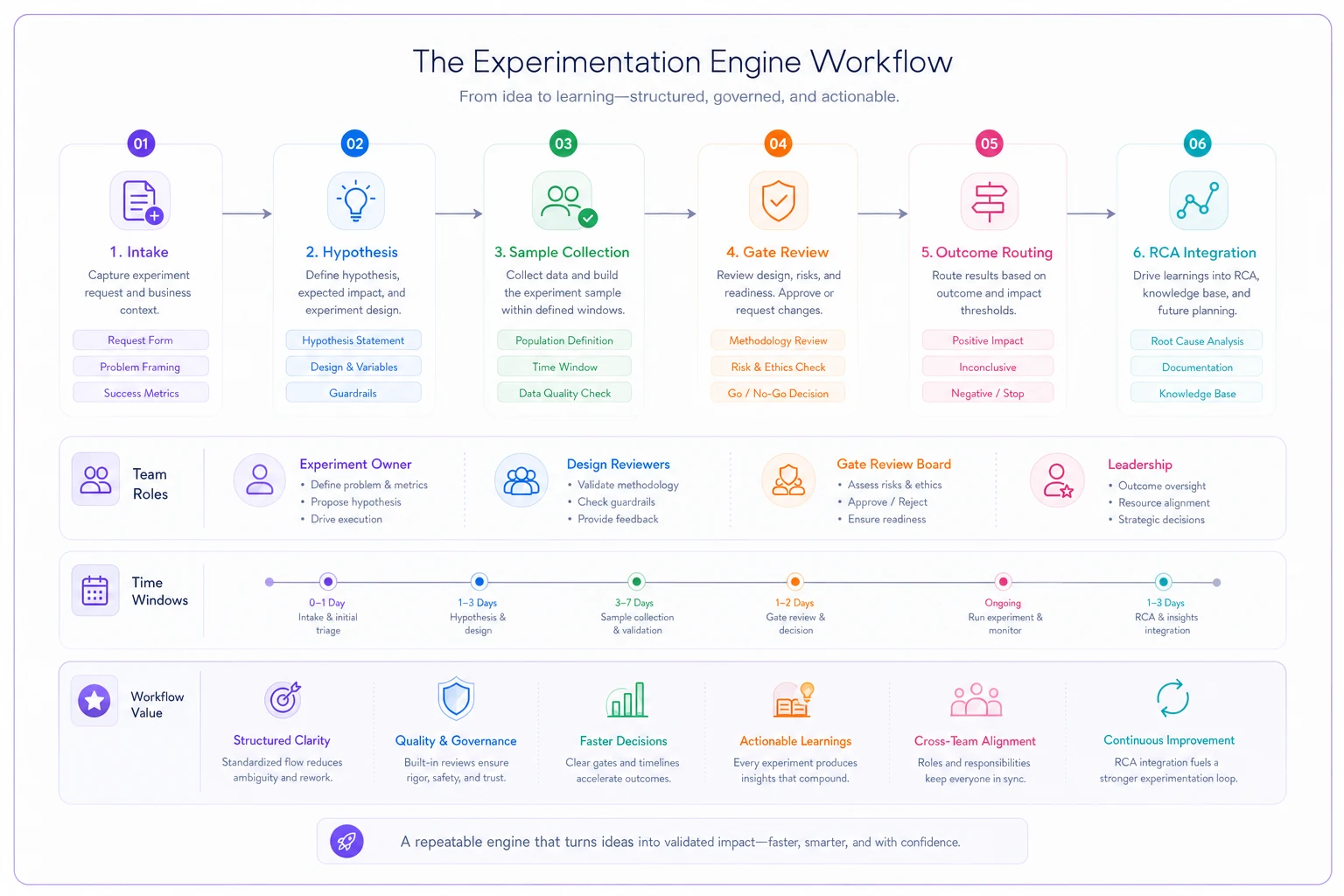
After you've established your sampling rules, a useful step is mapping the full experiment cycle — from intake through hypothesis, sample collection, gate review, and outcome routing — so everyone on the team knows where a given experiment stands at any moment.
KPI Gating: The Pass/Fail Threshold Set in Advance
Gating is where you decide, before the experiment runs, what result counts as success. This matters because human nature will rationalize almost any outcome after the fact. Set the bar first, and the decision at review becomes mechanical instead of political.
-
Pass — hit or beat the target. Adopt the change into the standard workflow and update the QMS.
-
Inconclusive — moved in the right direction but didn't clear the bar, or the sample was too thin. Extend or redesign.
-
Fail — no movement or moved the wrong way. Kill it and send the root cause back for a different hypothesis.
The outcome people underrate is fail. A failed experiment that's honestly logged is worth more than a vague success, because it removes a dead end permanently. Firms that treat failed experiments as embarrassing end up re-running the same bad fix every eighteen months because nobody recorded that it didn't work the first time.
Gating also forces an honest conversation about cost. A change that cuts exceptions by a point but adds twenty minutes of review per file might not pass once you price the reviewer's time against the exception savings. The gate should include the cost side, not just the quality side.
RCA Integration: Experiments Inherit Their Root Cause
The engine only compounds if experiments stay tethered to root causes. When a fix passes its gate, the confirmation should flow back to the RCA record: this root cause, addressed by this change, verified by this result. That's how a root cause gets genuinely closed instead of informally assumed dead.
The reverse flow matters too. When an experiment fails, the root cause doesn't get closed — it goes back into the queue with new information. Now you know one mechanism doesn't explain the defect, which narrows the next hypothesis. Over a year, this turns your defect taxonomy from a static list into a living map of what actually drives rework, backed by evidence rather than opinion.
In practice, this is usually where the biggest payoff shows up. A firm running this loop for a few quarters stops rediscovering the same root causes. New appraisers inherit a body of verified fixes instead of folklore. The institutional knowledge that normally walks out the door when a senior reviewer retires gets captured in the experiment log instead.
The Leadership Review Cadence
An engine with no governance stalls. Experiments need a standing rhythm where someone with authority looks at results and reallocates attention. Without it, experiments drift — owners get busy, windows lapse, and the whole thing quietly reverts to the old reactive mode.
-
Weekly (15 minutes, operational) intake triage. New candidates get a root cause check, an owner, and a target metric, or get routed to RCA. Nothing lingers in limbo.
-
Monthly (45–60 minutes, tactical) experiment review. Walk the active pipeline, apply the gates to anything that's hit its sample, make adopt/kill/extend calls.
-
Quarterly (strategic) portfolio view. Which root causes are still generating experiments? Where's the recurring cost concentrated? Which adopted changes have held up — and which ones quietly decayed?
The quarterly decay check is the one most firms skip and later regret. A change that passed its gate in Q1 can silently erode by Q3 as people drift back to old habits. Re-measuring adopted changes on a cadence is how you catch backsliding before it becomes the next "recurring" exception.
A Realistic Scenario
A three-appraiser firm doing roughly 110–130 orders a month kept getting comp-adjustment exceptions from two of its lenders. Their exception rate on those files sat around 11%, and each kickback cost them a day or two of turn time plus reviewer rework — a few hundred dollars of margin per event once you counted the time.
Instead of the usual "remind everyone" fix, they ran it through the loop. RCA traced most exceptions to inconsistent adjustment support on a specific file segment. The hypothesis: requiring a short adjustment-support note on those files would cut the segment's exception rate from about 11% to under 6% within 60 days. Sample rule: at least 35 affected files before judging. Gate: pass at 6% or below and under ten extra minutes of review per file.
By the end of the window they'd run it across roughly 40 files. Exceptions on the segment landed around 5–6%, and the added review time came in under the ceiling. It passed, got written into the standard workflow, and the root cause was marked verified-closed. Not a dramatic transformation — but a real, measured one, and one that didn't quietly reappear the next quarter because the data confirmed it held.
When This Makes Sense — and When It Doesn't
This is worth building when:
-
You're past the solo stage and fixes have to travel between people or locations
-
The same exceptions keep recurring despite corrective actions
-
You already have some RCA and QMS discipline but can't prove your fixes work
-
Leadership is making improvement decisions on gut feel instead of verified results
This is premature when:
-
You're a one-person shop where the feedback loop fits in your head
-
Your volume is low enough that you can't assemble meaningful samples in a reasonable window — forcing experiments on five files a month produces noise, not learning
-
You don't yet have a basic defect taxonomy or any RCA habit; build those first, because the engine sits on top of them, not instead of them
Who should not do this yet: firms with no reliable way to pull metrics. If you can't trust your exception counts or turn-time numbers, every gate decision rests on bad data. Fix measurement integrity before you build the loop, or you'll confidently adopt changes based on numbers that were wrong to begin with.
Making the Loop Low-Friction
The honest risk with any improvement engine is that the overhead kills it. If logging an experiment takes longer than the fix itself, people route around it. The discipline has to be lightweight enough to survive a busy week.
Keep the intake lightweight so people don't route around it.
This is where keeping the system connected matters more than making it fancy. When intake, RCA records, defect categories, and KPI dashboards live in one workflow platform instead of four spreadsheets and an email thread, the engine mostly runs itself — a closed exception automatically suggests a candidate experiment, the hypothesis template pulls the baseline from existing data, and the review cadence surfaces exactly which experiments have hit their sample threshold. The point isn't the software; it's that the friction of connecting RCA to QMS to measurement drops low enough that the loop actually gets used week after week instead of abandoned after the first busy stretch.
An appraisal continuous improvement system isn't a document or a dashboard. It's the habit of refusing to call a fix finished until a measured result says so — and building just enough structure around that habit that it survives contact with a normal, chaotic month of real assignments. Firms that get there stop fighting the same exceptions on repeat, and start accumulating a library of fixes they know work, because they watched the numbers prove it.
Ready to elevate your appraisal operations?
Join 500+ appraisal firms using Rateoly to enhance accuracy, save time, and improve client satisfaction.