

Most appraisal firms live and die by the order queue. Rates move, volume swings 40% in a quarter, and suddenly the same team that was turning away work in March is sitting idle in July. The fee-per-assignment model is honest, but it's exhausting — your revenue resets to zero on the first of every month, no matter how good last month was.
The firms that break out of that cycle do one thing differently: they package their services so some portion of revenue arrives whether or not a new order came in that week. Retainers, SLA-backed subscription tiers, committed volume agreements with lenders and AMCs. Not as a gimmick, but as a deliberate restructuring of how the business earns.
This is a systems article, not a list of pricing tricks. Because the moment you introduce recurring revenue, you change how your whole operation behaves — capacity planning, collections, QC load, client relationships. Get the packaging right and the business gets calmer. Get it wrong and you've just promised to deliver work you can't staff for at a price that erodes your margin.
Why transactional appraisal revenue breaks down at scale
The problem isn't that per-assignment pricing is bad. It's that it doesn't scale smoothly. Every new order is a fresh negotiation of expectations, every month is a fresh guess at volume, and your best clients get the exact same treatment as a one-off retail buyer you'll never hear from again.
-
Revenue is almost perfectly correlated with order count, so a demand dip hits the P&L instantly
-
The sales relationship never deepens — you're a vendor, interchangeable with the next panel appraiser
-
Capacity planning is reactive; you staff for the average and get crushed in the peaks
-
Your highest-value clients (steady AMCs, a credit union sending 30 files a month) aren't locked in by anything other than habit
That last point is the quiet killer. A client sending you 30 predictable files a month is worth enormously more than 30 scattered retail orders, but if there's no agreement structuring that relationship, you're one bad turn-time week away from losing all of it. The relationship has value you're not capturing.
Recurring revenue models fix this by converting relationships into contracts. The client commits to volume or a subscription, you commit to service levels, and both sides get predictability. The appraisal work itself doesn't change much. The economic wrapper around it does.
The packaging matrix: three ways to structure recurring income
There's no single right package. What works depends on who's buying — a lender, an AMC, or a direct professional client like an attorney or asset manager. But most durable recurring revenue in this industry falls into three shapes.
Manage every appraisal with confidence and clarity.
Rateoly helps you coordinate inspections, generate reports, and communicate seamlessly with clients.
- Comprehensive appraisal tracking
- Automated client notifications
- Integrated scheduling & report management
No credit card required
| Model | What the client gets | What you get | Best fit |
|---|---|---|---|
| Retainer | Reserved capacity + priority queue, drawn down against monthly fee | Guaranteed baseline revenue, predictable scheduling | Attorneys, asset managers, repeat relocation clients |
| Subscription tier | A bundle of services (reviews, consults, portfolio monitoring) at a flat monthly rate | Smooth monthly income, deeper client integration | Lenders, credit unions, property managers |
| SLA tier / committed volume | Faster guaranteed turn times, dedicated point of contact, volume pricing | Volume commitment, premium for speed guarantees | AMCs, high-volume lenders |
A retainer is the simplest to understand and often the first one firms try. The client pays, say, $2,500 a month, which buys them a reserved block of appraiser hours and front-of-line priority. If they use it, great. If they don't, you keep the fee — you held capacity for them. The tricky part is honest capacity accounting, which I'll come back to.
Subscription tiers work when you have a service beyond the standard 1004. A lender who subscribes might get a set number of desktop reviews, quarterly portfolio valuations, and pre-listing consults bundled into one monthly number. It reframes you from "order vendor" to "valuation partner," and partners don't get churned during a panel review.
SLA tiers are closest to the standard order flow but add a speed-and-service layer with real teeth. This connects directly to work many firms have already done on SLA-linked pricing and service tiers — the recurring version just adds a volume commitment on the client side so the premium is justified by predictability, not just urgency.
Channel economics: lenders, AMCs, and direct clients don't pay the same way
This is where a lot of firms go wrong. They design one package and try to sell it to everyone. The three main channels have completely different economics, and the same $500 of revenue costs you very different amounts to earn depending on where it comes from.
AMC channel. High volume, thin margins, heavy compliance and formatting requirements, slow and often squeezed payment. An AMC relationship is a volume play. Recurring revenue here looks like a committed-volume SLA: they guarantee you 40 orders a month, you guarantee a turn time and a dedicated contact, and you price the reliability rather than inflating the per-order fee — which they won't tolerate anyway. The margin per order is low but the predictability is real.
Direct lender channel. Better margins, slower to win, stickier once you're in. Lenders value fewer exceptions and faster closings more than a rock-bottom fee. This is subscription-tier territory. The channel economics reward depth — a credit union sending you 25 files a month is far more profitable than an AMC sending 40, because the files are cleaner, payment is faster, and the relationship generates referrals.
Direct professional channel. Attorneys, accountants, asset managers, divorce and estate work. Lowest volume, highest margin, most willing to pay a retainer for guaranteed access. A litigation attorney who needs defensible valuations on demand will happily pay to reserve your time. The work is complex — which is exactly why calibrating fees by assignment complexity matters so much here. Your retainer needs to assume these are not simple assignments.
The insight most firms miss: recurring revenue should be concentrated in your best channels, not your biggest one. The AMC channel is tempting because it's where the volume is, but committing capacity there locks in your lowest margins. The firms that build genuinely profitable recurring revenue tend to anchor it in direct lender and professional relationships and treat AMC volume commitments as capacity filler, not the core.
Running pricing experiments without blowing up existing relationships
You can't just announce a new package structure to your whole client base and hope for the best. You test. The problem is that appraisal clients are relationship-sensitive — a clumsy pricing experiment can read as "they're raising prices on me" and cost you the account.
-
Pick one package and one channel. Don't test retainers, subscriptions, and SLAs simultaneously. Start with a subscription tier for a small set of direct lenders, for example.
-
Offer it to 3–5 existing clients you already have good relationships with. Frame it as a new option, not a replacement. "We're introducing a priority service tier — wanted to offer it to you first."
-
Hold the per-order price constant during the test. You're measuring whether clients value the recurring structure, not whether they'll accept a price hike. Mixing the two destroys your signal.
-
Track uptake and usage for 60–90 days. Who signs up? Do they actually use the capacity they reserved? What's the real cost to deliver?
-
Measure churn, not just revenue. The point of recurring revenue is retention. If subscribers stop churning during slow periods while non-subscribers drift, that's your proof.
-
Reprice the tier based on real usage data, then expand to the next channel.
A common mistake at step 4: firms measure revenue from the experiment and declare victory without measuring the delivery cost. A retainer that generates $3k a month but requires dropping everything to jump the queue every time that client calls might be destroying margin on other work. You need the fully-loaded cost of the service level you're promising before you scale it.
The metrics that actually tell you if this is working
Transactional firms track turn time and order count. Recurring-revenue firms need two more numbers that most appraisal shops have never calculated: customer lifetime value and churn.
CLV is roughly: average monthly revenue from a client × gross margin × average number of months they stay. You don't need a finance degree. You just need to know what a steady client is actually worth over the life of the relationship, because that number justifies how much effort you put into keeping them.
A quick, realistic example. Say a subscribed credit union pays around $4,200 a month across bundled services, your gross margin on that work is roughly 45%, and these relationships tend to last about three years before anything changes.
-
Monthly gross profit
~$1,900
-
Over 36 months
roughly $68k in lifetime gross profit from one relationship
Compare that to the cost of winning it — maybe a few months of relationship-building and a couple of discounted trial assignments. The math on retaining that client versus chasing new retail orders isn't close.
Churn is the other half. Track it monthly: what percentage of recurring clients cancelled or let a commitment lapse? A firm with 5% monthly churn on recurring accounts is losing roughly half its recurring base per year and will spend all its energy just replacing it. A firm at 1–2% is compounding.
The pattern worth watching: churn usually spikes right after a service failure during a busy period — a blown SLA in peak season. Recurring revenue is most fragile exactly when the operation is most stretched. That's not a sales problem; it's a capacity and coordination problem, and it's why delivery has to be solid before you start selling guarantees.
A worked P&L: what recurring revenue does to the bottom line
A concrete small-firm example. Mid-size shop, three appraisers plus the owner, running mostly AMC and lender work.
Before — fully transactional (monthly):
-
~220 orders at a blended ~$375 = roughly $82k revenue
-
Highly variable
in a slow month this drops to $55k–$60k and fixed costs don't move
-
Fixed overhead (salaries, software, insurance, office)
~$48k
-
Net in a good month
decent. Net in a slow month: thin to negative
After — 12 months into a recurring mix:
-
~150 transactional orders at $375 = ~$56k
-
4 lender subscriptions averaging ~$4,000/mo = ~$16k
-
2 attorney retainers at ~$2,500/mo = ~$5k
-
1 AMC committed-volume SLA worth ~$9k/mo in guaranteed work
-
Total
roughly $86k, similar top line — but around $30k of it is contracted and shows up regardless of market swings
The headline revenue barely moved. That's the point people miss — recurring revenue often isn't about making more in a good month. It's about what happens in a bad one. The "after" firm's slow-month floor is now closer to $70k instead of $56k, because the subscriptions and retainers don't evaporate when volume dips. That $30k floor is what lets the owner staff confidently, invest in better tooling, and stop white-knuckling every rate announcement.
There's a second-order benefit too: recurring clients tend to be the clean, fast-paying ones, so days-sales-outstanding improves and cash flow smooths out alongside revenue.
When recurring revenue makes sense — and when it doesn't
When it works well:
-
You already have a handful of clients sending steady, predictable volume — you're just not capturing that stability contractually
-
Your delivery is consistent enough to promise an SLA without regularly breaking it
-
You've got service depth beyond the standard form (reviews, consults, portfolio work) to bundle
-
You have the capacity accounting to know what reserved time actually costs you
When it's a bad idea:
-
Your turn times are already shaky. Selling guarantees on top of an unreliable operation just converts quiet dissatisfaction into contractual breach. Fix delivery first.
-
Your volume is entirely retail one-off work with no repeat clients — there's no relationship to convert.
-
You can't yet track usage and delivery cost per client. Without that, you'll price retainers blind and find the margin leak only after it's done damage.
Who should hold off: solo shops already at capacity. If you're turning away work, a retainer doesn't help — you'd be reserving time you were going to sell anyway, usually at a discount. Recurring revenue is a stability tool, not a growth hack. It pays off when it smooths variance, not when it caps a business that's already full.
Getting the operational foundation right first
The uncomfortable truth: recurring revenue amplifies whatever your operation already is. A firm with clean workflows, honest capacity tracking, and reliable turn times gets more stable when it adds subscriptions. A firm that's already firefighting gets a new category of promises to break.
Back-office systems matter more here than pricing cleverness. You need to know, per client, how much capacity they're drawing, what it costs to deliver their service tier, and whether you're hitting the SLAs you sold. That's usage tracking, capacity planning, and margin visibility — and most firms are running it on a spreadsheet and gut feel, which works right up until you've committed to a dozen service agreements and can't tell which ones are actually profitable.
Here's a simple workflow for operational visibility.
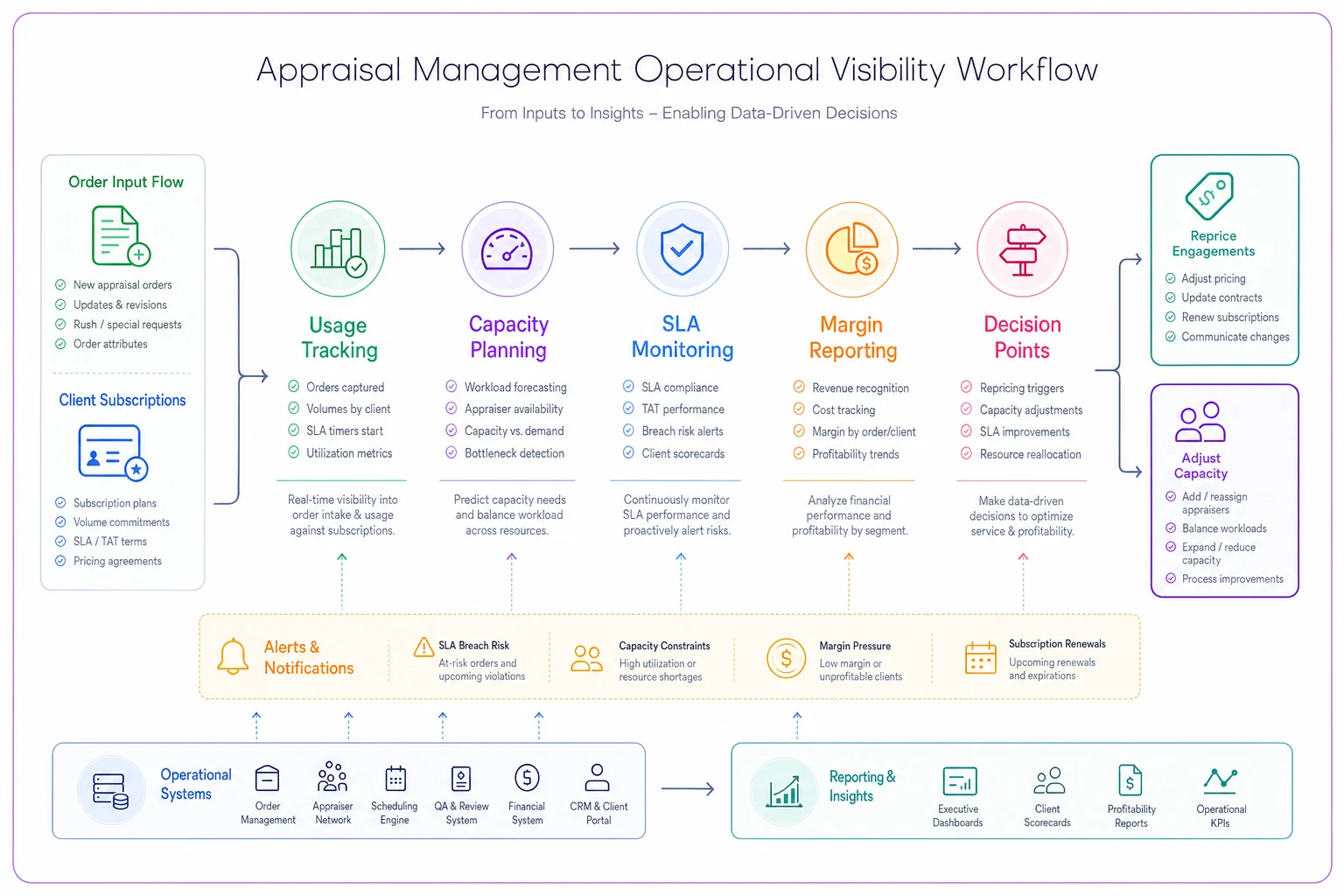
Tie client usage tracking directly to billing so you spot margin leaks before they scale.
Modern appraisal management platforms help by tying order flow, turn-time tracking, and client-level reporting together. When you offer a subscription tier, you can actually see whether that client is costing you more than they pay. That visibility is what separates firms that scale recurring revenue from ones that quietly lose margin on it. If you're evaluating tooling to support this, be deliberate — the same vendor-evaluation and TCO thinking that applies to any appraisal software applies here. The goal isn't fancy software; it's the operational visibility that lets you price and deliver recurring services without guessing.
A short real scenario
A two-appraiser firm doing mostly local lender and attorney work was riding the usual roller coaster — strong spring, dead summer, owner stressed every quarter. They weren't short on clients; they were short on stable ones.
They ran a small experiment: offered a priority subscription to four repeat lenders and a retainer to two estate attorneys they already worked with regularly. Held per-order prices flat. Over about four months, five of the six signed. Nothing dramatic changed in the work itself — same reports, same team.
What changed was the shape of the business. Roughly $18k–$20k a month started arriving on contract regardless of how retail volume moved. When the next slow stretch came, the floor held. The owner finally hired the part-time reviewer they'd been putting off for two years, because for the first time they could see the baseline and trust it.
The shift wasn't about clever packaging. It was about formalizing stability that already existed in the relationships — it just hadn't been captured in any agreement before.
The bigger shift
Recurring revenue for appraisal firms isn't a pricing trick layered on top of the same business. It's a different relationship with your best clients and a different relationship with risk. You stop earning purely by the transaction and start earning partly by the reliability you provide — which is something a good firm already delivers but rarely gets paid for separately.
The firms that pull this off aren't the ones with the cleverest package matrix. They're the ones whose delivery was solid enough to make promises on, who concentrated recurring revenue in their highest-margin channels instead of their highest-volume one, and who actually measured CLV and churn instead of just counting orders. Get those three things right and the package structure almost designs itself.
The firms that pull this off aren't the ones with the cleverest package matrix. They're the ones whose delivery was solid enough to make promises on, who concentrated recurring revenue in their highest-margin channels instead of their highest-volume one, and who actually measured CLV and churn instead of just counting orders. Get those three things right and the package structure almost designs itself.
Ready to elevate your appraisal operations?
Join 500+ appraisal firms using Rateoly to enhance accuracy, save time, and improve client satisfaction.